Maple vs Oak Cutting Board: Which Wood Is Better?
Hard maple is generally the better wood for an everyday cutting board because its fine, close grain creates a smooth surface that is simpler to clean. Oak is strong and durable, but its larger wood pores make it less suitable for frequent food preparation. White oak is a more practical option than red oak, although maple remains my preferred choice.
Choosing between these two hardwoods can be confusing because both are dense, attractive, and widely used in household products. Yet the grain structure that makes oak desirable for furniture can create cleaning challenges when the same wood becomes a food preparation surface.
A cutting board that is difficult to clean may retain food residue in its surface texture. Choosing a suitable hardwood reduces that problem while providing a stable area for chopping vegetables, slicing meat, and preparing daily meals.
The U.S. Food and Drug Administration’s 2026 Food Code, Section 4-101.17, specifically identifies hard maple or equivalently hard, close-grained wood as suitable for cutting boards in its retail food-service model. This guidance emphasizes hardness and grain characteristics rather than hardness alone.
The maple vs oak cutting board comparison also changes when red oak and white oak are considered separately. In my research, this distinction stood out because white oak contains natural structures that restrict liquid movement through many of its wood vessels, while red oak generally has more open vessels.
Another detail worth examining is knife friendliness. Hard maple has a Janka hardness of 1,450 pounds-force, compared with 1,350 for white oak and 1,220 for northern red oak. Those figures describe dent resistance, not a direct measure of knife-edge wear.
The following comparison covers wood grain, hardness, moisture behavior, hygiene, knife care, board construction, appearance, cost, and maintenance. These details will clarify why maple is often recommended for chopping and when a carefully made oak board may still be useful.
Maple vs Oak Cutting Board: Quick Comparison
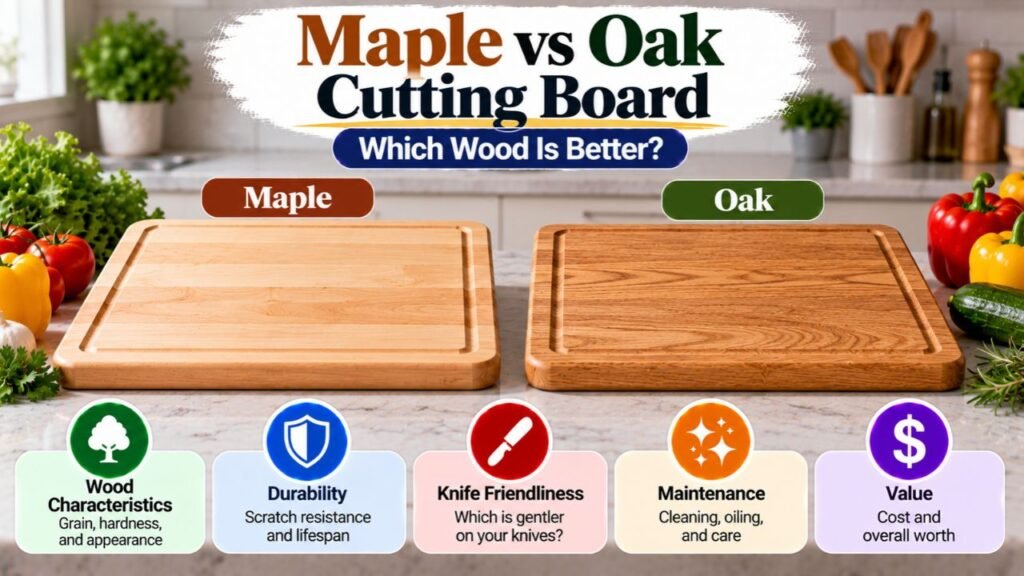
Maple and oak are both hardwoods, but their wood anatomy gives them different characteristics.
The table compares hard maple, American white oak, and northern red oak, three common North American species.
| Feature | Hard Maple | White Oak | Red Oak |
| Scientific name | Acer saccharum | Quercus alba | Quercus rubra |
| Janka hardness | 1,450 lbf | 1,350 lbf | 1,220 lbf |
| Grain structure | Fine, diffuse-porous | Coarse, ring-porous | Coarse, ring-porous |
| Wood vessels | Small and evenly distributed | Large, often blocked by tyloses | Large, generally open |
| Surface texture | Fine and smooth | More pronounced grain | More pronounced grain |
| Liquid movement through vessels | Relatively limited by small vessel size | Restricted by tyloses in heartwood | More readily passes through open vessels |
| Knife suitability | Very good | Usable with suitable construction | Less desirable for routine food preparation |
| Stain visibility | Dark stains show on pale wood | Tannin and iron staining possible | Tannin and iron staining possible |
| Common appearance | Creamy white to pale golden | Light to medium brown | Light brown with reddish undertones |
| Average dried weight | 44 lb/ft³ | 47 lb/ft³ | 43.8 lb/ft³ |
| Best application | Everyday chopping and butcher blocks | Select cutting boards and serving boards | Decorative and limited food-serving uses |
| Overall recommendation | Best choice | Conditional alternative | Not my first choice |
These are general species characteristics. A finished cutting board also depends on lumber quality, construction, grain direction, moisture content, and finish.
Hard maple has the strongest combination of fine grain and dent resistance for a primary kitchen cutting board.
What Is the Difference Between Maple and Oak Wood?
Although maple and oak are both hardwoods, they come from different tree genera and have different internal wood structures.
Understanding the exact species is important because products labeled simply as “maple” or “oak” may have very different characteristics.
Hard Maple: A Fine-Grained Hardwood
Hard maple, also called sugar maple or rock maple, is commonly used for butcher blocks, cutting boards, flooring, and furniture.
It has a pale cream color and a fine, even grain.
Hard maple is classified as diffuse-porous wood, meaning its small vessels are distributed relatively evenly throughout the growth rings.
This structure produces a smooth surface without the large, pronounced pores found in oak.
Its Janka hardness of 1,450 lbf gives it good resistance to ordinary dents and chopping pressure.
Hard maple should not be confused with soft maple. Red maple, for example, has a lower Janka rating of approximately 950 lbf.
White Oak: A Hard Wood With Blocked Vessels
White oak is commonly used for furniture, flooring, cabinetry, and barrels.
It has a coarse grain and a Janka hardness of approximately 1,350 lbf.
Unlike maple, white oak is ring-porous. Its growth rings contain bands of relatively large vessels.
Many of these vessels become blocked by natural structures called tyloses.
Tyloses reduce the movement of liquids through the wood, which explains why white oak heartwood has traditionally been used for barrels.
This characteristic makes white oak different from red oak, but its cutting surface still has a more pronounced grain texture than maple.
Red Oak: A Hardwood With Open Pores
Northern red oak has a Janka hardness of approximately 1,220 lbf.
It is hard enough for furniture, flooring, and many woodworking projects.
Its main drawback as a cutting-board material is its large, relatively open vessels.
Red oak is also ring-porous, but its vessels generally lack the abundant tyloses found in white oak heartwood.
The open structure permits air and liquid to travel along the wood grain more readily.
These characteristics make red oak less attractive for repeated contact with food juices and water.
Key Takeaway: Hard maple has a fine, uniform structure suited to daily cutting. White oak has partially blocked vessels, while red oak contains more open channels that can complicate cleaning.
Grain Structure: Why Maple Is Usually Better Than Oak
The difference between diffuse-porous and ring-porous wood is central to this comparison.
Both types contain natural openings, but their size and arrangement differ.
Maple Has Small, Evenly Distributed Pores
Hard maple has small wood vessels spread relatively evenly across its growth rings.
When properly sanded, this structure produces a smooth cutting surface with fewer large visible openings.
Food particles and liquids still need to be washed away, but the lack of deep, prominent pores is an advantage.
Maple can develop knife grooves over time, so it is not immune to contamination or surface wear.
Its fine texture simply provides a more suitable starting surface for everyday preparation.
Oak Has Larger Earlywood Vessels
Oak grows with bands of large vessels formed early in the growing season.
This is called a ring-porous structure.
On a finished oak surface, the vessel pattern creates the pronounced grain commonly seen in oak furniture.
When oak is used for chopping, some of these openings may collect tiny food particles and moisture.
Repeated knife contact can expose additional vessel openings.
Fine sanding can smooth the surrounding wood, but it does not remove the underlying anatomy.
This is why a finely sanded red oak board does not become structurally identical to maple.
White Oak Tyloses Change the Comparison
White oak has a meaningful advantage over red oak.
Tyloses are small, balloon-like structures that develop inside wood vessels and restrict the passage of liquid.
They are abundant in many white oak heartwood vessels but generally absent or scarce in northern red oak.
White oak can therefore resist liquid passage along the grain better than red oak.
Still, tyloses do not create a completely pore-free surface or eliminate all moisture absorption.
The visible grain remains coarser than hard maple’s.
Key Takeaway: Maple’s fine pore structure is its main advantage for cutting boards. White oak is less permeable than red oak, but neither oak species has the same uniform surface texture as hard maple.
Which Is Harder and More Knife-Friendly: Maple or Oak?
A cutting board must be firm enough to resist dents while providing a suitable surface for a knife edge.
Hardness is relevant, but it does not tell the complete story.
Janka Hardness Comparison
The Janka hardness test measures the force required to press a standardized steel ball halfway into a wood sample.
According to The Wood Database, the commonly reported values are:
| Wood Species | Janka Hardness |
| Hard maple | 1,450 lbf |
| White oak | 1,350 lbf |
| Northern red oak | 1,220 lbf |
Hard maple is approximately 7% harder than white oak and 19% harder than northern red oak using these values.
These differences indicate resistance to standardized indentation, not the exact rate of knife dulling.
White oak and red oak remain relatively hard woods despite their lower ratings.
Does Oak Dull Knives Faster Than Maple?
There is no sound basis for assigning an exact knife-sharpening interval to either wood based on Janka hardness alone.
Knife-edge wear depends on several conditions, including blade steel, edge geometry, chopping force, wood grain orientation, and abrasive particles on the surface.
Oak’s coarse grain may produce a different cutting feel than maple’s fine texture.
Hard maple offers a smooth, predictable surface and has a long record of use in butcher blocks.
That makes it my preferred option for quality kitchen knives.
Neither maple nor oak should be compared with glass or stone, which are much harder surfaces and can wear knife edges rapidly.
Which Board Resists Knife Marks Better?
Hard maple generally has the highest resistance to dents among these three species.
A maple board may show fewer indentations from repeated chopping pressure than a similarly constructed red oak board.
Yet surface marks are normal on wooden cutting boards.
End-grain construction, knife technique, and board maintenance also affect how marks appear.
A high Janka rating does not make any wooden board scratchproof.
Key Takeaway: Hard maple offers the greatest dent resistance and a fine cutting surface. Oak is also hard, but its pore structure is a more meaningful limitation than its hardness rating.
Is Maple or Oak Better for Food Safety?
Hard maple is generally the more practical material for a cutting board that receives frequent food contact.
Oak is not automatically toxic or unsafe simply because it has visible pores. The concern is how easily a particular surface can be cleaned and maintained.
What FDA Guidance Says About Wood
The FDA’s 2026 Food Code identifies hard maple or an equivalently hard, close-grained wood as an acceptable material for cutting boards in regulated retail food-service settings.
This is a model code that jurisdictions may adopt into their own rules.
It does not mean every hardwood cutting board sold to homeowners has received FDA approval.
Nor does it establish that all oak boards are legally prohibited from household use.
The wording highlights an important design principle: a cutting board should have appropriate hardness and a close-grained surface.
Hard maple directly fits that description.
Can Bacteria Grow in Oak’s Open Pores?
Foodborne bacteria can contaminate cutting boards made from wood, plastic, or other materials.
Oak’s larger pores can create more places for moisture and food residue to lodge, especially when the surface becomes worn.
That makes cleaning the board a practical concern.
Still, visible pores do not prove that every oak board contains harmful bacteria or that bacteria will remain alive longer than on every maple board.
Bacterial survival depends on moisture, contamination, cleaning, drying, and other conditions.
I would avoid claims that maple naturally sterilizes itself or that oak automatically causes food poisoning.
Neither statement accurately describes normal kitchen hygiene.
Which Wood Is Better for Raw Meat?
For a frequently used wooden cutting board, hard maple is the stronger choice.
Its fine grain is easier to inspect and clean than the prominent pores of red oak.
The USDA Food Safety and Inspection Service states that consumers may use wooden cutting boards for raw meat and poultry.
It recommends separate cutting surfaces for raw meat, poultry, and seafood and for fresh produce or ready-to-eat foods.
A separate dishwasher-safe plastic board can also be convenient for raw animal products.
Proper separation, cleaning, and sanitizing matter more than relying on any wood’s natural characteristics.
Key Takeaway: Maple is generally preferable for regular food preparation, but no cutting-board material eliminates the need for proper washing and safe separation of ingredients.
Moisture Resistance: Is White Oak Better Than Maple?
White oak has a reputation for moisture resistance because of its use in barrels and marine construction.
That characteristic deserves attention, but it does not automatically make white oak a better cutting board.
Why White Oak Resists Liquid Movement
White oak heartwood often contains tyloses that block many of its large vessels.
This structure limits the movement of water along those channels.
It is one reason white oak is suitable for certain barrels and outdoor woodworking applications.
Maple lacks that same vessel-blocking system, but it has much smaller, evenly distributed pores.
The two woods resist liquid movement through different anatomical features.
Water Resistance Is Not the Same as Dimensional Stability
Wood expands as it absorbs moisture and contracts as it dries.
This natural movement can contribute to warping, cracking, and separated glue joints.
Published total volumetric shrinkage figures are approximately 14.7% for hard maple and 16.3% for white oak, measured from green wood to an oven-dry condition.
These values are not predictions of how much a finished kitchen board will change during ordinary washing.
They do show that white oak’s resistance to liquid passage does not mean it experiences less dimensional movement than maple.
Board construction, drying quality, thickness, and storage conditions also influence warping.
What About Red Oak and Water?
Red oak’s open vessels make it more permeable along the grain than white oak.
Water can enter those channels more readily, especially when exposed end grain is present.
A food-safe finish may slow moisture absorption, but ordinary board oil cannot permanently close every internal vessel.
For frequent wet food preparation, I would choose maple rather than a red oak board that requires closer attention to cleaning and drying.
Key Takeaway: White oak restricts liquid passage better than red oak, but neither wood is waterproof. Maple remains a practical cutting-board choice because of its fine texture and established use in food preparation.
Stains, Tannins, and Food Odors: Maple vs Oak
Appearance matters because a cutting board is repeatedly exposed to food pigments, moisture, oils, and cleaning.
Maple and oak can both become stained, but the causes may differ.
Maple Shows Dark Stains More Easily
Hard maple is usually creamy white or pale golden.
Strongly colored ingredients such as beetroot, berries, and turmeric can leave visible marks on the surface.
Its light color also makes remaining food particles easy to notice during cleaning.
A stain is not automatically evidence of unsafe contamination.
Still, fresh food residue should be removed promptly rather than allowed to dry on the board.
Oak Contains Tannins That Can React With Iron
Oak contains natural compounds called tannins.
These compounds can react with iron and moisture, producing dark gray, blue-black, or black discoloration.
Contact with wet iron or steel-containing objects may contribute to staining.
Acidic conditions can also influence these reactions.
For example, leaving an iron-containing utensil on a damp oak board may produce marks that ordinary washing cannot remove.
Stainless steel generally resists this reaction better than unprotected iron, but its behavior varies by alloy and condition.
Maple can also stain, though prominent tannin-and-iron reactions are more characteristic of oak.
Can Oak Affect Food Flavor?
Oak is widely used in barrels partly because its compounds can contribute flavor during prolonged contact with beverages.
A finished cutting board is a different application.
Brief contact during ordinary slicing does not mean an oak board will noticeably flavor every ingredient.
Still, an unfinished or poorly maintained oak surface may release more noticeable wood odors or become discolored under certain conditions.
For a neutral everyday food preparation surface, hard maple is the simpler choice.
Key Takeaway: Maple’s pale surface shows food stains clearly, while oak may develop dark marks through tannin-and-iron reactions. Prompt washing and drying reduce staining problems for both woods.
Edge Grain vs End Grain: Does Construction Change the Choice?
Wood species is only one part of cutting-board quality.
The arrangement of the wood fibers also changes the cutting feel, appearance, and maintenance requirements.
Edge-Grain Maple vs Oak
An edge-grain cutting board is made from wood strips arranged so their long grain forms the cutting surface.
Hard maple is commonly used in this construction.
Its fine texture provides a smooth surface suitable for chopping vegetables, fruit, herbs, and meat.
Oak can also be made into edge-grain boards.
White oak is the more reasonable oak option because tyloses restrict many of its vessels, but the surface still has a pronounced grain.
An edge-grain red oak board retains its open-vessel structure even after sanding.
For routine kitchen preparation, I favor edge-grain maple.
End-Grain Maple vs Oak
An end-grain cutting board has the ends of the wood fibers facing upward.
This creates a different cutting feel because the knife contacts vertically oriented fibers.
End-grain maple butcher blocks are popular because they provide a durable, thick cutting surface.
End-grain oak boards present additional concerns.
The large wood vessels that run along oak’s grain become directly exposed on the cutting face.
This is most concerning with red oak, where those vessels are generally open.
White oak’s tyloses offer some resistance to liquid passage, but they do not create a uniform, close-grained surface.
For an end-grain butcher block, I strongly prefer hard maple over oak.
Key Takeaway: Maple works well in both edge-grain and end-grain constructions. Oak’s pronounced vessel structure is a greater concern in end-grain designs, especially with red oak.
Maple vs Oak Cutting Board: Appearance, Weight, and Price
Both hardwoods are available in the United States, but their visual characteristics and finished-board prices can differ considerably.
Natural Color and Grain Pattern
Hard maple usually has a light cream or pale golden appearance.
Its grain is subtle, giving it a clean and uniform look.
White oak tends to have a light to medium brown color, sometimes with olive undertones.
Red oak often has warmer, reddish-brown tones.
Both oaks display prominent grain patterns and may show attractive ray flecks, especially in quartersawn lumber.
Oak’s distinctive grain can look appealing on serving boards and kitchen accessories.
For a primary cutting surface, I would prioritize cleanability over decorative grain.
Weight and Handling
Published average dried wood weights are approximately:
- Hard maple: 44 pounds per cubic foot
- White oak: 47 pounds per cubic foot
- Northern red oak: 43.8 pounds per cubic foot
For boards with identical dimensions, white oak is generally somewhat heavier than maple.
The difference is modest compared with changes in board thickness or overall size.
A heavy board may remain stable during chopping, but it also requires more effort to lift, wash, and store.
A smaller board with nonslip support may be more convenient for everyday use than an oversized block.
Which Wood Costs More?
Hard maple is widely used in commercial cutting-board production and is available in many sizes and constructions.
Oak is also widely available as lumber, but finished oak cutting boards are less common than maple models.
Red oak lumber can be economical, while selected white oak may command a higher price.
Finished-board cost depends on grain construction, thickness, dimensions, craftsmanship, and manufacturer.
A custom white oak serving board may cost more than a standard maple cutting board.
A lower-priced oak board is not necessarily better value if its surface is poorly suited to the intended food preparation tasks.
Key Takeaway: Maple provides a pale, subtle appearance and broad cutting-board availability. Oak offers stronger grain patterns, but visual appeal and lower lumber cost do not necessarily make it the better kitchen cutting surface.
Which Wood Should You Choose for Different Kitchen Uses?
The best choice becomes clearer when the board is matched to a specific task.
Best for Everyday Chopping: Hard Maple
Hard maple is my recommendation for daily meal preparation.
Its fine grain and strong dent resistance make it suitable for chopping vegetables, slicing fruit, mincing herbs, and preparing other ingredients.
A properly constructed maple board provides an even surface for repeated knife work.
A board around 18 × 12 inches offers useful working space for many home kitchens, provided it fits the countertop and sink.
Best for Heavy Chopping: End-Grain Maple
For repeated chopping and substantial knife work, a thick end-grain maple board is a strong option.
Its construction provides a different cutting feel from an edge-grain board, while hard maple offers good resistance to indentation.
A large butcher block should remain stable during use.
Avoid striking the surface with excessive force or using heavy bone-cutting tools unless the board is designed for that purpose.
Best Oak Option for Light Food Preparation: White Oak
If you prefer oak’s appearance and want an oak cutting board, choose a reputable white oak product intended for direct food contact.
Look for a smooth surface, quality construction, and clear cleaning instructions.
White oak is more suitable than red oak from the standpoint of liquid permeability.
Even so, I would reserve it mainly for lighter preparation rather than choose it as my primary board for raw meat and frequent wet chopping.
Best for Decorative Serving: Oak
Oak’s prominent grain makes it attractive for serving boards and kitchen displays.
A properly finished white oak board can be suitable for presenting bread, cheese, and other foods when the manufacturer identifies it as food-contact-safe.
Decorative oak boards should not automatically be treated as cutting boards.
Some contain furniture finishes, stains, adhesives, or surface treatments not intended for direct food contact.
Check the manufacturer’s intended use before placing food directly on the surface.
Key Takeaway: Maple is the stronger choice for regular chopping and butcher blocks. White oak is a conditional option for lighter use and serving, while red oak is not my preferred material for food preparation.
How to Choose a Quality Maple or Oak Cutting Board
A well-made board should remain stable during cutting, offer enough working space, and be simple to clean.
The product label alone cannot establish its quality.
Confirm the Wood Species
For maple, look for descriptions such as hard maple, sugar maple, or rock maple.
For oak, confirm that the product uses white oak rather than red oak.
A vague description such as “solid oak” does not identify the species.
Color alone is not a reliable way to distinguish red oak from white oak.
If the manufacturer cannot identify the wood, I would consider a product with clearer material information.
Inspect Construction and Surface Quality
Look for a flat board with smoothly finished edges and no visible cracks.
On glued boards, inspect the joints for gaps or separation.
The surface should feel smooth without raised fibers or rough areas that could trap food.
A board that rocks on a flat countertop is inconvenient and may shift during cutting.
Check for a stable base, suitable feet, or compatibility with a nonslip mat.
Check the Finish and Intended Use
A cutting board should have a finish suitable for direct food contact and repeated knife use.
Food-grade mineral oil and certain food-contact-safe wax conditioners are commonly used.
Do not assume that a furniture oil, wood stain, varnish, or exterior wood preservative is suitable for a cutting surface.
An attractive oak board may have been manufactured for display rather than chopping.
Check the intended use and cleaning instructions before purchasing.
Key Takeaway: Confirm the exact species, construction quality, stability, and food-contact suitability. A well-made hard maple board is a safer purchasing direction than an oak product with unclear materials or finishes.
How to Clean and Maintain Maple and Oak Cutting Boards
Proper cleaning and drying are necessary for both hardwoods.
Neither should be treated as a maintenance-free kitchen surface.
Wash After Food Preparation
The USDA recommends washing cutting boards with hot, soapy water after each use, rinsing with clean water, and air drying or drying with clean paper towels.
For a wooden board:
- Remove loose food scraps.
- Wash the cutting surface with warm or hot water and dish soap.
- Scrub the edges, corners, and any juice grooves.
- Rinse thoroughly with clean water.
- Dry promptly and allow air to circulate around the board.
Pay extra attention to pronounced grain lines on oak boards.
Do not leave a wooden board submerged in the sink.
Although some solid wood boards are described as dishwasher-safe in USDA guidance, many cutting-board manufacturers advise against dishwashers because heat and moisture can damage wood and glued joints. Follow the instructions for your particular board.
Sanitize When Necessary
Cleaning removes food residue, while sanitizing reduces microorganisms on the surface.
The USDA describes a cutting-board sanitizing solution made with 1 tablespoon of unscented liquid chlorine bleach per gallon of water.
Its guidance calls for applying the solution, allowing it to remain for several minutes, rinsing with clean water, and drying.
Use a sanitizer suitable for the board and follow applicable product instructions.
Never mix bleach with vinegar, ammonia, or other cleaning chemicals.
Boards used for raw meat and poultry deserve careful attention before any later contact with ready-to-eat foods.
Apply Food-Grade Mineral Oil
Wooden boards may need occasional conditioning.
Food-grade mineral oil helps slow moisture exchange and reduces the dry appearance that develops through repeated washing.
Apply a thin layer to a clean, fully dry board according to the manufacturer’s directions.
Cover the cutting surface, underside, and edges.
Allow the recommended absorption period, then remove excess oil.
A food-contact-safe beeswax and mineral oil conditioner is another common option.
Oil does not make maple or oak waterproof, and it does not permanently seal oak’s large vessels.
Store the Board to Prevent Warping
Store wooden boards in a dry area with suitable airflow.
Avoid leaving either side in contact with standing water.
Do not place the board against prolonged heat from an oven, radiator, or direct sunlight.
Uneven moisture exposure can contribute to cupping, twisting, or cracking.
Inspect the board regularly for open joints, deep cuts, splinters, and other damage.
The USDA recommends replacing cutting boards that become excessively worn or develop grooves that are difficult to clean.
Key Takeaway: Wash, rinse, and dry both woods after use. Apply food-grade conditioner when needed, and replace boards with damage that prevents proper cleaning.
Common Mistakes When Comparing Maple and Oak Cutting Boards
One common mistake is assuming that all oak species have identical moisture behavior.
White oak and red oak share a ring-porous structure, but tyloses make white oak less permeable along many of its vessels.
Another mistake is believing that the harder wood must always be more damaging to a knife.
Janka hardness measures dent resistance and cannot independently predict blade wear.
Some buyers also assume that a thick layer of mineral oil will permanently close red oak’s open pores.
Oil can slow moisture absorption, but it does not change the wood’s vessel structure.
A fourth mistake is treating white oak’s barrel-making reputation as proof that it is the best choice for every kitchen cutting surface.
Water passage through heartwood and the ability to clean a knife-marked surface are different issues.
Finally, do not confuse a decorative serving board with a board designed for chopping.
The wood, adhesive, finish, and construction should all be appropriate for the intended use.
Conclusion
The maple vs oak cutting board comparison favors hard maple for everyday food preparation. Its fine, diffuse-porous grain, strong dent resistance, and smooth cutting surface make it better suited to repeated chopping than the coarser structure of oak.
White oak is a more reasonable alternative than red oak because its tyloses restrict liquid passage through many wood vessels. Still, that feature does not eliminate its large pore structure or guarantee a cleaner cutting surface.
For a primary kitchen board, I recommend well-constructed hard maple in either edge-grain or end-grain form. If you prefer oak’s appearance, consider a food-contact-safe white oak board for lighter preparation or serving. Regardless of the species, proper washing, drying, and timely replacement remain necessary.
FAQs About Maple and Oak Cutting Boards
Is maple or oak better for a cutting board?
Hard maple is generally better for a cutting board because it has a fine, even grain and strong resistance to dents.
Oak has a coarser, ring-porous structure with larger wood vessels that can complicate cleaning.
White oak is more suitable than red oak because many of its vessels contain tyloses that restrict liquid movement.
For regular chopping and food preparation, hard maple remains the more practical choice.
Is white oak safe for cutting boards?
A properly constructed white oak board made with suitable food-contact materials can be used for certain kitchen tasks.
White oak is not inherently poisonous, and its natural tyloses reduce permeability along many vessels.
Still, its coarse grain makes it less desirable than hard maple for frequent chopping, especially with raw or juicy foods.
Choose a manufacturer that identifies the board as suitable for direct food contact and provides clear cleaning instructions.
Why is red oak not recommended for cutting boards?
Red oak has large, relatively open wood vessels that allow moisture and other liquids to move along the grain.
These openings can also complicate the removal of food residue from a worn cutting surface.
The concern is primarily cleanability rather than a claim that red oak is inherently toxic.
Hard maple provides a finer, more uniform surface, making it the preferable material for a main kitchen cutting board.
Is maple harder than oak?
Hard maple has a Janka hardness of approximately 1,450 lbf.
American white oak measures about 1,350 lbf, while northern red oak measures approximately 1,220 lbf.
Therefore, hard maple is harder than both of these common oak species.
Other oak and maple species have different hardness ratings, so the exact wood identification matters.
Hardness indicates resistance to indentation rather than complete resistance to scratches or knife marks.
Does an oak cutting board dull knives faster than maple?
There is no reliable universal ranking showing that every oak cutting board dulls knives faster than every maple board.
Hardness, grain orientation, knife steel, edge shape, and cutting pressure all affect blade wear.
Oak’s coarse structure may feel different under a knife, while maple provides a fine, uniform cutting surface.
For everyday knife work, I prefer hard maple because of its overall suitability rather than an unsupported claim about exact sharpening intervals.
Can you make a cutting board from oak wood?
Yes. Oak can be used to manufacture wooden boards, but the species and intended use matter.
White oak is preferable to red oak for a food-contact board because its vessels are less permeable.
A board intended for chopping should use properly dried lumber, suitable adhesives, and a food-contact-safe finish.
Avoid reclaimed wood of uncertain treatment history.
For frequent cutting, hard maple remains a more practical material.
Is white oak more water-resistant than maple?
White oak heartwood often resists liquid movement through its vessels because tyloses block many of those channels.
Hard maple has smaller, evenly distributed vessels rather than the same natural blocking structures.
This does not mean a white oak cutting board is waterproof or less likely to warp.
Both woods absorb and release moisture, and both can crack or distort through poor cleaning and drying practices.
Which lasts longer, maple or oak cutting boards?
A well-made hard maple board can last for many years with proper cleaning, drying, and conditioning.
Oak boards can also be durable, but their more pronounced grain may create cleaning challenges with repeated cutting.
Hard maple offers greater resistance to standardized indentation than common white and northern red oak.
Actual service life depends on construction quality, cutting habits, moisture exposure, and surface condition rather than wood species alone.