Beech vs Bamboo Cutting Board: Which One Is Better?
Beech is generally the better cutting board material for protecting knife edges and handling frequent chopping. Bamboo is often more affordable, resists moisture absorption, and works well for light everyday food preparation. Both materials are durable when properly maintained, but beech offers a more traditional cutting feel, while bamboo appeals to budget-conscious households.
Choosing between these materials is not always straightforward. A board that feels comfortable during occasional vegetable cutting may become less appealing when used with expensive kitchen knives every day. Poor moisture management can also cause warping, cracking, and separation along glued joints.
The right material provides a stable cutting surface, suits your knife collection, and fits your cleaning habits. A well-made board can remain useful for years without demanding complicated maintenance.
The U.S. Forest Service’s Forest Products Laboratory reports a dry hardness value of 1,300 pounds-force for American beech. This measurement describes resistance to denting, not knife-edge wear. Bamboo hardness varies by species, fiber orientation, and manufacturing method, making simple hardness comparisons less reliable than they first appear.
What stood out to me during the research was that the beech vs bamboo cutting board decision involves more than hardness. Beech has a consistent hardwood structure, while bamboo boards are manufactured from bonded strips. Those construction differences influence cutting feel, moisture behavior, and long-term durability.
Another overlooked detail is that neither material is naturally waterproof. Bamboo generally absorbs less moisture than many hardwoods, but its adhesive joints can still deteriorate if the board is soaked or repeatedly exposed to excessive heat.
The following comparison examines material construction, knife friendliness, durability, food safety, maintenance, cost, and environmental considerations. It also identifies which cutting board makes more sense for different cooking habits and what to inspect before buying.
What Are Beech and Bamboo Cutting Boards?
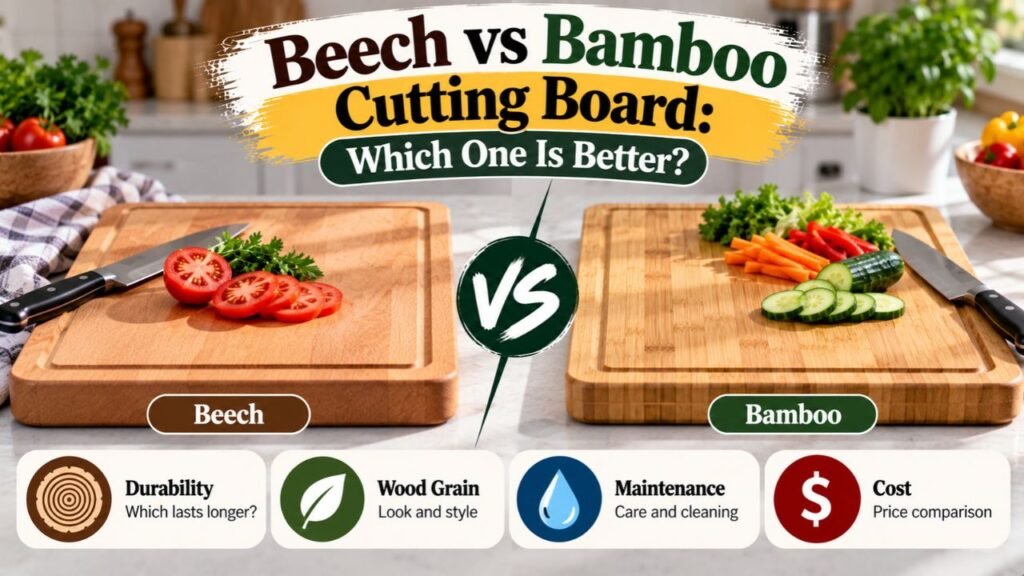
Beech and bamboo cutting boards may look similar on a kitchen countertop, but they come from different plant materials and have distinct internal structures.
Understanding these differences makes their cutting characteristics easier to compare.
What Is a Beech Cutting Board?
A beech cutting board is a kitchen preparation surface made from the hardwood of a beech tree.
Two relevant species are American beech (Fagus grandifolia) and European beech (Fagus sylvatica).
Beech has a fine, relatively uniform grain and a naturally pale appearance. Its color ranges from light cream to pinkish brown, sometimes with subtle reddish tones.
The wood is strong enough for repeated chopping while offering some resilience under a knife blade.
Beech boards may be constructed from a single piece of wood or multiple joined sections. Edge-grain and end-grain versions are available.
Its traditional appearance makes beech popular for vegetable preparation, bread slicing, and wooden butcher blocks.
What Is a Bamboo Cutting Board?
A bamboo cutting board is made from processed bamboo strips joined together to form a flat cutting surface.
Bamboo is technically a grass rather than a hardwood.
Manufacturers generally cut bamboo into strips, dry and process the material, then bond the pieces with adhesive.
The finished boards commonly feature parallel grain lines or contrasting strips.
Moso bamboo is one species frequently used for kitchen products.
Bamboo cutting surfaces tend to feel firm and resist light scratches. Many are also relatively thin and convenient to store.
Why Their Construction Matters
Beech has a natural wood-fiber structure that can provide a comfortable surface during repetitive cutting.
Bamboo consists of dense fibrous material assembled into a finished board.
Both materials can contain glued joints, but bamboo boards typically require multiple bonded strips because of the shape of the original bamboo stalk.
Adhesive quality, processing, thickness, and finishing influence the durability of either board.
Key Takeaway: Beech is a conventional close-grained hardwood, while bamboo is a manufactured cutting surface made from grass. Their different structures influence cutting feel and maintenance.
Beech vs Bamboo Cutting Board: Side-by-Side Comparison
The major differences become clearer when both materials are compared under the same conditions.
| Feature | Beech Cutting Board | Bamboo Cutting Board |
| Material | Natural hardwood | Processed bamboo grass |
| Surface feel | Firm but somewhat forgiving | Generally firm and rigid |
| Knife friendliness | Usually better for knife edges | May increase knife wear |
| Scratch resistance | Good, with visible marks over time | Often resists shallow marks well |
| Moisture absorption | Absorbs moisture and needs careful drying | Generally absorbs less moisture |
| Warping risk | Possible with uneven moisture exposure | Possible, including at glued joints |
| Maintenance | Hand washing and periodic oiling | Hand washing; conditioning varies |
| Weight | Varies with size and thickness | Often sold in lightweight designs |
| Price | Budget to premium | Frequently budget-friendly |
| Appearance | Fine, pale hardwood grain | Striped or layered grain |
| Repair potential | Some thick boards can be resurfaced | Resurfacing options are more limited |
| Sustainability | Depends on forest management | Fast-growing raw material; processing matters |
| Best suited for | Frequent chopping and knife-focused cooking | Light preparation, serving, and budget use |
Beech has an advantage for cooks who place a high priority on knife care.
Bamboo is attractive for people who want a firm, affordable board and do not mind its harder cutting feel.
Neither material automatically wins every category. Two boards made from the same raw material can behave differently because of their dimensions, finishes, and manufacturing quality.
Which Is Better for Kitchen Knives: Beech or Bamboo?
Beech is generally the better choice for knife-edge preservation, especially when a cutting board receives frequent use.
A cutting surface should support the knife without placing unnecessary stress on its fine edge.
Why Beech Is Usually Gentler on Knives
Beech has a close-grained hardwood structure with some natural resilience.
During chopping, the cutting edge contacts a surface that can yield slightly under pressure.
This helps reduce the harsh impact associated with very rigid materials.
Beech is not soft enough to avoid knife marks, but that is not necessarily a disadvantage.
A board that receives shallow cuts can be preferable to one that causes unnecessary blade wear.
For repeated vegetable preparation with a sharp chef’s knife, beech offers a comfortable balance of firmness and resilience.
Why Bamboo Can Be Harder on Knife Edges
Bamboo’s firm structure helps it resist surface damage, but it may contribute to faster knife-edge wear.
Bamboo also contains naturally occurring silica, a mineral component that can contribute to abrasiveness.
The amount and distribution of silica vary across bamboo material and finished boards.
Repeated knife contact with a hard or abrasive cutting surface may increase sharpening needs.
That does not mean every bamboo board immediately damages kitchen knives.
A well-finished bamboo board can still serve ordinary home cooking tasks. The concern becomes more relevant with frequent cutting and delicate knife edges.
Does Janka Hardness Tell the Whole Story?
Janka hardness measures the force required to press a steel ball into a material.
It is commonly used to compare wood resistance to denting.
American beech has a reported dry hardness of about 1,300 lbf, while European beech is commonly listed around 1,450 lbf.
Bamboo hardness figures vary with species, fiber direction, processing, and test method.
These numbers do not directly measure how a knife edge behaves after thousands of cuts.
A board’s grain orientation, resin content, surface finish, and cutting technique also influence knife wear.
Which Is Better for Japanese and German Kitchen Knives?
Japanese-style kitchen knives often have thin cutting edges and relatively hard steel.
These characteristics can provide precise cutting but may make some blades less tolerant of harsh impacts or sideways force.
For these knives, I would generally favor beech over bamboo.
German-style chef’s knives commonly use somewhat thicker, tougher edges.
They can handle ordinary bamboo-board use, although sharpening needs may differ.
For either knife type, avoid striking the board unnecessarily hard or twisting the cutting edge against the surface.
Key Takeaway: Beech is generally preferable for frequent knife work and delicate blades. Bamboo remains usable for routine cutting but may create more knife-edge wear.
Which Cutting Board Is More Durable?
Both beech and bamboo can withstand years of kitchen use, but durability depends on more than material hardness.
Surface wear, moisture exposure, construction quality, and maintenance all influence lifespan.
Resistance to Scratches and Knife Marks
Beech offers good resistance to ordinary cutting damage.
Fine knife marks gradually appear with regular chopping, and some surfaces develop a worn appearance.
Bamboo is often resistant to shallow scratching because of its firm, dense structure.
Still, a harder surface does not guarantee a longer-lasting board.
Deep cuts, splitting, and damaged joints can develop in either material.
A few shallow knife scratches are usually normal. The greater concern is damage that makes cleaning difficult.
Resistance to Moisture and Warping
Beech is responsive to changes in moisture.
When exposed to water, wood fibers can expand. During drying, they contract.
Uneven moisture exposure can lead to cupping or warping, especially if one surface stays wet longer than the other.
Bamboo generally absorbs less moisture than many conventional hardwoods.
The USDA describes bamboo cutting boards as relatively resistant to moisture absorption.
Still, bamboo boards are not waterproof.
Water can affect bonded joints, and repeated soaking may cause distortion or separation.
Both materials benefit from prompt drying after washing.
Cracking and Glue-Line Separation
Beech can crack if exposed to repeated moisture changes, excessive heat, or poor storage conditions.
Boards made from multiple pieces may also develop problems along glued joints.
Bamboo boards contain numerous bonded strips, making adhesive quality an important consideration.
When glue lines begin to open, food residue and moisture may enter the gaps.
A board with deep cracks or separating strips should not continue to be used for food preparation.
Can Beech and Bamboo Boards Be Resurfaced?
Some thick beech cutting boards can be sanded and refinished when shallow knife damage develops.
The process requires enough remaining material and a sound board structure.
Bamboo boards may be more difficult to restore because of their thin laminated construction and adhesive lines.
Light surface refinishing may be possible on certain products, but aggressive sanding can damage them.
For repairability, a substantial beech board usually offers more options.
Key Takeaway: Bamboo often resists minor surface marks and moisture absorption, while a thick beech board may be easier to restore. Construction quality determines long-term durability.
Is Beech or Bamboo Better for Food Safety?
Both beech and bamboo cutting boards can be suitable for food preparation when made from food-contact-safe materials and cleaned correctly.
Neither should be considered automatically sanitary simply because of its natural properties.
Bacteria and Surface Porosity
Beech is a porous hardwood.
Its wood structure can absorb moisture, so cleaning and drying are necessary after use.
Bamboo is generally less porous than many conventional hardwoods, which can limit moisture absorption.
That characteristic does not make bamboo self-sanitizing.
Bacteria can remain on either surface when food residue is left behind.
Cracks, deep knife grooves, and damaged adhesive joints also create cleaning problems.
Preparing Raw Meat and Poultry
The USDA allows suitable wooden and nonporous cutting boards for preparing raw meat and poultry.
The greater concern is cross-contamination.
Raw chicken juices, for example, should not contact a surface used for ready-to-eat vegetables without thorough cleaning and appropriate sanitizing.
Both beech and bamboo require careful cleaning after contact with raw animal products.
I prefer using a separate dishwasher-safe plastic board for raw meat because it simplifies cleanup.
That does not mean beech or bamboo is automatically unsafe for the task.
Are Bamboo Glues and Beech Finishes Safe?
Bamboo cutting boards are manufactured with adhesives that hold their strips together.
The presence of adhesive is not automatically a safety problem.
Look for manufacturer confirmation that the adhesives and finishes are suitable for direct food contact.
Beech boards also require attention to finish quality, especially when made from multiple joined pieces.
Avoid products with unknown decorative coatings or unclear food-contact claims.
A smooth, properly manufactured board is preferable to one with visible glue residue, peeling coatings, or poorly joined sections.
Key Takeaway: Both materials can be food-safe. Clean surfaces, intact construction, suitable finishes, and prevention of cross-contamination matter more than claims of natural antibacterial properties.
How to Clean and Maintain Beech and Bamboo Cutting Boards
Both materials usually require hand washing and careful drying.
Beech may need more frequent attention to moisture conditioning, while bamboo maintenance varies by finish and manufacturer.
Daily Cleaning Method
A simple cleaning routine works for most conventional beech and bamboo boards.
- Remove food scraps. Clear away loose ingredients and remaining residue.
- Wash with dish soap. Use warm water and mild dishwashing liquid to clean the cutting surface, sides, and grooves.
- Rinse thoroughly. Remove soap and loosened food particles with clean water.
- Dry promptly. Wipe the board with a clean towel and allow remaining moisture to evaporate before storage.
Avoid soaking either material in a sink.
Most conventional beech and bamboo boards should not go into the dishwasher because extended heat and moisture may cause cracking, warping, or adhesive damage.
Follow the manufacturer’s instructions if a specialized product has different washing requirements.
Oiling Beech Cutting Boards
Beech benefits from periodic treatment with a suitable board conditioner.
Food-grade mineral oil is a common choice because it does not become rancid like many ordinary cooking oils.
Apply oil to a clean, completely dry board and allow it to absorb according to product instructions.
Wipe away excess oil before returning the board to use.
A pale, rough, or dry-looking surface can indicate that conditioning is needed.
Frequency varies with use, washing, room humidity, and the existing finish.
Oiling Bamboo Cutting Boards
Bamboo boards may also benefit from conditioning.
Some manufacturers recommend mineral oil to limit moisture movement and preserve appearance.
Other products have specialized coatings and may not require routine oiling.
Totally Bamboo, for example, explains that oiling its boards is helpful but not always necessary, with care varying by finish.
Follow the specific board’s instructions rather than applying the same maintenance schedule to every bamboo product.
Sanitizing After Raw Food Preparation
When sanitizing is needed, clean the board first.
The USDA provides a household sanitizing method using 1 tablespoon of unscented liquid chlorine bleach in 1 gallon of water.
Its guidance describes applying the solution to a cleaned cutting surface, allowing several minutes of contact, rinsing, and drying.
Use a bleach product appropriate for this purpose and follow its label instructions.
Never combine bleach with vinegar, ammonia, or other cleaning chemicals.
Proper Drying and Storage
After washing, wipe both sides of the board.
Stand it securely on an edge or place it where air can circulate around the surfaces.
Avoid storing the board while damp against a countertop or another cutting board.
Do not place either material directly beside intense heat sources for drying.
Excessive heat can create uneven moisture changes and damage glued joints.
Key Takeaway: Hand wash, dry completely, and condition each board according to its finish. Neither conventional beech nor bamboo should be treated as dishwasher-safe without manufacturer confirmation.
Beech vs Bamboo Cutting Board: Weight, Size, and Appearance
Physical design can influence daily convenience as much as cutting performance.
A board that is too heavy to wash comfortably or too small for meal preparation may become frustrating regardless of its material.
Weight and Handling
Beech is a dense hardwood, and thick boards can be relatively heavy.
Large beech butcher blocks may stay steady during repeated chopping because of their substantial weight.
Bamboo is often sold in thinner, lighter designs that are convenient to lift and store.
Material alone does not determine weight.
A thick bamboo board may weigh more than a smaller beech board.
Compare the actual dimensions and product weight before purchasing.
Surface Appearance
Beech generally has a pale, fine-grained appearance.
Its light cream and pinkish-brown tones suit kitchens that favor a natural hardwood finish.
Bamboo commonly displays parallel lines, striped patterns, or alternating light and dark sections.
Some bamboo boards undergo heat treatment that creates a darker caramel-like color.
Both materials can serve as attractive presentation surfaces for bread, fruit, and cheese.
Thickness and Stability
Thin boards are usually easier to store, but they may be more likely to move on smooth countertops.
Thicker boards often provide a steadier chopping platform.
Many household cutting boards are available in sizes around 12 × 18 inches, although dimensions vary widely.
A non-slip base or secure grip can improve stability.
The board should also fit inside the kitchen sink for washing.
Key Takeaway: Beech often appeals to people who want a substantial hardwood board, while bamboo is common in lightweight designs. Compare actual dimensions rather than judging by material alone.
Which Is More Affordable: Beech or Bamboo?
Bamboo cutting boards are frequently less expensive than comparable premium hardwood products.
Their availability in mass-produced designs makes them attractive for budget-conscious shoppers.
Beech boards cover a broader range, from basic wooden preparation boards to substantial butcher blocks.
Initial Purchase Cost
Bamboo is widely sold in affordable cutting board sets and individual models.
Beech may cost more when the product includes thick hardwood construction, precision finishing, or specialized grain orientation.
Still, a basic beech board may cost less than a premium bamboo board.
The brand, size, construction, and finish influence the price.
For a fair comparison, examine boards with similar usable cutting areas and thicknesses.
Long-Term Value
A quality beech board may provide good long-term value if it can be maintained and resurfaced.
Bamboo can also last for years when properly constructed and cared for.
The cheaper board is not always the better purchase.
A thin bamboo board that warps early may offer less value than a sturdier product.
Likewise, an expensive beech board can deteriorate quickly if repeatedly soaked or stored wet.
I would spend more on construction quality and stability before paying extra for decorative features.
Replacement Costs
Eventually, both materials develop wear.
Minor scratches are normal, but deep cracks, unstable warping, and separation at glued joints may require replacement.
Thick beech boards sometimes permit resurfacing.
Many thin laminated bamboo boards are more practical to replace once serious structural damage appears.
This difference may influence ownership costs over time.
Key Takeaway: Bamboo generally offers a lower entry price, while well-made beech may offer better repair potential and long-term value for frequent cooks.
Is Beech or Bamboo More Environmentally Friendly?
Bamboo has an advantage in raw-material growth speed, but sustainability involves more than how quickly a plant grows.
Sourcing, manufacturing, adhesives, transportation, and product lifespan also influence environmental impact.
Bamboo Growth and Renewability
Bamboo is a fast-growing grass.
Many commercially used bamboo species reach harvestable maturity much faster than hardwood trees.
The plant can produce new shoots from its established underground system.
This makes bamboo attractive as a renewable material.
Still, finished cutting boards require processing, drying, bonding, finishing, and shipping.
Those activities influence the environmental footprint of the product.
Beech Wood Sourcing
Beech trees grow more slowly than bamboo.
They can still provide a renewable source of hardwood when managed responsibly.
Beech from well-managed forests may be a sensible material for durable kitchen equipment.
Forest certification and traceable sourcing are useful indicators to review.
A cutting board made from responsibly sourced beech should not automatically be dismissed as environmentally inferior to bamboo.
Manufacturing and Product Lifespan
Bamboo boards generally use bonded strips, making adhesive selection and manufacturing processes relevant.
Beech boards may also contain adhesives depending on their construction.
A product’s expected lifespan matters because repeated replacement creates more material waste.
For environmentally focused buying, I would prioritize transparent sourcing, food-contact-safe construction, and a design that can withstand years of use.
Key Takeaway: Bamboo renews faster, while responsibly sourced beech can provide long service. Neither material is automatically the greener finished product.
Which Is Better for Different Kitchen Uses?
The most practical recommendation comes from matching the board to your usual cooking tasks.
Beech and bamboo serve many of the same purposes, but their strengths suit different priorities.
Best for Frequent Vegetable Chopping: Beech
Beech is my preferred option for someone who chops vegetables almost every day.
Its hardwood surface provides comfortable knife contact during repeated slicing and dicing.
A reasonably thick board also offers a steady platform for preparing large quantities of ingredients.
Beech makes sense for onions, carrots, potatoes, herbs, and everyday meal preparation.
Best for Occasional Food Preparation: Bamboo
Bamboo is a practical choice for light or occasional chopping.
A well-made board can handle fruit, vegetables, bread, and simple meal preparation.
Its firm surface and commonly affordable pricing make it attractive for households that do not perform extensive knife work.
Choose a board with stable construction and a smooth finish.
Best for Expensive Kitchen Knives: Beech
For sharp, thin-edged kitchen knives, I would lean toward beech.
Its cutting feel is generally more forgiving than that of a typical firm bamboo board.
A suitable end-grain beech design may offer further comfort during repeated knife contact.
The exact advantage depends on board construction and knife type.
Best for Serving and Presentation: Either Material
Both beech and bamboo can look attractive on a dining table.
Beech provides a traditional hardwood appearance.
Bamboo offers a striped, modern look that suits cheese, fruit, sandwiches, and appetizers.
For serving, appearance and size may matter more than differences in knife contact.
Always use a clean board for ready-to-eat food.
Best for Households Preparing Raw Meat: A Separate Board
Neither beech nor bamboo removes the need for careful sanitation.
Both may be used for raw meat when properly cleaned, but a dedicated plastic board can simplify the routine.
A sensible kitchen arrangement is a beech or bamboo board for general preparation, paired with a dishwasher-safe plastic board for raw meat, poultry, and seafood.
Key Takeaway: Choose beech for frequent chopping and knife care, bamboo for budget-friendly lighter use, and a separate washable board for raw animal foods.
What to Look for Before Buying a Beech or Bamboo Cutting Board
Construction and usability deserve attention before making a final purchase.
Two boards advertised under the same material name may differ substantially in quality.
Choosing a Quality Beech Cutting Board
Look for a smooth, close-grained cutting surface without deep cracks, splinters, or visible structural defects.
Check the board’s thickness and grain construction.
A thick edge-grain or end-grain model may suit frequent food preparation, but it should still be manageable during washing.
Confirm that the finish and any adhesives are suitable for food contact.
A board with clear maintenance instructions is preferable to one with an unknown finish.
Choosing a Quality Bamboo Cutting Board
Inspect the laminated strips and glued seams.
They should appear tightly joined, without gaps or raised edges.
Choose a board intended specifically for food preparation rather than a decorative bamboo serving tray with an unsuitable coating.
Look for manufacturer information about food-contact safety and cleaning requirements.
The surface should be smooth enough for comfortable cutting without feeling slippery.
Checking Size and Practical Features
A main cutting board should offer enough space for both uncut and prepared ingredients.
For many kitchens, a medium-to-large rectangular board provides a good working area.
Non-slip feet, finger grips, and juice grooves can be useful, but they are not necessary for every cooking task.
A flat, reversible surface may provide more usable space than a highly decorative board.
Key Takeaway: Prioritize a smooth food-contact-safe surface, sound construction, adequate size, and manageable maintenance requirements over appearance alone.
Conclusion
In the beech vs bamboo cutting board comparison, beech is generally my preferred choice for everyday knife work. Its close-grained hardwood surface offers a comfortable cutting feel, good durability, and potential for resurfacing in suitably thick boards. Bamboo remains a reasonable alternative for light preparation, lower initial cost, and reduced moisture absorption.
Beech requires attention to drying and conditioning, while bamboo needs care around its laminated construction. Neither material is immune to moisture damage, cracking, or surface wear. Both can be suitable for food preparation when properly manufactured and cleaned.
I recommend beech for households that cook frequently or use delicate kitchen knives. Bamboo makes sense when affordability, lighter handling, and occasional chopping are higher priorities. Whichever material you choose, a stable surface and consistent cleaning routine matter more than marketing claims.
FAQs About Beech and Bamboo Cutting Boards
Is Beech Wood Better Than Bamboo for Cutting Boards?
Beech is generally better for people who prioritize knife comfort and frequent chopping. Its hardwood structure is somewhat more forgiving than the firm surface of many bamboo boards.
Bamboo offers advantages in affordability and moisture resistance.
Both are suitable for ordinary kitchen preparation when properly manufactured and maintained. Beech is my preferred primary cutting surface, while bamboo can be a practical lower-cost option.
Does Bamboo Dull Knives Faster Than Beech?
Bamboo may dull certain knife edges faster than beech because of its firm structure and naturally occurring silica.
The actual difference depends on bamboo processing, knife steel, sharpening angle, and cutting technique.
Normal light chopping on a quality bamboo board does not guarantee blade damage.
For repeated cutting with delicate Japanese-style knives, beech is generally the more comfortable choice.
Is Beech Harder Than Bamboo?
There is no universal answer because beech species and bamboo products vary.
American beech has a reported dry hardness of about 1,300 pounds-force, while European beech is commonly listed around 1,450 pounds-force.
Bamboo hardness changes with species, grain orientation, and processing.
Janka hardness also measures dent resistance rather than knife-edge wear, so hardness figures alone should not determine a cutting board purchase.
Is Bamboo More Hygienic Than Beech?
Bamboo generally absorbs less moisture than many hardwoods, but this does not automatically make it more hygienic than beech.
Either board can retain food residue or contamination if cleaning is neglected.
Wash with dish soap and water after use, dry completely, and avoid using deeply cracked or damaged boards.
Separate cutting surfaces for raw animal foods and ready-to-eat ingredients provide another layer of food safety.
Can You Put Beech or Bamboo Cutting Boards in the Dishwasher?
Most conventional beech and bamboo cutting boards should be washed by hand.
Extended exposure to dishwasher heat, moisture, and detergent can cause warping, cracking, or damage to glued joints.
A specially manufactured board may have different care instructions.
Only use a dishwasher when the specific product is clearly identified as dishwasher-safe.
Does a Bamboo Cutting Board Need Oil Like Beech?
Some bamboo boards benefit from food-grade mineral oil, while others have finishes that require little or no conditioning.
Beech generally benefits from periodic oiling to reduce moisture-related stress and maintain its appearance.
Always clean and dry the board before treatment.
Avoid ordinary vegetable or olive oil because these products can oxidize and develop unpleasant odors.
Follow the manufacturer’s instructions for the specific finish.
Which Lasts Longer: Beech or Bamboo?
Both materials can remain useful for years with proper care.
A thick, well-made beech board may last longer when minor surface damage can be repaired through suitable resurfacing.
Quality bamboo boards can also be durable, but thin laminated models may be harder to restore after deep damage.
There is no reliable universal lifespan for either material. Construction quality, washing habits, moisture exposure, and board condition determine when replacement becomes necessary.