Silicone vs Wood Cutting Board: Which Is Better?
Wood cutting boards are generally better for frequent chopping because they provide a firm, stable cutting surface and can last for years with proper care. Silicone cutting boards are easier to clean, resist water absorption, and often offer a non-slip surface. Both can be gentle on knives, but silicone’s flexibility and resistance to knife cuts vary considerably between products.
Choosing between these materials involves more than appearance or cleaning convenience. A silicone surface that is too soft may develop cuts or feel unstable during chopping, while a poorly maintained wooden board can warp, crack, or become difficult to clean.
A suitable board should support controlled knife movement, provide enough space for ingredients, and fit your washing routine. Understanding the material differences can prevent unnecessary knife wear, premature board replacement, and frustrating meal preparation.
Food safety also deserves attention. According to the Centers for Disease Control and Prevention’s November 2025 information, an estimated 48 million people experience foodborne illness annually in the United States. This estimate covers foodborne illness from many causes, not cutting boards alone, but it emphasizes the importance of preventing cross-contamination during food preparation.
The silicone vs wood cutting board comparison is interesting because both materials provide some cushioning under a knife, yet they behave differently. Wood offers structural rigidity, while silicone relies on a flexible synthetic rubber surface. That distinction influences chopping control, knife marks, washing, and storage.
One detail stood out during my research: many silicone products sold for kitchen preparation are actually baking or pastry mats, not cutting boards. A flexible silicone sheet is not automatically safe for direct knife contact, and some products contain reinforcing materials that must never be exposed by cutting.
The following comparison explains material construction, knife friendliness, food safety, durability, cleaning, maintenance, cost, and practical uses. It also covers how to identify a genuine silicone cutting board and which material makes more sense for different kitchen routines.
What Are Silicone and Wood Cutting Boards?

Silicone and wooden cutting boards are both designed to provide a food preparation surface, but their materials and construction differ.
Silicone is a manufactured elastomer, while wood is a natural plant material. These differences influence flexibility, moisture absorption, cutting resistance, and maintenance.
What Is a Silicone Cutting Board?
A silicone cutting board is a food preparation surface made from food-contact-safe silicone rubber.
Silicone is a synthetic polymer with a flexible, rubber-like structure. It resists water absorption and is available in different levels of firmness.
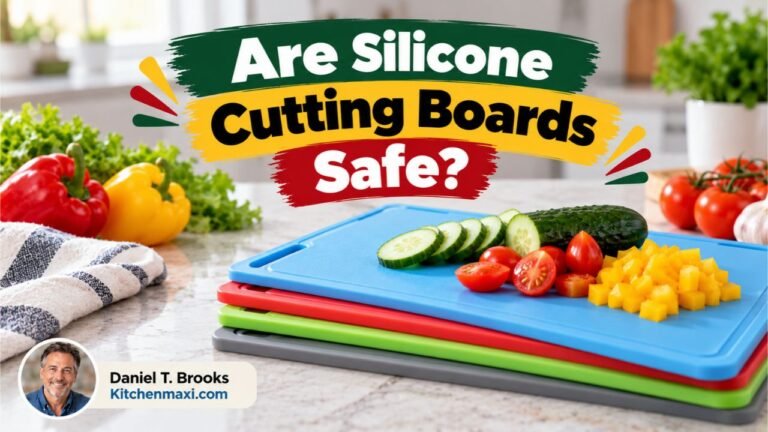
Cutting boards made from silicone may be thick and somewhat rigid or thin enough to bend when lifted.
Common characteristics include a non-slip surface, lightweight construction, and resistance to moisture.
Some models can be folded slightly to transfer chopped ingredients into a bowl or cooking pot.
Silicone cutting boards are different from ordinary plastic boards made from polyethylene or polypropylene.
They are also different from natural rubber boards, although all three materials are sometimes grouped together in product descriptions.
What Is a Wooden Cutting Board?
A wooden cutting board is a food preparation surface made from one or more pieces of wood.
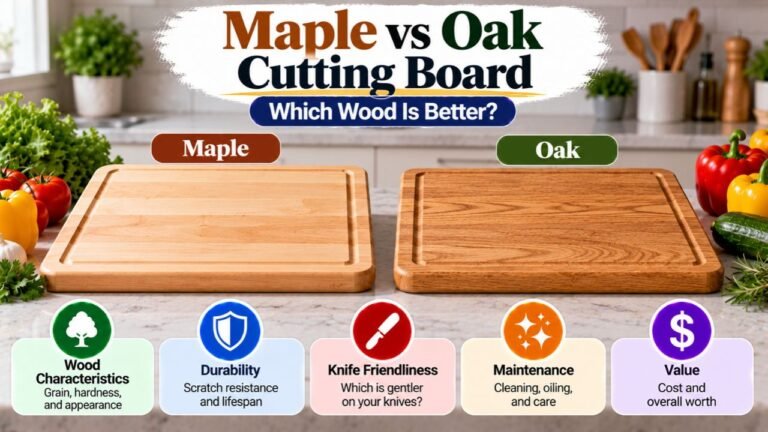
Common materials include maple, walnut, cherry, beech, teak, and acacia.
Many premium boards use close-grained hardwoods because they provide a durable cutting surface with some natural resilience.
Wooden boards are available in several constructions, including edge grain, end grain, and face grain.
Edge-grain boards expose the long edges of wooden strips, while end-grain boards expose the ends of the wood fibers.
Wood naturally responds to moisture and humidity, so most wooden boards require hand washing, prompt drying, and occasional conditioning.
Silicone Cutting Boards vs. Silicone Baking Mats
This distinction is easy to miss when shopping.
A silicone cutting board is specifically manufactured to withstand contact with kitchen knives.
A silicone baking mat is generally intended for baking, dough preparation, or other non-cutting activities.
Many baking mats contain fiberglass reinforcement beneath the silicone surface.
Manufacturers such as Tupperware specifically warn against cutting directly on certain silicone baking mats.
A sharp blade can damage the silicone coating and expose the internal reinforcement.
Never use a silicone baking or pastry mat as a cutting board unless its manufacturer explicitly approves knife use.
Key Takeaway: Silicone cutting boards are flexible synthetic rubber surfaces, while wooden boards provide a rigid natural cutting platform. Always verify that a silicone product is intended for direct knife contact.
Silicone vs Wood Cutting Board: Key Differences
The following table compares the main characteristics of silicone and wooden cutting surfaces.
| Feature | Silicone Cutting Board | Wood Cutting Board |
| Material | Synthetic silicone rubber | Natural wood |
| Cutting feel | Soft and sometimes springy | Firm with natural resilience |
| Knife friendliness | Generally gentle, but product-dependent | Generally very good |
| Surface stability | Good grip; flexibility varies | Usually stable when sufficiently heavy |
| Water absorption | Very low | Absorbs some moisture |
| Dishwasher cleaning | Many models are dishwasher-safe | Most laminated boards require hand washing |
| Knife marks | May develop cuts, nicks, or tears | Develops scratches and shallow grooves |
| Maintenance | Generally no oiling required | Periodic conditioning recommended |
| Heat resistance | Varies by formulation and product | Can be damaged by concentrated heat |
| Odor and staining | Some products retain stains or odors | Can absorb stains and food odors |
| Portability | Often lightweight and flexible | Usually heavier and more rigid |
| Storage | Some models fold or roll | Usually stored flat or upright |
| Resurfacing | Usually not practical | Some thick boards can be sanded |
| Appearance | Modern, often colorful | Natural wood grain |
| Long-term value | Depends on resistance to cutting damage | Quality hardwood can provide long service |
The comparison assumes a genuine food-contact-safe silicone cutting board, not a pastry mat or a plastic board with silicone grips.
For frequent knife work, wood has a practical advantage because it combines surface resilience with structural support.
Silicone’s strengths are its low water absorption, easy handling, and relatively simple cleaning routine.
Which Cutting Board Is Better for Kitchen Knives?
Both silicone and wood can be gentle on knife edges, but their cutting characteristics are not identical.
Knife friendliness involves more than surface softness.
A suitable board should provide enough resistance to support controlled cutting while avoiding excessive impact against the blade.
How Silicone Affects Knife Sharpness
Silicone provides a soft surface that can cushion knife contact.
Unlike glass, ceramic, or metal, silicone does not create a rigid impact surface.
This can make it comfortable for light slicing and chopping.
Still, silicone hardness varies substantially.
A very soft board may compress under a sharp knife, making the blade feel as though it is pressing into the material.
Some surfaces may also create noticeable friction against the knife edge.
A knife-friendly surface should not require excessive downward pressure or interfere with normal cutting movements.
Silicone boards that are too thin or soft may be less comfortable for repeated chopping.
How Wood Affects Knife Sharpness
Wood is a widely established cutting board material because it provides a useful balance of firmness and resilience.
Hardwoods such as maple, walnut, and cherry support a knife without the harsh contact associated with stone or glass.
The wood fibers yield slightly when the blade contacts the surface.
This contributes to comfortable cutting during repeated vegetable preparation.
The exact cutting feel changes with wood species, grain orientation, and finish.
A well-made hardwood board offers predictable resistance during slicing and chopping.
End-Grain Wood vs. Silicone
End-grain wood boards expose the ends of the wood fibers.
This construction can provide a forgiving cutting surface because the blade contacts the fiber ends rather than moving across their length.
Silicone also cushions knife contact, but it does so through rubber-like compression.
These are different mechanisms.
A high-quality end-grain wooden board can provide a comfortable cutting feel without the excessive flexibility found in some silicone mats.
Neither material guarantees that knives will remain sharp indefinitely.
Which Is Better for Japanese Kitchen Knives?
Japanese kitchen knives often feature thin cutting edges and relatively hard steel.
These blades benefit from cutting surfaces that avoid harsh impact.
A well-made end-grain or edge-grain hardwood board is a strong choice.
A properly designed silicone cutting board may also be suitable if its surface offers enough firmness and support.
I would choose a quality hardwood board for frequent precision slicing because its stable surface provides more predictable knife control.
Key Takeaway: Both materials can protect knife edges, but wood usually offers a better combination of cutting comfort and stability. Silicone works best when the surface is firm enough for controlled chopping.
Which Material Provides Better Stability and Cutting Control?
Stability is one of the biggest practical differences between silicone and wood.
A cutting board must remain secure while the knife moves through ingredients.
A surface that shifts, bends, or grips the knife unexpectedly can make chopping less controlled.
Silicone Grip and Flexibility
Silicone naturally provides considerable surface friction.
This can help a silicone board stay in place on a smooth countertop.
Some silicone products feature textured undersides that increase grip.
Their flexibility can also be convenient for transferring chopped ingredients.
The disadvantage appears when the board is too thin.
A thin surface may bend or wrinkle, especially when lifted or used over an uneven counter.
Soft silicone may compress during forceful chopping.
For regular knife work, choose a silicone cutting board with enough thickness to remain flat during use.
Wooden Board Weight and Stability
Wooden boards are typically more rigid.
A thick hardwood board can provide a substantial cutting platform, especially when preparing large quantities of vegetables.
Weight can help reduce movement, although a smooth wooden board may still slide on a slippery countertop.
Non-slip feet or a suitable damp cloth underneath can improve grip.
Avoid placing a board on a wrinkled towel that creates an uneven surface.
A wooden board with a broad, flat base is generally more comfortable for forceful or repetitive chopping.
Transferring Chopped Ingredients
Silicone offers a convenient advantage after cutting.
Some flexible models can be bent into a shallow funnel, directing chopped onions, herbs, or vegetables into a container.
Wood cannot normally perform this function because it is rigid.
Ingredients must be transferred with a bench scraper, knife spine, or by lifting and tilting the board.
For small kitchens and quick meal preparation, silicone’s flexibility can be convenient.
Key Takeaway: Wood offers steadier support for repeated chopping, while silicone often grips countertops well and can make ingredient transfer simpler.
Which Is Safer for Food Preparation: Silicone or Wood?
Both materials can be suitable for food preparation when manufactured for food contact and maintained correctly.
Neither surface should be treated as automatically sanitary.
Cleaning, surface condition, and prevention of cross-contamination are more important than claims that a material naturally resists bacteria.
Is Silicone Food-Safe?
Properly formulated silicone can be suitable for repeated food contact.
In the United States, 21 CFR § 177.2600 addresses rubber articles intended for repeated use with food and includes specified silicone materials under defined conditions.
A generic label such as “FDA approved” does not establish that an individual cutting board has received a special FDA product certification.
Buyers should look for clear information about food-contact compliance, material composition, and intended use.
Silicone has very low water absorption, which can simplify surface cleaning.
Still, sharp knives can damage the material, and cuts may trap food residue.
Are Wooden Cutting Boards Hygienic?
Wood is porous and can absorb moisture.
That property does not automatically make wood unsafe.
The USDA recognizes wooden cutting boards as suitable for food preparation when properly cleaned and maintained.
Research on bacteria and wooden surfaces has produced varying findings based on wood species, moisture conditions, surface damage, and test methods.
Wood should not be described as completely bacteria-proof.
A clean, intact wooden board can be suitable for everyday cooking.
Which Is Better for Raw Meat and Poultry?
Silicone can be convenient for raw meat preparation if the board is specifically intended for knife use and can be thoroughly cleaned and sanitized.
Its nonabsorbent surface is useful when handling raw juices.
Wood can also be used for raw meat and poultry when maintained and cleaned correctly.
The USDA recommends separate cutting boards for raw meat, poultry, and seafood and for ready-to-eat foods such as vegetables and bread.
My preference is a separate dishwasher-safe board for raw animal products, with a hardwood board reserved primarily for general chopping.
That arrangement simplifies cleaning and reduces opportunities for cross-contamination.
Do Silicone Boards Release Small Particles?
Silicone is a synthetic polymer, and cutting damage can potentially remove small pieces from its surface.
Claims that silicone cutting boards can never shed particles are not well supported.
Research has not established that every silicone cutting board is free from particle release during knife use.
There is also limited direct evidence comparing the long-term health effects of particles from silicone cutting boards with those from conventional plastic boards.
A damaged board should be evaluated by its condition rather than relying on broad claims that one synthetic material is completely harmless.
Key Takeaway: Both silicone and wood can be food-safe. Choose products intended for food contact, clean them after use, and replace surfaces with damage that prevents thorough cleaning.
Silicone vs Wood Cutting Board: Cleaning and Maintenance
Silicone generally requires less routine maintenance than wood.
Both materials need washing after food preparation, but their response to water and cleaning equipment differs.
How to Clean a Silicone Cutting Board
A silicone cutting board can usually be cleaned with warm water and dish soap.
Use this basic procedure:
- Remove food scraps and remaining ingredients.
- Wash both surfaces with warm water and dishwashing liquid.
- Pay attention to grooves, textured areas, and any knife marks.
- Rinse thoroughly with clean water.
- Dry completely before folding, stacking, or storing.
Many silicone cutting boards are dishwasher-safe.
Check the manufacturer’s instructions because dishwasher compatibility varies with silicone formulation, thickness, and product design.
Do not assume every silicone kitchen mat can withstand the same cleaning conditions.
How to Clean a Wooden Cutting Board
Most laminated wooden cutting boards require hand washing.
Remove loose ingredients, then wash the board with dish soap and warm water.
Rinse thoroughly and wipe away moisture immediately.
Allow air to circulate around both sides before placing the board in storage.
Avoid soaking wooden boards or leaving them in a wet sink.
Repeated water exposure can contribute to swelling, cracks, or separation along glued joints.
Do Silicone and Wood Boards Need Sanitizing?
Cleaning should always come before sanitizing.
Soap and water remove food residue that can interfere with sanitizing products.
The USDA provides a sanitizing procedure for conventional cutting boards using 1 tablespoon of unscented liquid chlorine bleach mixed with 1 gallon of water.
The USDA directs users to apply the solution to a cleaned surface, allow several minutes of contact, rinse, and dry.
For silicone boards, confirm that the material and manufacturer permit the sanitizer before applying it.
Commercial food-contact sanitizers may have different dilution and contact-time requirements.
Never combine bleach with vinegar, ammonia, or other cleaning products.
Does a Wooden Cutting Board Need Oil?
Most unfinished or oil-finished hardwood cutting boards benefit from periodic conditioning.
Food-grade mineral oil is a common choice.
It helps reduce moisture movement and preserves the wood’s appearance.
Some conditioners combine mineral oil with beeswax.
John Boos recommends oiling many of its wooden cutting boards at least monthly, with frequency adjusted according to use and household conditions.
Silicone cutting boards do not require mineral oil.
Applying wooden board conditioner to silicone serves no useful maintenance purpose.
Key Takeaway: Silicone is generally simpler to wash and needs no oiling. Wood requires careful drying and periodic conditioning, but both materials must be cleaned after every use.
Which Cutting Board Lasts Longer?
Durability depends on manufacturing quality, board thickness, cutting habits, and maintenance.
A material that resists water may still suffer damage from knife blades.
Likewise, a wooden board that develops shallow scratches may remain usable for years.
Silicone Resistance to Knife Cuts and Tears
Silicone is flexible, but it is not cut-proof.
A sharp knife can create surface marks, slices, or punctures.
Very soft and thin silicone boards may be more vulnerable to deep cutting damage.
Repeated chopping in the same area can eventually weaken the surface.
Once silicone begins tearing, exposing internal layers, or releasing visible fragments, replacement is appropriate.
A thicker cutting board designed for knife use may withstand more wear than a thin silicone sheet.
Wooden Board Scratches and Surface Wear
Wood develops knife marks during ordinary use.
Shallow cuts are expected and do not automatically make the board unsuitable.
Some thick wooden boards can be sanded and refinished when the surface becomes rough.
This gives wood a practical advantage over silicone, which generally cannot be restored after serious cutting damage.
Deep cracks, warped surfaces, and separated glued joints require attention.
Moisture Damage vs. Cutting Damage
Silicone has the advantage in resistance to water absorption.
It does not swell like wood after ordinary washing.
Wood is more vulnerable to prolonged soaking and uneven drying.
Silicone faces a different concern: repeated contact with sharp knives can compromise its soft surface.
A material’s resistance to one type of damage does not guarantee greater durability overall.
When Should Either Board Be Replaced?
Replace a silicone board if it develops tears, peeling layers, exposed reinforcement, or deep damage that cannot be cleaned thoroughly.
Replace a wooden board if it has severe cracks, loose joints, excessive warping, or hard-to-clean grooves.
The USDA recommends discarding cutting boards that become excessively worn or develop grooves that resist cleaning.
There is no universal replacement date for either material.
Key Takeaway: Quality hardwood boards often offer better long-term repair potential. Silicone resists water-related damage but may need replacement once repeated knife cuts compromise the surface.
Heat Resistance, Stains, and Odors
Silicone and wood respond differently to heat and strongly colored or aromatic ingredients.
These differences may influence which material suits your daily cooking habits.
Silicone Heat Resistance
Silicone is widely used in heat-resistant kitchen equipment.
Certain silicone products tolerate temperatures that would damage ordinary plastic.
Still, heat resistance depends on the exact formulation and finished product.
A silicone cutting board is not automatically oven-safe or suitable for direct contact with a hot skillet.
Some models can double as trivets, while others cannot.
Always follow the stated temperature limit and intended use.
Wooden Cutting Boards and Heat
Wood does not behave like silicone under heat exposure.
Direct contact with a hot pan can leave burn marks or damage the board’s finish.
Concentrated heat may also contribute to uneven drying and cracking.
A wooden cutting board should not be used as a trivet unless its manufacturer specifically permits that application.
Stain Resistance
Silicone does not absorb water like wood, but that does not guarantee complete resistance to stains.
Strongly colored foods such as turmeric, tomato sauce, and certain spices may discolor some silicone products.
Wood can also develop stains from berries, beets, spices, and food juices.
The visibility of stains varies by material color and surface condition.
A cosmetic stain does not automatically mean a board is contaminated.
Odor Retention
Silicone can sometimes retain odors from garlic, onion, fish, or oily foods despite being nonporous.
Wood may also hold food odors, especially if residue remains or the board is not dried properly.
Routine washing should be the first response.
For persistent odors, follow the manufacturer’s cleaning guidance instead of experimenting with harsh chemicals.
Key Takeaway: Silicone generally handles moisture better and may tolerate more heat, but both materials can stain or retain odors. Neither should be used with hot cookware without product approval.
Silicone vs Wood for Different Kitchen Tasks
The preferred material changes with the food being prepared and the type of cutting involved.
Daily vegetable chopping places different demands on a board than slicing a few strawberries or transferring ingredients into a saucepan.
Best for Everyday Vegetable Chopping: Wood
A hardwood cutting board is my preferred surface for regular vegetable preparation.
Its rigidity supports repeated chopping, slicing, and dicing.
A medium-to-large board gives enough room for ingredients and a chef’s knife.
Wood also offers a consistent surface during rocking cuts and fine chopping.
Maple, walnut, and cherry are suitable choices for ordinary home cooking.
Best for Light Food Preparation: Silicone
Silicone can work well for light preparation when the product is intended for knives.
Examples include slicing fruit, preparing soft vegetables, and cutting small amounts of food.
Its lightweight construction can be useful for quick tasks.
A flexible design may also simplify moving chopped ingredients into a bowl.
Avoid using a very thin mat for forceful chopping.
Best for Raw Meat Preparation: Silicone Can Be Convenient
A washable, knife-rated silicone board can serve as a separate surface for raw meat.
Its low water absorption and potential dishwasher compatibility are attractive.
The board must be cleaned and sanitized according to its manufacturer’s instructions.
For larger cuts of meat, a rigid board may provide better support.
The most practical option is a separate surface that can handle the necessary cutting and cleaning routine.
Best for Bread and Cheese: Wood
Wooden boards are well suited to bread slicing and cheese preparation.
Their firm surfaces provide enough support for serrated knives and repeated slicing.
Wood also offers an attractive serving appearance.
Silicone can handle light food cutting, but a soft surface may develop marks under a serrated blade.
Best for Small Kitchens and Travel: Silicone
Thin silicone cutting boards are easy to move and often require less storage space than thick wooden boards.
Some designs can be rolled or stored in narrow spaces.
That makes them attractive for compact kitchen setups.
A thick butcher block may be inconvenient when counter space and sink dimensions are limited.
Still, portability should not come at the cost of a stable cutting surface.
Best for Frequent Heavy Chopping: Wood
Repeated heavy chopping requires a firm platform.
A thick hardwood board generally provides better structural support than a flexible silicone mat.
For demanding knife work, choose a well-constructed board intended for the task.
Do not assume an ordinary wooden board is suitable for heavy cleaver strikes.
Key Takeaway: Wood is the stronger general-purpose choice for frequent chopping, while silicone suits light preparation, compact storage, and convenient ingredient transfer.
Which Cutting Board Is More Affordable?
Both materials are available across different price levels.
Basic silicone cutting mats may be inexpensive, while thicker specialty models can cost considerably more.
Wooden boards also range from simple budget models to premium handcrafted butcher blocks.
Silicone Cutting Board Costs
Thin silicone products are often affordable, but shoppers need to distinguish knife-rated cutting boards from baking mats.
A low-priced silicone pastry mat should not be treated as a bargain cutting board.
Thicker silicone models with reinforced designs, substantial cutting surfaces, or special features may carry higher prices.
Evaluate construction and intended use before comparing costs.
Wooden Cutting Board Costs
Wood prices vary with species, dimensions, thickness, and grain orientation.
An ordinary edge-grain hardwood board may cost less than an elaborate end-grain model.
Premium walnut and maple boards can be expensive because of material costs and manufacturing labor.
The price alone does not establish durability.
A properly manufactured, moderately priced hardwood board may provide a comfortable everyday cutting surface for years.
Long-Term Value
Silicone avoids routine conditioning costs but may be difficult to repair after substantial knife damage.
Wood requires occasional oil and more careful washing.
A thick wooden board may offer better long-term value when it remains structurally sound and can be resurfaced.
I would compare the expected use and replacement requirements rather than choosing solely by initial price.
Key Takeaway: Silicone may cost less initially, but a durable wooden board can offer better long-term value for frequent knife work.
Environmental Considerations: Silicone vs. Wood
Environmental impact depends on raw materials, manufacturing, transportation, lifespan, and disposal.
Neither silicone nor wood should automatically be considered the better environmental choice in every situation.
Silicone Manufacturing and Disposal
Silicone is a synthetic material commonly produced using silicon-derived chemistry.
Manufacturing requires processing and energy.
Silicone products can be reused many times, which may reduce the need for disposable kitchen accessories.
Still, silicone is not readily recyclable through many ordinary household recycling programs.
Specialized recycling arrangements may exist, but availability varies.
A product’s long service life matters when considering its environmental impact.
Wooden Cutting Board Sustainability
Wood is a renewable material when harvested through responsible forestry practices.
A durable hardwood board can remain useful for years with regular care.
Some products carry forest sourcing certifications or other information about responsible harvesting.
Transportation, adhesives, finishes, and manufacturing also influence environmental impact.
A wooden board should not be considered environmentally responsible solely because it is made from a natural material.
Which Material Produces Less Waste?
There is no universal answer without examining comparable products across their entire life cycles.
A silicone board replaced frequently because of deep knife cuts can create unnecessary waste.
A wooden board discarded early because of poor maintenance does the same.
My preference is to choose a durable, repairable cutting surface and maintain it until its condition requires replacement.
Key Takeaway: Wood offers renewable sourcing and possible repairability, while silicone can provide repeated use but presents recycling challenges. Product longevity matters more than simple environmental claims.
How to Choose a Quality Silicone or Wooden Cutting Board
Buying either material requires attention to construction and practical use.
A product description may emphasize softness, antibacterial properties, or attractive design without explaining how the surface behaves under a sharp knife.
What to Look for in a Silicone Cutting Board
Start by confirming that the product is specifically intended for knife use.
Review the following details:
- Food-contact suitability: Clear information about the silicone material
- Knife compatibility: Manufacturer approval for direct cutting
- Thickness: Enough material to resist unwanted bending
- Surface stability: A flat, secure working area
- Cleaning instructions: Confirmed dishwasher compatibility if needed
- Construction: No exposed reinforcement or weak layers
- Temperature limits: Documented restrictions for heat exposure
Avoid relying only on phrases such as “food grade” or “non-toxic.”
A food-safe baking mat may still be unsuitable for chopping.
What to Look for in a Wooden Cutting Board
Choose a hardwood board with a smooth, well-finished surface.
Check the wood species, thickness, and grain orientation.
Maple, walnut, cherry, and beech are established choices.
Inspect glued joints for gaps and confirm that the finish is suitable for direct food contact.
A board should be large enough for the ingredients usually prepared but manageable during washing.
Consider its weight and how it will be stored.
Which Material Should a Beginner Choose?
For someone buying a first primary cutting board, I recommend a medium-sized hardwood model.
It provides a reliable surface for common kitchen tasks and supports comfortable knife handling.
A separate silicone board can be added for light preparation if easy washing and compact storage are priorities.
A dishwasher-safe rigid plastic board is another practical companion for raw meat preparation.
Key Takeaway: Choose a genuine knife-rated silicone board or a properly finished hardwood board. Construction quality, stability, and cleaning instructions matter more than marketing language.
Pros and Cons of Silicone and Wood Cutting Boards
The main advantages and disadvantages can be summarized without treating either material as universally superior.
| Material | Advantages | Disadvantages |
| Silicone | Low water absorption, flexible, often non-slip, easy to wash, lightweight | Can develop cuts or tears, may feel too soft, usually cannot be resurfaced |
| Wood | Firm cutting surface, durable, knife-friendly, attractive, some boards can be repaired | Requires hand washing, careful drying, and periodic conditioning |
Silicone works best when convenience and portability take priority.
Wood works best when the surface receives frequent knife contact and stability matters.
The difference becomes more noticeable as cooking volume increases.
A person chopping vegetables for several meals every day is likely to appreciate a substantial wooden board more than someone preparing occasional snacks.
Conclusion
In the silicone vs wood cutting board comparison, wood is generally the better primary cutting surface for most home kitchens. It provides reliable support for everyday chopping, works comfortably with kitchen knives, and can offer a long usable life. Silicone is attractive for easy cleaning, low water absorption, compact storage, and light preparation.
The main limitation of silicone is its susceptibility to knife cuts and excessive flexibility in some designs. Wood has different disadvantages, including moisture sensitivity and the need for periodic conditioning. Both materials can support safe food preparation when properly manufactured, cleaned, and maintained.
My recommendation is to choose a quality hardwood board for frequent chopping and consider a knife-rated silicone board as a secondary preparation surface. Always confirm that a silicone product is intended for cutting rather than baking, and replace either material when damage prevents thorough cleaning.
FAQs About Silicone and Wooden Cutting Boards
Is Silicone Better Than Wood for Cutting Boards?
Silicone is generally more convenient for cleaning, moisture resistance, and compact storage.
Wood is usually better for frequent chopping because it provides a firm, stable cutting surface.
Both materials can be gentle on kitchen knives.
A quality hardwood board is my preferred primary cutting surface, while silicone is useful for light preparation when the product is specifically manufactured for knife contact.
Are Silicone Cutting Boards Safe to Use?
Yes, properly manufactured silicone cutting boards can be suitable for food preparation.
Choose a product intended for direct food contact and sharp kitchen knives.
Do not assume that silicone baking mats are safe for chopping.
Inspect the board for deep cuts, tearing, exposed reinforcement, or other structural damage.
Clean it after each use and follow the manufacturer’s sanitizing instructions.
Do Silicone Cutting Boards Dull Knives?
Silicone is generally softer than hard cutting surfaces such as glass or metal, so it can provide cushioning under a knife.
Still, not every silicone board delivers the same cutting feel.
Very soft surfaces may compress or create excessive drag.
There is limited direct research comparing long-term knife-edge retention on silicone versus hardwood cutting boards.
A well-made wooden board remains a reliable choice for regular knife use.
Can You Put a Silicone Cutting Board in the Dishwasher?
Many silicone cutting boards are dishwasher-safe, but this depends on the product.
Check the manufacturer’s instructions for approved cleaning methods and temperature restrictions.
Do not assume a silicone baking mat and a silicone cutting board have identical washing requirements.
Most laminated wooden cutting boards should be washed by hand because dishwasher heat and moisture can damage the wood or glued joints.
Does Silicone Harbor Bacteria Like Wood?
Silicone has very low water absorption, making its intact surface relatively easy to wash.
Wood is porous and requires careful cleaning and drying.
Neither material is automatically free from bacteria.
Knife grooves, cracks, trapped food residue, and poor cleaning habits can create contamination risks.
Use separate cutting boards for raw animal products and ready-to-eat ingredients whenever practical.
Are Silicone Cutting Boards Microplastic-Free?
Silicone is chemically different from common polyethylene and polypropylene cutting board plastics.
Still, cutting damage can potentially create small silicone particles.
There is not enough direct research to conclude that every silicone cutting board is completely free from particle shedding or that silicone exposure presents no health concerns.
Choose a durable, knife-rated product and replace it if the surface begins tearing or shedding visible fragments.
Can I Use a Silicone Baking Mat as a Cutting Board?
No, unless the manufacturer specifically states that the product is suitable for direct knife contact.
Many silicone baking mats contain fiberglass reinforcement or thin silicone layers that sharp knives can damage.
Cutting through the surface may expose internal material and make the mat unsuitable for continued food use.
Use a dedicated cutting board for chopping and reserve ordinary baking mats for their intended purpose.
Which Lasts Longer, Silicone or Wood Cutting Boards?
A well-made hardwood cutting board can provide many years of use with proper maintenance.
Some thick wooden boards can also be resurfaced after shallow cutting damage.
Silicone resists water absorption but may develop cuts, tears, or surface deterioration from repeated knife contact.
There is no fixed lifespan for either material.
Replace the board when it becomes unstable, structurally damaged, or difficult to clean thoroughly.