Cutting Board Wax vs Oil: Differences, Uses, and Care
Cutting board oil soaks into wood and slows moisture absorption, while board wax adds a thin, water-resistant layer near the surface. Food-grade mineral oil is a good starting point for routine care. A food-contact-safe wax or oil-and-wax conditioner adds surface protection and a smoother finish, but neither product makes wood waterproof.
Choosing the wrong treatment can leave a wooden board greasy, sticky, or poorly protected against repeated washing. A shiny finish does not repair cracks or replace cleaning.
Matching the treatment to the board’s condition makes upkeep simpler. A dry, pale board usually benefits from oil first, while a board that already looks conditioned may need only a light wax finish or no treatment at all.
The U.S. Department of Agriculture’s Food Safety and Inspection Service recommends washing cutting boards with hot, soapy water after use. For sanitizing, it describes a solution of 1 tablespoon of unscented liquid chlorine bleach per gallon of water, followed by rinsing and drying. Those instructions matter because oil and wax protect a surface; neither sanitizes it.
What stood out to me in the manufacturer’s care instructions was their shared approach to cutting board wax vs oil: treat the wood with oil, then add wax if extra surface resistance is wanted. That is more useful than treating the two products as interchangeable.
The differences in protection, the best option for each board condition, safe ingredients, application steps, maintenance timing, and ways to fix common mistakes will make it easier to maintain a cutting surface without unnecessary products.
Cutting Board Wax vs Oil: What Is the Difference?
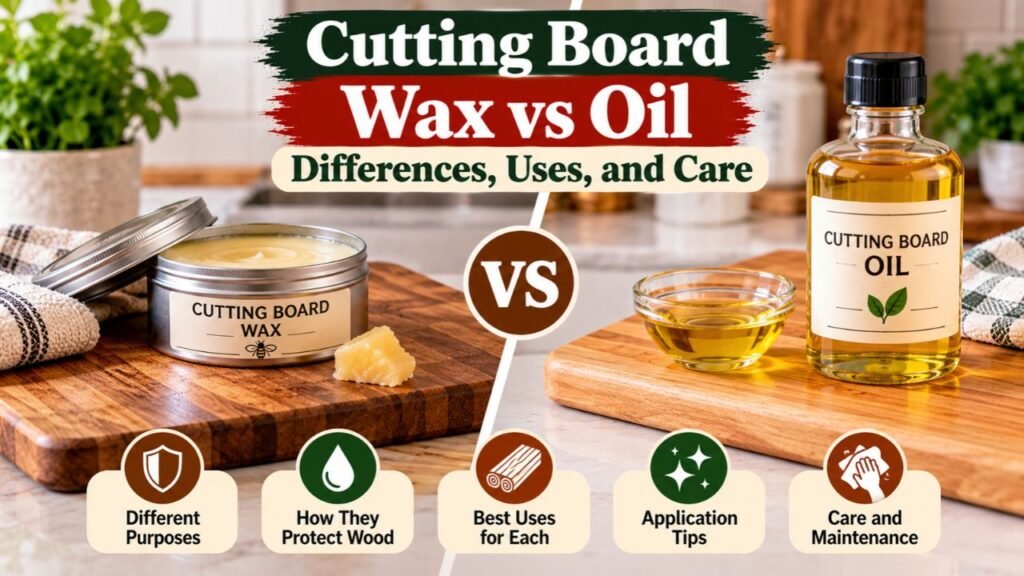
The simplest distinction is penetration versus surface protection. An oil treatment moves into exposed wood fibers. A wax treatment stays mainly at or near the surface and is buffed into a thin coating. Both need renewal.
| Feature | Cutting board oil | Cutting board wax |
| Typical ingredient | Food-grade mineral oil | Beeswax, often blended with mineral oil |
| Main action | Penetrates exposed wood | Forms a thin, water-repelling surface layer |
| Best use | New, dry, or frequently washed wood | Extra surface protection and a smooth finish |
| Appearance | Darkens and enriches grain | Adds a soft satin sheen after buffing |
| Application | Spread, let absorb, wipe excess | Rub on thinly, then buff |
| Main limitation | Provides modest surface resistance | Does not condition deeper wood as well as liquid oil |
| Upkeep | Renew as wood looks dry | Renew when the surface finish wears down |
What Cutting Board Oil Does
Food-grade mineral oil is a clear, nearly odorless, non-drying oil. It enters exposed pores and grain rather than forming a hard coating on top. That helps moderate how readily a board takes up water during brief contact and keeps the grain from looking faded or chalky.
Oil does not add water to wood or reverse structural damage. Wood expands as it absorbs moisture and shrinks as it dries. The USDA Forest Products Laboratory explains that water-repellent finishes can reduce the effects of these changes. Oiling is one part of managing that exposure, along with prompt washing and thorough drying.
Mineral oil remains liquid. It does not harden into a permanent finish, so repeated washing and normal food preparation gradually reduce its presence near the cutting surface.
What Cutting Board Wax Does
Cutting board wax is a product made for wood that touches food. It may be pure food-contact-safe beeswax, but many products sold as board wax are blends of beeswax, mineral oil, and sometimes another wax such as carnauba.
Wax fills some surface irregularities and leaves a thin coating that makes drops of water bead more readily. It can add a pleasant feel and mild sheen without the hard, brittle film associated with furniture varnish.
That protection is temporary. Chopping, scrubbing, soap, and hot water remove the surface layer over time.
Where Board Butter and Conditioner Fit
Terms such as board butter, board cream, and butcher block conditioner often describe a premixed oil-and-wax product. The oil portion spreads through accessible wood pores, while the wax portion stays closer to the surface.
These blends offer a convenient single-product treatment for boards that are already reasonably conditioned. On very dry or newly sanded wood, plain mineral oil first often provides more even coverage. Always check the ingredient list because product names alone do not tell you what is inside.
Key Takeaway: Oil works mainly within exposed wood; wax adds a temporary surface layer; board butter combines both functions.
Which Is Better for Your Wooden Cutting Board?
Neither wins every situation. The board’s current finish and exposure to washing matter more than the product’s label.
For a New, Unfinished Cutting Board
Start with plain food-grade mineral oil, provided the board maker recommends an oil finish. Freshly sanded or untreated wood can absorb more oil than a board that has already been conditioned.
Howard Products advises at least two coats on new, raw wood, allowing each coat to absorb for at least an hour, with extra coats for thicker pieces. That is guidance for its product, not a rule that every board needs the same quantity. Once excess oil has been removed, a thin wax conditioner is an optional final step.
For a Dry, Faded, or Rough-Looking Board
Oil is the more sensible first treatment when the wood looks dull or pale, especially around heavily used areas. Apply it to all sides rather than concentrating only on the center of the cutting face.
A wax-only coat may make dry wood look darker briefly, but the surface layer does less to treat the exposed grain below. If the board feels rough because its fibers have risen after washing, conditioning may improve the feel a little; noticeable splinters or damaged grain need proper repair, not more wax.
For a Board That Sees Frequent Washing
A thin oil-and-wax finish can offer more water resistance than mineral oil alone. It may be useful on boards that are cleaned many times during the week, as long as the coating is thoroughly buffed and does not leave the cutting face slippery.
Do not try to compensate for soaking or dishwasher cycles with extra wax. Repeated exposure to water and heat can damage glued joints and change a board’s shape even after conditioning.
For a Simple, Low-Cost Care Routine
Choose food-grade mineral oil if you want just one straightforward product. It is widely sold for wood kitchenware, has a long shelf life, and does not become rancid like common cooking oils.
A separate wax is optional. I would spend money on a board-safe conditioner only if the added surface feel and water beading matter to you. A clean, dry, well-maintained board does not require an expensive two-step treatment every time.
Key Takeaway: Start with mineral oil for untreated or dry wood; add a thin wax finish for extra water resistance if the board needs it.
Are Cutting Board Oil and Wax Food-Safe?
The ingredients must be suitable for repeated direct food contact, not merely labeled natural or marketed as a wood polish. A product intended for furniture is not automatically suited to a surface that a knife will scratch every day.
Food-Grade Mineral Oil
Look for a bottle specifically labeled food-grade mineral oil, USP mineral oil, or intended for cutting boards and butcher blocks. Do not substitute industrial lubricating oil or scented baby oil.
The USDA Forest Products Laboratory identifies mineral oil as a traditional non-drying finish for wooden utensils and warns that baby oil can contain ingredients unsuitable for food contact. Highly refined mineral oil used for board care is different from petroleum products intended for machines.
Beeswax and Other Board-Safe Waxes
Beeswax is a common choice because it buffs into a thin, flexible layer. Some formulas include carnauba or other plant-derived waxes to alter hardness and sheen. For a vegan alternative, select a product that clearly states it is suitable for cutting boards rather than choosing a general candle or furniture wax.
Check for fragrances, pigments, solvents, and other additives. The word wax on a container does not establish food-contact suitability. A finished board should not have loose flakes or an obvious layer that transfers onto food.
Cooking Oils and Hard Film Finishes to Avoid
Olive, corn, sunflower, and other ordinary cooking oils are poor routine substitutes for mineral oil because they can oxidize and develop unwanted smells or flavors over time. The USDA Forest Products Laboratory notes that vegetable oils may become rancid even though that condition is not necessarily hazardous.
Avoid standard furniture polish, scented mineral oil, and finishes that form a thick brittle film on an active cutting surface. A knife repeatedly scores that film, and the coating may chip or peel. Pure drying oils used in woodworking have different curing requirements and are not direct swaps for simple mineral oil.
Key Takeaway: Buy products labeled for food-contact cutting boards, and check the ingredients rather than assuming every oil or wax is suitable.
How to Apply Cutting Board Oil and Wax Correctly
For an ordinary unfinished or oil-finished wood board, the most predictable sequence is clean, dry, oil, wipe, wax, and buff. Follow the board manufacturer’s directions if it arrived with a special factory finish.
Prepare the Board Before Adding a Finish
Wash the cutting board with warm or hot water and dish soap, rinse it thoroughly, and dry it with a clean towel. Let the remaining moisture air-dry with airflow around both sides. Do not apply oil or wax over a damp surface, trapped food residue, or a wet juice groove.
Have a clean lint-free cloth or disposable applicator, food-grade mineral oil, and an optional food-contact-safe wax conditioner ready. Check the entire board for splitting, loose joints, or deep grooves before starting.
Apply Oil First and Wax Afterward
- Spread the oil. Put a modest amount of mineral oil on the board and distribute it across the cutting face. Coat the back, edges, end grain, handles, and juice groove as well. Add only enough to wet the surface evenly.
- Give it time to absorb. Follow the label’s waiting period. Some manufacturers suggest an hour or more; John Boos recommends leaving its Mystery Oil overnight. If a dry patch absorbs oil rapidly, add a little more there rather than pouring on a heavy layer everywhere.
- Remove the excess. Wipe away remaining puddles with a clean cloth. The cutting face should feel conditioned, not wet or greasy. If the board already looks evenly treated, you can stop here.
- Add a thin wax layer. Rub a small amount of cutting board wax or board cream across the dry-to-the-touch, oiled surface. Cover the sides and edges, then follow the wax product’s stated resting time.
- Buff and inspect. Use a clean cloth to remove surplus product and polish the surface to a light sheen. Before preparing food, check that the board feels dry to the touch, does not transfer residue, and sits flat without sliding.
Howard Products and John Boos both describe oil-first routines followed by an optional conditioner. Their waiting times differ, so product directions should take priority over a fixed timing rule.
Tip: A little wax goes a long way. A thin, buffed layer is more practical on a working board than a thick glossy coat that collects residue in knife marks.
Key Takeaway: Treat a clean, fully dry board with oil first; use wax only after excess oil is removed, then buff off every greasy patch.
How Often Should You Oil or Wax a Cutting Board?
There is no universal calendar that fits every board. Washing frequency, indoor humidity, wood species, grain direction, and the finish already present all change how quickly the surface looks dry.
John Boos suggests oiling its wood cutting boards at least monthly, adjusted for use and household conditions. That makes about once a month a reasonable inspection point for an often-used, oil-finished board, not a requirement to add more oil to a surface that remains saturated.
Watch for a pale, dull cutting area, water soaking in more quickly than it used to, or a surface that feels dry after washing. Those signs suggest an oil treatment may be due. A loss of the smooth, softly buffed finish can suggest the wax layer has worn down.
Wax can be renewed less often if the coating still looks and feels sound. A water-drop check may show reduced resistance, but water beading does not prove that the board is sanitary. Wipe the water away promptly.
Do not oil or wax a board after every wash unless its maker specifically calls for that routine. Too much product can create buildup without preventing water damage.
Common Problems With Cutting Board Wax and Oil
Many disappointing results come from the amount applied or the condition of the wood, rather than from a defective care product.
| Problem | Likely reason | First fix |
| Sticky, greasy surface | Too much oil or wax left behind | Buff repeatedly with a clean cloth; wash if needed |
| Patchy color | Uneven absorption or incomplete cleaning | Clean, dry, and apply a small amount of oil evenly |
| Water no longer beads | Surface wax has worn off | Add a thin, board-safe wax coat after cleaning and drying |
| Sour or stale smell | Food residue or an unsuitable cooking oil | Wash thoroughly; assess the finish and wood condition |
| Cracks or separated joints | Moisture movement or physical damage | Stop using if the area cannot be cleaned safely |
Why the Board Feels Sticky After Waxing
Too much conditioner is the usual suspect. Wax should be applied sparingly and buffed, not left as a visible paste in scratches or grooves. A thick film traps crumbs and may transfer to food.
Start with a clean, dry cloth. If the tacky layer remains, gently wash the board with dish soap, rinse, dry it fully, and reassess before applying anything else. Do not stack another treatment over the residue.
Why Water Still Soaks Into an Oiled Board
Mineral oil adds some water resistance but does not make wood impervious to liquid. Open end grain, wear from chopping, and repeated washing can all make water penetrate more readily.
A light wax conditioner may reduce short-term wetting at the surface. If the board has open splits, failed glue lines, or deep gaps, a fresh finish is not a repair. Replace a board whose damaged areas cannot be cleaned thoroughly.
Why a Board Still Cracks or Warps After Treatment
Oil and wax slow some moisture movement; they cannot prevent all expansion or shrinkage. Leaving wood submerged, drying one side against a wet counter, or putting a board near strong heat can still create stress.
Hand-wash promptly, dry both sides, and store the board with airflow. The USDA’s food-safety guidance also advises replacing boards with excessive wear or hard-to-clean grooves. Surface maintenance should never hide a structural problem.
Key Takeaway: Sticky residue needs removal, poor water beading may call for a fresh wax layer, and structural damage needs more than conditioner.
Does the Type of Cutting Board Change the Choice?
The oil-and-wax method is intended mainly for unfinished or oil-finished wood. Other materials and factory finishes may require a different routine.
End-Grain Wooden Cutting Boards
An end-grain board exposes the ends of wood fibers on its cutting face. Those areas may absorb more oil, especially on a newly made board, so inspect for uneven dry patches during the first treatment.
Apply oil across the full board, not just the top, and finish with a thin wax blend if recommended.
Edge-Grain and Face-Grain Wooden Cutting Boards
Both styles can be maintained with mineral oil and board-safe wax when the original finish allows it. Oil absorption may differ from end-grain boards, but the order of treatment does not change.
A wide edge-grain board that rests flat on the counter still needs attention on the underside and edges. Skipping those areas can lead to uneven exposure during washing and storage.
Bamboo, Plastic, and Factory-Sealed Boards
Many bamboo boards can be maintained with mineral oil if their maker recommends it. The USDA’s cutting board guidance mentions rubbing bamboo boards with mineral oil. Check for manufacturer restrictions before adding wax to a laminated bamboo product.
Plastic boards do not need either treatment. Some wooden serving boards have a lacquer, varnish, or other factory-applied coating and are not meant to absorb mineral oil. Identify the original finish before using a standard wood-board conditioner.
Key Takeaway: Oil and wax suit many unfinished wood boards, but bamboo and factory-coated products need their maker’s instructions; plastic needs neither.
Is Homemade Board Butter Worth Making?
A simple homemade board butter usually combines food-grade mineral oil and beeswax. A common starting mix is around four parts mineral oil to one part beeswax by volume, with more wax producing a firmer result. This is a preparation ratio, not a required standard.
If making it, gently melt the beeswax over a water bath, away from direct flame, mix in the mineral oil, and let the mixture cool before use. Keep the container and utensils clean, and avoid adding perfume, essential oils, or ingredients not intended for food-contact surfaces.
Premixed conditioner is less messy and provides clearer manufacturer directions. For a first board, I prefer buying an ingredient-labeled product rather than experimenting with a thick homemade wax that takes extra effort to buff off.
Conclusion
For cutting board wax vs oil, the practical distinction is simple: oil penetrates exposed wood, while wax adds a thin layer that repels some surface moisture. Neither makes a board waterproof, and neither replaces washing and drying.
Food-grade mineral oil is usually enough for basic maintenance. An oil-and-wax conditioner is useful when you want a smoother finish and a little extra resistance to brief contact with water. Apply the oil first on dry or untreated wood, and remove every bit of excess before waxing.
I recommend checking the board’s condition before reaching for either product. If it is clean, smooth, and already well conditioned, leave it alone. If it is cracked, splitting, or too deeply grooved to clean, extra wax is not the answer.
FAQs About Cutting Board Wax and Oil
Is Beeswax Better Than Mineral Oil for Cutting Boards?
Beeswax is better at forming a thin water-repelling layer near the surface, while mineral oil is better suited to soaking into exposed wood. Neither does every job alone. On a new or dry cutting board, start with food-grade mineral oil. Use a beeswax-based conditioner later if you want extra surface protection and a softly buffed finish.
Can I Use Cutting Board Wax Without Oil?
Yes, on a board that is already well conditioned, a food-contact-safe wax or board cream can be used by itself for surface upkeep. Pure hard beeswax may be awkward to spread evenly, so a wax-and-oil blend is often simpler. For very dry, untreated wood, liquid mineral oil first is the more useful approach.
Should I Oil or Wax My Cutting Board First?
Apply oil first, give it time to absorb, and wipe away the excess. Then spread a small amount of board wax or conditioner and buff it to a thin finish. Putting a heavy wax coat on first may limit how evenly a later oil treatment reaches exposed wood. Follow any different sequence specified by the board maker.
Does Cutting Board Wax Make Wood Waterproof?
No. Wax can make water bead on the surface and slow brief absorption, but it wears away with chopping and cleaning. Water can still reach wood through knife marks, edges, seams, and areas where the coating is thin. A waxed cutting board should still be hand-washed, rinsed, dried promptly, and kept out of standing water.
Can I Use Olive Oil Instead of Mineral Oil?
I do not recommend olive oil for routine wooden cutting board care. It is a food ingredient, but it can oxidize and eventually give the board an unpleasant odor or flavor. Food-grade mineral oil is more stable for this purpose and is available without added fragrance. Check a commercial board oil’s ingredient list if you prefer another formula.
How Long After Oiling and Waxing Can I Use My Cutting Board?
Use the waiting period on the care product’s label. Some oils are left to absorb for an hour or longer, and some manufacturers advise overnight treatment. After the recommended time, wipe or buff off all remaining product. The board should not feel greasy, tacky, or coated with loose wax before it touches food.
Do Bamboo and Plastic Cutting Boards Need Wax or Oil?
Plastic cutting boards need neither, since mineral oil will not condition plastic the way it treats wood. Bamboo boards may benefit from mineral oil, depending on their construction and care instructions. Wax is optional only if the maker permits a board conditioner. Both materials still need proper cleaning, drying, and replacement when excessively damaged.