Fullstar 4 in 1 Chopper Review: Blades, Performance, Pros & Cons
The Fullstar 4-in-1 is a practical manual vegetable chopper for people who regularly dice onions, peppers, cucumbers, zucchini, potatoes, and similar produce. Its two dicing grids create consistent cubes much faster than repeated knife cuts, while the spiral and ribbon attachments add extra prep options. Hard vegetables and cleanup around the blade grid are its main drawbacks.
This is a push-down grid chopper, not a spinning-blade mini food processor. Food sits over a fixed blade grid, and closing the lid forces it through the stainless-steel cutters into the container below. That design is much better suited to uniform dice than a rotating S-blade.
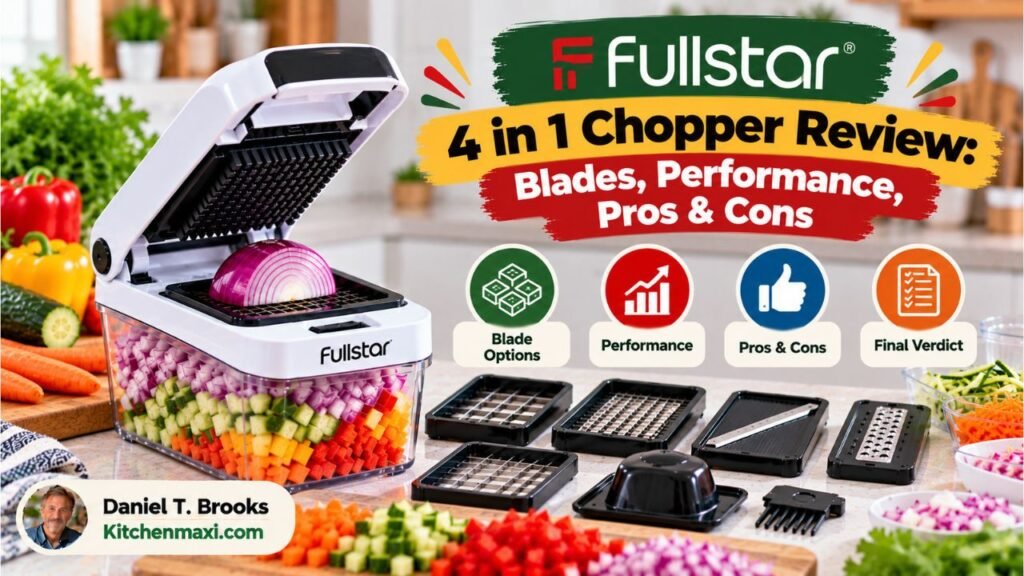
The four supplied cutting options are the main reason to choose this model over Fullstar’s simpler choppers. The set includes 1/4-inch and 1/2-inch dicing grids, plus spiral and ribbon cutters, giving it enough range for everyday vegetable prep without the larger attachment collection of an 8-in-1 model.
Its strongest use case is repetitive prep. Chopping several onions for chili, peppers for meal-prep bowls, cucumber for salad, or vegetables for soup is where a fixed-grid chopper starts to make sense.
For this Fullstar 4 in 1 chopper review, the biggest point is that speed comes with some preparation. Large vegetables still need to be cut into sections that fit the blade area, and very dense produce can demand considerable downward force.
Read More: Fullstar Vegetable Chopper vs Mueller
Current owner feedback is generally strong. Walmart’s listing shows a 4.6-star rating from hundreds of ratings, with frequent praise for ease of operation, sharp blades, onion chopping, and meal prep. Negative comments commonly mention the force needed for firmer vegetables, clogging, and extra cleanup around the cutting areas.
My take is that the Fullstar 4-in-1 makes sense if uniform vegetable dicing is the main job. It is less convincing if you mostly mince garlic, chop herbs, purée foods, or process extremely hard root vegetables.
Fullstar 4 in 1 Chopper Review: Quick Verdict
The Fullstar 4-in-1 earns its counter space by doing a small number of prep jobs well.
Its strongest points are:
- 1/4-inch fine dicing grid
- 1/2-inch medium dicing grid
- Spiral cutter
- Ribbon cutter
- 420J stainless-steel blades
- Catch container
- Manual operation
- Non-skid base
- Grip handle
- Dishwasher-safe construction
- Replaceable blade inserts
Fullstar currently lists its Original Chopper with 420J stainless-steel inserts, a BPA-free and PFAS-free body, dishwasher-safe parts, a safety lock, and replacement blade availability.
The two dicing grids are the parts most people will probably use regularly. They produce repeatable vegetable sizes with less knife work, especially during larger meal-prep sessions.
The spiralizer functions are a nice addition, but they are less central to the product’s appeal. If you rarely make vegetable noodles or ribbons, think of them as extras rather than the reason to buy the chopper.
The main drawbacks are physical force and cleanup. Dense potatoes and carrots need sensible pre-cutting, and the blade grid plus pusher can trap vegetable fibers.
Key Takeaway: The Fullstar 4-in-1 is strongest as a manual dicer for onions, peppers, cucumbers, zucchini, and other everyday produce. Buy it for the two grid sizes first; treat the spiral attachments as a bonus.
What Comes With the Fullstar 4-in-1 Vegetable Chopper?

The standard Original Pro 4-in-1 configuration combines the chopper body with four cutting options.
1/4-Inch Fine Dicer Blade
The 1/4-inch dicing grid creates smaller cubes.
Good uses include:
- Onion for salsa
- Bell pepper
- Zucchini
- Mushrooms
- Small cucumber pieces
- Ingredients for omelets
- Soup vegetables
- Fine meal-prep dice
Because the openings are smaller, more blade edges contact the food during each press.
That means dense vegetables require more force on this grid than they do on the 1/2-inch blade.
1/2-Inch Medium Dicer Blade
The 1/2-inch dicer creates larger cubes and is easier to press through firm produce.
It works well for:
- Potato
- Onion
- Cucumber
- Zucchini
- Bell pepper
- Fruit
- Stew vegetables
- Chunky salads
For a first-time user, I would start with the larger grid when chopping firmer foods.
Spiral Blade
The spiral attachment turns suitable vegetables into long spiral shapes.
Firm, straight produce such as zucchini and cucumber is easier to feed through the spiralizer than irregular or very short pieces.
This attachment is useful for vegetable noodles, salad garnishes, or decorative prep.
Ribbon Blade
The ribbon cutter produces broader vegetable strips rather than noodle-like spirals.
It can be used for zucchini, cucumber, and similar firm produce.
Fullstar’s instructions describe twisting firm cylindrical vegetables through the spiral or ribbon cutting section while applying gentle pressure.
Key Takeaway: The 1/4-inch and 1/2-inch grids handle normal dicing, while the spiral and ribbon blades expand the chopper into vegetable noodle and garnish prep.
How the Fullstar 4-in-1 Chopper Works
The dicing mechanism is simple.
Place the Blade in the Chopper
Select either the fine or medium dicing blade and fit it securely into the chopper body.
The blade needs to sit correctly before food goes near it.
Fullstar’s operating instructions call for aligning the insert with the base and seating it securely before chopping.
Pre-Cut the Vegetable
This step is easy to underestimate.
A large onion, potato, cucumber, or pepper should be cut so the piece stays inside the actual blade area.
Pre-cutting has three benefits:
- Less pressure on the chopper
- Cleaner cuts
- Lower chance of food catching on the frame
For dense vegetables, making the starting piece thinner can make a large difference.
Place Food on the Grid
Position the food near the middle of the blades.
A flat cut surface usually sits more securely than a rounded side.
Keep your fingers away from the grid once the food is positioned.
Push the Lid Down
Bring the lid toward the vegetable and use a firm downward motion.
The pusher forces the food through the grid and into the catch container.
Fullstar’s instructions call for a firm, quick press rather than slowly forcing food through in several weak movements.
Empty the Container Before It Gets Packed
Do not let finished pieces pile tightly against the underside of the grid.
Emptying the container before it is completely packed keeps food from pushing back against the cutters.
Key Takeaway: The chopper works best when vegetables are pre-cut to fit the entire grid, placed flat, and pushed through with one controlled downward press.
Fullstar 4-in-1 Performance on Different Vegetables
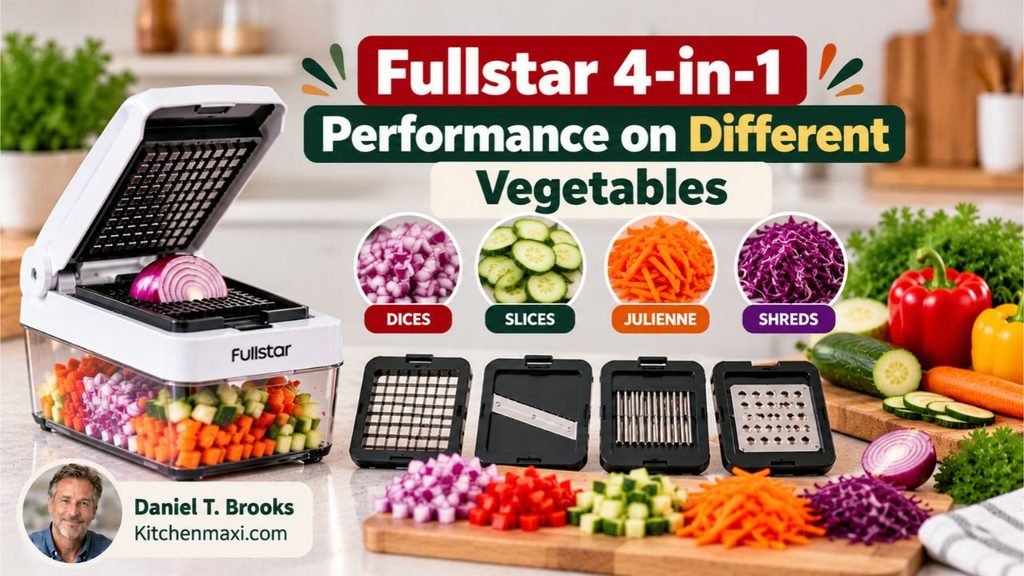
The product feels very different with an onion than with a dense sweet potato.
Fullstar 4-in-1 for Onions
Onion dicing is arguably the strongest reason to own this chopper.
Peel the onion and cut it into halves or quarters based on its size.
Place a flat cut side against the grid and press.
The 1/4-inch grid works well for small onion pieces used in:
- Salsa
- Chili
- Omelets
- Stuffing
- Soup bases
The 1/2-inch grid suits recipes where a larger onion texture is wanted.
Because the pieces fall directly into the container, there is also less loose onion scattered across the cutting board.
Owner feedback frequently mentions onion chopping as a strong point of the Fullstar design.
Fullstar 4-in-1 for Bell Peppers
Bell peppers work well once the stem, seeds, and large internal ribs are removed.
Cut the pepper into flat sections and lay each section across the dicing grid.
A quick press produces small or medium pieces depending on the insert.
The skin can sometimes catch between blades if the pepper is very soft or the grid contains previous food residue.
Fullstar 4-in-1 for Cucumbers
Cucumber is easier to push through than a dense potato or carrot.
Cut long cucumbers into shorter sections first.
Use the medium grid for chunky salad pieces or the fine grid for smaller dice.
Cucumber also works well with the spiral and ribbon attachments because its long, cylindrical shape suits that cutting mechanism.
Fullstar 4-in-1 for Zucchini
Zucchini is another good match.
It is firm enough to cut cleanly without the resistance of harder root vegetables.
The dicing blades work for soup, sautéed dishes, casseroles, and meal-prep bowls.
The spiral blade can turn zucchini into long noodle-style strands.
Fullstar 4-in-1 for Potatoes
Raw potato can be chopped, but size matters.
Cut large potatoes into smaller slabs or chunks first.
The 1/2-inch dicer is the better starting point because the larger openings create less resistance.
Trying to force a thick raw potato through the fine grid can require much more pressure.
If the lid stops firmly, remove the potato and cut it thinner rather than putting extreme force on the plastic body.
Fullstar 4-in-1 for Carrots
Carrots also need pre-cutting.
Thin carrots can be cut into short pieces. Very thick carrots are easier to handle after being split lengthwise.
The fine grid can work, but the medium dicer demands less force.
Do not load several dense carrot pieces across the entire grid at once.
Fullstar 4-in-1 for Tomatoes
Tomatoes need more care because soft produce can crush before it passes cleanly through the grid.
Use a firm tomato.
Very ripe tomatoes may release juice and lose their shape.
For salsa, the larger grid often gives cleaner pieces than trying to create very small cubes from soft fruit.
Fullstar 4-in-1 for Sweet Potatoes and Beets
This is where expectations should stay realistic.
Fullstar’s instructions warn against attempting extremely hard foods that could damage the blades or unit.
Dense raw sweet potatoes and beets can require considerable pressure.
If you regularly dice these vegetables in large quantities, I would not make the Fullstar 4-in-1 my first choice.
Key Takeaway: Onion, pepper, cucumber, and zucchini suit the Fullstar well. Potato and carrot need smaller starting pieces, while very dense sweet potato or beet can push the chopper beyond its strongest use case.
How Consistent Are the Fullstar 4-in-1 Dice Sizes?
Consistency is one of the product’s strongest traits.
A fixed blade grid determines the width of the pieces, so vegetables come out much more uniform than food processed with a spinning mini-chopper blade.
This matters for more than appearance.
Similar-size pieces tend to cook at a similar rate.
That is useful for:
- Soup
- Roasted vegetables
- Omelets
- Stir-fry
- Salsa
- Meal-prep bowls
- Potato dishes
The 1/4-inch grid is suited to finer prep, while the 1/2-inch grid creates chunkier pieces.
Food shape can still affect the final cube dimensions. A thin pepper panel going through a 1/2-inch grid does not magically become 1/2 inch thick.
The grid controls two dimensions of the cut; the thickness of the starting food controls the other.
Is the Fullstar 4-in-1 Easy to Press?
With soft-to-medium vegetables, yes.
With dense vegetables, not always.
Foods That Need Less Force
The chopper is fairly straightforward with:
- Onion
- Bell pepper
- Zucchini
- Cucumber
- Mushroom
- Strawberries
- Similar medium-firm produce
Foods That Need More Force
Expect more resistance from:
- Carrots
- Potatoes
- Apples
- Dense root vegetables
The fine grid also requires more force than the medium grid.
Some Walmart reviewers specifically report that firm produce can bind or require more pressure, while positive reviews praise the sharp blades and stable operation.
Why Pre-Cutting Matters
Pre-cutting is not a flaw unique to this model.
A grid chopper has a fixed cutting area.
Cutting a potato into a manageable slab puts less stress on:
- Blade grid
- Lid hinge
- Plastic frame
- Handle
- Your hands
Trying to save ten seconds of knife prep by forcing a huge piece through the chopper can make the job harder.
Key Takeaway: The Fullstar presses easily through many everyday vegetables, but hard produce needs smaller starting pieces. The 1/2-inch grid is easier to use with dense foods than the 1/4-inch grid.
Fullstar 4-in-1 Container and Counter Stability
The catch container is more useful than it first appears.
Instead of diced food spreading across a cutting board, each press drops the pieces into the box underneath.
This is convenient for meal prep because the container can collect several vegetables before you move them into a pan or storage container.
The current Fullstar Original 4 in 1 Chopper also uses a non-skid base and grip handle intended to keep the unit stable during downward pressure.
A stable counter still matters.
Place the chopper on:
- Flat surface
- Dry counter
- Clean counter
- Area with enough room to press directly downward
Avoid chopping on a wet counter where the base can move as force is applied.
Is the Fullstar 4-in-1 Easy to Clean?
Cleaning is manageable, but it is not as simple as rinsing a chef’s knife.
The Container Is Simple
The catch container has large open surfaces and is easy to wash.
Most food residue comes away with warm water and dish soap.
The Grid Needs More Attention
The dicing blades have many small openings.
Onion membrane, pepper skin, celery fiber, and small vegetable pieces can remain trapped between the cutters.
The pusher section in the lid can collect food too.
This is the part of cleanup that some owners find tedious. Walmart review themes include both positive comments about cleaning and complaints about the time needed to clear the cutting areas.
Clean It Before Food Dries
Rinse the grid soon after chopping.
Fresh vegetable pieces are much easier to remove than dried onion or potato starch.
Use the supplied cleaning tool rather than pushing fingers between the blades.
Can the Fullstar 4-in-1 Go in the Dishwasher?
Yes. Fullstar currently lists the Original Chopper as dishwasher safe, and the 4-in-1 instructions state that the parts can go on the top rack.
Hand washing the sharp inserts is still a reasonable choice if you want to reduce the chance of blades knocking against other items.
Key Takeaway: The bowl and large plastic parts are easy to wash, while food trapped around the grid and pusher takes more attention. Rinsing immediately after use reduces most of the cleanup hassle.
Fullstar 4-in-1 Blade Quality and Build
The current Original Chopper uses 420J stainless-steel blade inserts. Fullstar also sells replacement blade kits, so worn inserts do not automatically mean replacing the complete chopper.
That replaceable-blade design is a strong point for a manual chopper.
The plastic body still carries much of the force each time the lid is pressed.
That is why technique matters.
Use the chopper as a cutting tool, not as a lever for crushing food that refuses to move through the blades.
Check periodically for:
- Cracks around the hinge
- Loose blade seats
- Damaged locking parts
- Bent grid sections
- Chipped container edges
Stop using a blade insert if the grid is bent or damaged.
Fullstar 4-in-1 Safety Features and Blade Handling
The blades are extremely sharp.
The biggest injury risk often appears during assembly and cleaning rather than normal chopping.
Handle Blades by Their Plastic Edges
Avoid touching the metal grid.
Use the designated plastic frame or grip points to insert and remove each blade.
Keep Fingers Off the Food During Pressing
Once the vegetable sits on the grid, move your hands to the handle.
Do not try to hold a small piece in position while closing the lid.
Use the Supplied Safety Equipment
Fullstar’s 4-in-1 instructions list a safety glove and warn users to keep fingers away from the blade during use and cleaning.
Store the Blades Carefully
Do not toss loose grids into a crowded drawer.
Store them where the cutting surfaces cannot catch a hand reaching for another tool.
Key Takeaway: Normal chopping keeps hands away from the grid, but blade changes and cleaning expose the sharp edges. Handle inserts by the frame and use the supplied safety gear.
Fullstar 4-in-1 Chopper Pros and Cons
Pros
- Two useful dicing sizes
- Creates more uniform pieces than rotating-blade choppers
- Good for onions and common meal-prep vegetables
- No electricity required
- Catch container reduces counter mess
- Spiral and ribbon options included
- Sharp stainless-steel grid inserts
- Dishwasher-safe parts
- Non-skid base
- Grip handle
- Replacement blades available
- BPA-free and PFAS-free body
- Useful for repeated batch prep
Cons
- Hard vegetables require pre-cutting
- Fine grid can need considerable pressure
- Very hard root vegetables are poor candidates
- Soft tomatoes can crush
- Blade grids collect food residue
- Cleaning takes longer than washing a knife
- Four functions may be unnecessary if you only want one dicing size
- Sharp removable grids require careful storage
- Still requires some knife work before chopping
Fullstar 4-in-1 vs Fullstar 8-in-1 Chopper
The 4-in-1 is the simpler option.
Choose the Fullstar 4-in-1 If You Mainly Want Dicing
The four attachments cover the main jobs:
- Fine dice
- Medium dice
- Spiral
- Ribbon
That is enough for many kitchens.
Fewer attachments also mean fewer loose pieces to store and wash.
Choose the Fullstar 8-in-1 If You Want More Cutting Styles
The larger Fullstar configurations add more slicing, shredding, or grating options depending on the version.
That may suit someone trying to replace several manual prep tools with one system.
The tradeoff is more accessories and storage.
I prefer the 4-in-1 concept for someone who primarily wants a vegetable dicer rather than a large multi-attachment prep kit.
Key Takeaway: The 4-in-1 keeps the tool centered on dicing and spiralizing, while the larger Fullstar sets make more sense for cooks who will regularly use extra slicing and grating attachments.
Fullstar 4-in-1 vs a Food Processor
These tools solve different prep problems.
Fullstar Creates Defined Dice
A grid physically sets the width of each cut.
That makes the Fullstar a stronger option for:
- Salsa
- Salad
- Diced onions
- Diced peppers
- Potato cubes
- Meal-prep vegetables
A Food Processor Uses Rotating Blades
A standard food processor can chop, mince, mix, purée, shred, and perform many other jobs.
Its regular S-blade does not create the same grid-shaped cubes.
Some larger processors have dedicated dicing kits, but that is a separate attachment system.
Fullstar Requires More Physical Force
A food processor has a motor.
The Fullstar relies on hand pressure.
For someone with limited hand, wrist, shoulder, or upper-body strength, an electric appliance may be more comfortable.
Key Takeaway: Pick the Fullstar for simple uniform dicing and a food processor for powered chopping, puréeing, mixing, and broader food-prep tasks.
Who Should Buy the Fullstar 4-in-1 Chopper?
The Fullstar 4-in-1 is a good fit for someone who frequently prepares:
- Onions
- Peppers
- Cucumbers
- Zucchini
- Potatoes
- Carrots
- Salad ingredients
- Soup vegetables
- Salsa
- Meal-prep vegetables
It makes the most sense when several vegetables need to be cut into similar-size pieces.
Families, batch cooks, and people who prep several meals in advance have more opportunity to save time than someone who chops half an onion once a week.
It is also a sensible choice for cooks who want uniform pieces but do not want an electric appliance taking up counter space.
Who Should Skip the Fullstar 4-in-1?
Skip it if most of your prep involves:
- One or two small ingredients
- Garlic mincing
- Herb chopping
- Puréeing
- Sauces
- Very hard root vegetables
- Foods that need irregular chopping
- Very soft produce
A chef’s knife may be faster when only a small amount of food needs cutting.
A mini electric chopper is better for garlic, herbs, and fine mincing.
A food processor is better for purées, mixtures, and larger powered prep jobs.
Someone who has difficulty applying firm downward pressure may also prefer an electric cutting method.
Is the Fullstar 4-in-1 Chopper Worth It?
For regular vegetable prep, yes—the design has a clear purpose.
The two dicing grids are the strongest part of the package. They turn properly prepared produce into repeatable small or medium pieces and collect everything directly below the blades.
The spiral and ribbon cutters expand what the tool can do, but I would not buy the set for those features alone.
The biggest compromises are the physical pressure needed for dense vegetables and the cleaning required around the blade grid.
Current retail feedback supports the same general picture: many owners praise the blades, ease of use, onion chopping, and meal-prep speed, while a smaller group reports difficulty with hard foods, clogging, setup, or cleanup.
If your weekly cooking includes several onions, peppers, cucumbers, zucchini, potatoes, or other dice-friendly foods, the time saved can justify adding another kitchen tool.
If you already dice quickly with a knife and rarely prepare larger batches, it may spend more time in storage than in use.
Conclusion
This Fullstar 4 in 1 chopper review points to a clear strength: the product is very good at turning common vegetables into consistent small or medium pieces without electricity.
The 1/4-inch and 1/2-inch dicing grids are the attachments that give the chopper most of its practical appeal. Onion, bell pepper, cucumber, zucchini, and similar produce fit the system well, while potatoes and carrots need more preparation and pressure.
The drawbacks are easy to identify. Hard vegetables can strain the tool, very soft produce may crush, and vegetable fibers can become lodged in the blade grid and pusher.
I would choose the Fullstar 4-in-1 for regular meal prep, salads, soups, salsa, and recipes that call for repeated uniform dicing. For very small prep jobs, fine mincing, or extremely hard produce, another tool is likely to fit the task better.
FAQs About the Fullstar 4-in-1 Chopper
What Blades Come With the Fullstar 4-in-1 Chopper?
The 4-in-1 configuration includes a 1/4-inch fine dicer, 1/2-inch medium dicer, spiral blade, and ribbon blade.
The two grids produce different cube sizes, while the spiral attachments are intended for long vegetable spirals and ribbons.
Is the Fullstar 4-in-1 Good for Onions?
Yes.
Onions are one of its strongest uses. Peel and halve or quarter the onion so it fits the blade area, put a flat side against the grid, and press the lid down firmly. Choose the fine or medium blade according to the piece size you want.
Can the Fullstar 4-in-1 Chop Potatoes?
Yes, but potatoes should be cut into smaller sections first.
The 1/2-inch grid is generally easier to press through a dense raw potato. If the lid needs extreme force, remove the potato and make the starting piece thinner.
Can the Fullstar Chopper Cut Carrots?
Yes.
Thick carrots should be split or cut into short sections before chopping. Dense carrots create more resistance than onion, cucumber, or zucchini, so avoid covering the whole fine grid with thick carrot pieces at once.
Can the Fullstar 4-in-1 Chop Sweet Potatoes?
Very hard raw sweet potato may require more force than the chopper is suited to handle.
Fullstar warns against attempting extremely hard foods that could damage the unit. If a piece does not move through the grid with reasonable pressure, stop rather than forcing the lid.
Is the Fullstar 4-in-1 Dishwasher Safe?
Yes.
Fullstar’s current Original Chopper listing describes it as dishwasher safe, and the 4-in-1 instructions recommend the top rack. Remove trapped food from the blade and pusher before washing and let the parts dry before storage.
Does the Fullstar 4-in-1 Make Uniform Dice?
It makes more consistent dice than a spinning-blade manual or electric chopper because the food passes through a fixed-size grid.
The final piece thickness still depends partly on how thick the vegetable was before it went through the blades.
Is the Fullstar 4-in-1 Better Than Cutting Vegetables by Hand?
It can be faster for repeated uniform dicing, especially when preparing several onions, peppers, cucumbers, or other vegetables.
For one small ingredient, using a knife may be quicker once setup and washing are included. The Fullstar has the strongest advantage during larger batches.