Cutting Boards for Different Foods: Colors and Safe Uses
Using separate cutting boards for raw meat, poultry, seafood, and ready-to-eat foods reduces the risk of cross-contamination. Most home kitchens need at least two boards: one for raw animal products and another for vegetables, fruits, bread, and cooked foods. Color-coded boards offer additional separation, but proper cleaning remains necessary.
Using the same unwashed cutting surface for raw chicken and fresh salad ingredients can transfer harmful bacteria to food that will not be cooked. This creates a food safety risk even when the board looks clean.
Assigning boards to specific food groups reduces accidental contact between raw and ready-to-eat ingredients. It also keeps meat juices, seafood residue, and strong food odors away from foods that should remain separate.
A 2022 North Carolina State University study involving 300 home cooks found that about one-quarter of participants transferred a harmless bacterial marker from raw chicken to prepared salad. The findings demonstrated how easily contamination can spread during ordinary meal preparation.
The purpose of using cutting boards for different foods is to prevent these transfers before they happen. I found that the most useful distinction is not simply between wood and plastic. It is between surfaces used for raw animal products and those reserved for foods that may be eaten without further cooking.
Another detail deserves attention: a color-coded cutting board is not automatically sanitary. A red board used for raw beef still needs thorough cleaning before it is used for another ingredient, including raw chicken.
Choosing suitable boards, understanding the food color codes, and following proper washing procedures will make daily food preparation safer and more organized. The sections below explain which boards belong with specific foods, which materials work best, and how many boards a home kitchen needs.
Why Different Foods Need Separate Cutting Boards
Different foods carry different contamination risks. Raw meat, poultry, and seafood may contain microorganisms that can cause foodborne illness. Fresh vegetables, sliced fruit, cooked meat, and bread are often eaten without another cooking step.
Cross-contamination occurs when harmful microorganisms transfer from one food or surface to another.
For example, slicing raw chicken on a board can leave contaminated juices behind. Cutting lettuce on that same unwashed surface may transfer bacteria to the lettuce.
This is why the U.S. Department of Agriculture recommends separate cutting boards for raw meat, poultry, and seafood and for fresh produce and bread.
Using different boards also addresses practical problems beyond bacterial contamination.
Fish residue may leave an unwanted odor on a board used for fruit. Raw meat juices can stain a surface intended for bread, while cheese, wheat, and nuts can leave allergenic proteins behind.
Allergen cross-contact is different from bacterial cross-contamination. It happens when an allergen unintentionally transfers into another food, potentially causing an allergic reaction.
A useful board system should therefore separate high-risk raw foods, protect ready-to-eat ingredients, and account for any food allergies in the household.
Choosing Cutting Boards for Different Foods
The safest board assignment begins with the type of ingredient being prepared. Raw animal foods need more careful separation, while many ready-to-eat ingredients can share a clean, dedicated surface.
Cutting Boards for Raw Beef, Pork, and Lamb
A dedicated cutting board for raw red meat keeps meat juices away from salads, bread, and cooked foods.
Red plastic cutting boards are commonly used for raw beef, pork, lamb, and similar meats in color-coded kitchen systems.
Food-grade plastic is a practical choice because its nonporous surface is relatively easy to wash and sanitize. A board with a shallow juice groove can also help contain liquid released while trimming meat.
Wooden boards are not automatically unsafe for raw meat. USDA guidance permits properly maintained wooden or nonporous cutting boards for raw meat preparation.
My preference for everyday home cooking is a dishwasher-safe plastic board dedicated to raw proteins. It simplifies cleanup after handling meat juices.
After cutting raw beef or pork, wash the board thoroughly before using it for a different food, even another type of raw meat.
Cutting Boards for Raw Chicken and Turkey
Raw poultry deserves special attention because chicken and turkey may contain bacteria such as Salmonella and Campylobacter.
Yellow cutting boards are commonly assigned to raw poultry.
A separate yellow plastic board is useful for trimming chicken breasts, cutting turkey, or preparing poultry before cooking.
The board should have enough space to keep the meat from hanging over its edges. A stable, non-slip surface also reduces movement while handling slippery poultry.
Avoid placing cooked chicken back onto a board used for raw chicken unless the board has been properly cleaned and sanitized.
There is also no need to rinse raw chicken before cutting it. The CDC and USDA advise against washing raw poultry because splashing water can spread germs around the sink and surrounding surfaces.
Cutting Boards for Raw Fish and Shellfish
A blue cutting board is commonly used for raw seafood, including fish, shrimp, and shellfish.
Seafood preparation can leave moisture, proteins, and odors on the cutting surface. A nonporous plastic board is convenient because it can be washed thoroughly after use.
A separate seafood board becomes more useful in households that prepare fish frequently or also handle shellfish allergens.
Raw fish intended for cooking should not share an unwashed surface with cooked shrimp, prepared vegetables, or other ready-to-eat ingredients.
Special consideration: Raw fish prepared for sushi or sashimi is intended to be eaten without cooking. It needs a clean, sanitized preparation surface and utensils protected from contamination by other raw animal foods. Board separation alone does not establish that raw fish is suitable for uncooked consumption.
Cutting Boards for Fruits, Vegetables, and Herbs
Fresh produce should have a cutting board that stays separate from raw meat, poultry, and seafood.
Green boards are commonly used for fruits, vegetables, herbs, and salad ingredients.
Wooden cutting boards made from suitable hardwoods, such as maple or walnut, are practical for everyday produce preparation. Food-grade plastic and bamboo boards are also common choices.
Before cutting, rinse fresh fruits and vegetables under running water. Wash firm produce such as melons with a clean produce brush, even when the rind will not be eaten.
Cutting through a dirty rind can carry microorganisms from the outside into the edible portion.
A produce board also needs cleaning when switching from visibly dirty vegetables to ready-to-eat ingredients. For example, scrub and rinse soil-covered potatoes before placing them on a surface used for salad greens.
Cutting Boards for Bread, Cheese, and Cooked Foods
Bread, cheese, sliced deli meats, and fully cooked foods belong on surfaces protected from raw animal juices.
White cutting boards commonly represent bakery and dairy products, while brown boards are often assigned to cooked meat.
A wooden board works well for slicing bread because it provides a stable surface for a serrated knife. Clean plastic boards also work well for cheese, sandwiches, and prepared foods.
Cooked roast beef, grilled chicken, and other cooked meats should be transferred to a clean board before carving.
For a household that frequently prepares large roasts, a separate carving board with a juice groove may be useful. It should not double as an unwashed raw-meat preparation surface.
One exception involves food allergies. A bread-and-cheese board may contain wheat or milk allergens, so it should not automatically be considered suitable for preparing allergy-safe meals.
Cutting Boards for Foods With Allergy Restrictions
A dedicated cutting board is a sensible precaution when preparing food for someone with a diagnosed food allergy.
Purple boards are sometimes used to identify allergy-controlled food preparation areas. This is an optional convention, not a universal safety rule.
Foods containing peanuts, tree nuts, milk, eggs, wheat, fish, or shellfish may leave allergenic proteins on shared surfaces.
Food Allergy Research & Education recommends using separate cutting boards and utensils for allergy-free food preparation when possible.
Store dedicated allergy-safe equipment separately and clean it thoroughly before use.
Key Takeaway: Separate raw animal products from ready-to-eat foods first. Add dedicated poultry, seafood, cooked-food, or allergy-safe boards when those distinctions make food preparation safer.
Cutting Board Color Code for Different Foods
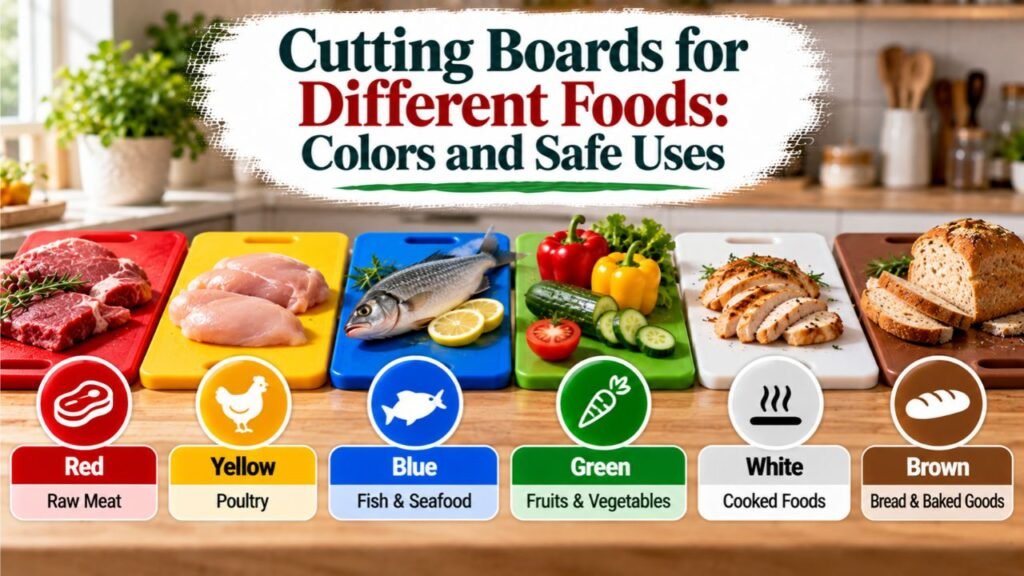
Color coding is a visual system that assigns cutting boards to specific food groups. It reduces confusion during meal preparation and is common in restaurants and commercial kitchens.
The following chart shows a widely used six-color arrangement, plus an optional allergy-related color.
| Cutting Board Color | Food Type | Common Examples |
| Red | Raw red meat | Beef, pork, lamb |
| Yellow | Raw poultry | Chicken, turkey, duck |
| Blue | Raw seafood | Fish, shrimp, shellfish |
| Green | Fruits and vegetables | Lettuce, tomatoes, apples, herbs |
| White | Bakery and dairy | Bread, pastries, cheese |
| Brown | Cooked meat | Roast beef, cooked chicken, ham |
| Purple (optional) | Allergy-controlled preparation | Foods prepared without a specified allergen |
These colors are common industry conventions, not a universal U.S. legal requirement.
The FDA does not prescribe this exact color system for every home or commercial kitchen. Commercial food operations must follow their applicable food safety rules, and color assignments may vary.
Some establishments use red for all raw animal products. Others separate raw poultry, red meat, and seafood into different colors.
Color coding is most useful when everyone preparing food understands the assignments and follows them consistently.
At home, a green board for produce and a red board for raw meat may be enough. Labels, engraved symbols, or clearly different board designs can serve the same purpose.
Tip: If several people share the kitchen, place a small cutting board color chart inside a cabinet door. This reduces the chance of someone accidentally using the raw-meat board for salad preparation.
Best Cutting Board Materials for Different Foods
Board material influences cleaning, maintenance, knife wear, and how easily food residue can be removed.
No single material prevents contamination by itself. The board must remain clean, undamaged, and suitable for food contact.
Plastic Cutting Boards for Raw Animal Foods
Food-grade plastic is one of the most convenient materials for raw meat, poultry, and seafood.
Its smooth, nonporous surface is relatively simple to wash. Many plastic cutting boards are dishwasher-safe, although the manufacturer’s instructions should always be checked.
Plastic boards are also available in multiple colors, making food-group assignments straightforward.
Their main weakness is surface wear. Repeated knife cuts can produce deep scratches and grooves that trap residue.
Inspect raw-meat boards regularly and replace heavily damaged ones rather than relying on repeated scrubbing.
Wooden Cutting Boards for Produce and Ready-to-Eat Foods
Wooden boards are popular for vegetables, fruit, bread, and cooked foods.
Hardwoods such as maple and walnut provide durable cutting surfaces when properly maintained.
Wood is also permitted for raw-meat preparation under USDA consumer guidance. Its safety depends on proper washing, sanitizing when appropriate, drying, and surface condition.
For a two-board home setup, I recommend reserving a wooden board for ready-to-eat foods and choosing a dishwasher-safe plastic board for raw animal products.
This arrangement keeps daily maintenance simple without treating wood as inherently unsafe.
Most wooden boards should be hand-washed rather than placed in a dishwasher, unless their manufacturer specifically permits machine washing. Prolonged moisture exposure can cause warping, cracking, or glue-line problems.
Bamboo, Composite, Glass, and Stone Boards
Bamboo cutting boards are useful for vegetables, fruit, bread, and some other ready-to-eat foods. They are relatively hard and need suitable cleaning and drying.
Composite cutting boards combine manufactured materials into a durable cutting surface. Some are dishwasher-safe, making them useful for several food groups.
Glass, marble, and stone surfaces are easy to wipe clean but are generally poor choices for regular chopping.
Their hard surfaces can dull knife edges quickly, and slippery contact between a knife and a hard board may reduce cutting control.
I would reserve marble or glass surfaces mainly for suitable food presentation rather than routine knife work.
Key Takeaway: Plastic is convenient for raw proteins, while wood and bamboo work well for produce and ready-to-eat foods. Cleaning practices and surface condition matter more than material alone.
How Many Cutting Boards Do You Need at Home?
Most home kitchens can operate safely with two dedicated cutting boards. Additional boards are useful when several food groups are prepared frequently or when allergy restrictions require separate equipment.
Two Boards for Basic Home Cooking
The simplest arrangement is:
- Raw-food board: Used for uncooked meat, poultry, and seafood.
- Ready-to-eat board: Used for washed produce, bread, cheese, and cooked foods.
This setup follows the main separation principle recommended by the USDA and FDA.
Each board still needs proper cleaning after use. When switching between different raw animal foods on the same board, wash and sanitize it between tasks.
Two boards are a practical starting point for households with limited counter and storage space.
Three or Four Boards for Frequent Cooking
A household that prepares multiple food groups in one meal may benefit from additional boards.
For example, a three-board arrangement could include a dedicated raw poultry board, another board for raw meat and seafood, and one for ready-to-eat foods.
A four-board arrangement could separate raw red meat, poultry, seafood, and ready-to-eat ingredients.
This reduces the number of times a board must be cleaned during meal preparation.
The extra boards are a convenience, not a substitute for washing.
Six or More Boards for Specialized Preparation
Commercial kitchens may use six separate colors because several food preparation tasks occur simultaneously.
A home kitchen usually does not need the complete system.
Extra boards become more practical when preparing food for large gatherings, handling seafood regularly, or working with several allergen restrictions.
For allergy-controlled cooking, I would prioritize a dedicated, clearly labeled board before purchasing a full color-coded set.
Key Takeaway: Two boards meet the basic separation goal for most homes. Add more when frequent food changes, shared kitchen responsibilities, or food allergies justify the extra equipment.
How to Clean and Sanitize Cutting Boards Between Foods
Cleaning and sanitizing are two different processes.
Cleaning removes food particles, grease, and other visible residue. Sanitizing reduces microorganisms on the surface after cleaning.
Both matter when cutting boards have been exposed to raw animal products.
Step 1: Remove Food Residue and Wash Thoroughly
Follow this basic cleaning sequence after food preparation:
- Remove meat scraps, vegetable pieces, crumbs, and other food residue.
- Wash the board with hot, soapy water and scrub the entire cutting surface.
- Pay attention to grooves, corners, edges, and handles where residue may collect.
- Rinse thoroughly with clean water.
- Dry with clean paper towels or allow the board to air-dry.
Wash the knife and any other utensils that contacted the food.
A quick rinse is not a suitable replacement for washing with detergent, especially after raw meat preparation.
Step 2: Sanitize After Raw Meat, Poultry, or Seafood
Sanitizing is a useful additional precaution after preparing raw animal products.
The USDA provides a household sanitizing method using 1 tablespoon of unscented liquid chlorine bleach mixed with 1 gallon of water.
After washing and rinsing the board, apply the solution to the cutting surface and allow it to remain for several minutes. Rinse with clean water and air-dry or dry with clean paper towels.
Use bleach suitable for this purpose and follow its label instructions. Never mix bleach with ammonia, vinegar, or other cleaning products.
For a commercial kitchen, follow the applicable food-contact sanitizer instructions and local food safety requirements.
Sanitizing does not replace the initial washing step. Food residue should be removed first.
Step 3: Dry and Store Boards Correctly
Many plastic boards can go into the dishwasher when their manufacturer permits it.
Wooden and bamboo boards generally need hand washing and careful drying unless the product instructions state otherwise.
Do not leave wooden boards soaking in water.
After cleaning, place boards in a position where air can circulate around their surfaces. Upright storage in a clean rack works well.
Avoid stacking damp cutting boards tightly together.
Store raw-food boards so their surfaces cannot contact clean boards reserved for ready-to-eat ingredients.
Key Takeaway: Wash cutting boards after each food preparation task, sanitize after raw animal foods as appropriate, and allow every board to dry completely before storage.
How to Prevent Cross-Contamination During Meal Preparation
Separate boards reduce food safety risks, but preparation order and utensil handling matter just as much.
A few consistent habits prevent a clean surface from becoming contaminated during cooking.
Prepare Ready-to-Eat Foods Before Raw Meat
When using a small kitchen, prepare washed vegetables, salad ingredients, fruit, and bread before handling raw meat.
For example, when making chicken sandwiches, slice the tomatoes, lettuce, and bread first.
Move those ingredients to clean containers before trimming the chicken on its dedicated board.
This reduces the chance of touching salad ingredients with hands or utensils contaminated by raw poultry.
If raw-food preparation has already started, wash your hands and use clean equipment before returning to ready-to-eat foods.
Keep Knives, Hands, and Utensils Separate
A clean board can become contaminated if the knife touching it has already been used on raw chicken.
Wash knives, tongs, and other utensils when switching food groups.
The FDA recommends washing hands with soap and water for at least 20 seconds before and after handling food, including raw animal products.
Other common mistakes include:
- Placing cooked meat on a board that previously held raw meat without cleaning it.
- Using the unwashed reverse side of a board after raw juices have reached its edges.
- Wiping a raw-meat board with a damp cloth and assuming it is sanitized.
- Touching a clean board with hands that handled raw poultry.
A board’s color does not prevent contamination from dirty hands or utensils.
Handle Eggs, Raw Flour, and Allergens Carefully
Raw eggs and uncooked flour also require attention during food preparation.
The CDC identifies raw eggs and raw dough containing uncooked flour as foods that may carry harmful germs.
If raw egg or dough contacts a cutting board, clean the surface before using it for ready-to-eat food.
Allergen cross-contact needs a different precaution. Sanitizing products intended to reduce bacteria do not replace thorough cleaning to remove allergenic food proteins.
The FDA has found that proper washing, rinsing, sanitizing, and drying can remove allergen residue from food-contact surfaces. For serious food allergies, dedicated equipment offers an additional layer of separation.
Key Takeaway: Prepare ready-to-eat ingredients first, keep raw-food utensils separate, and wash every surface that may have contacted raw ingredients or allergens.
When Should You Replace a Cutting Board?
A cutting board should be replaced when its surface becomes so damaged that it can no longer be cleaned thoroughly.
Common warning signs include deep knife grooves, cracks, loose layers, splinters, and damaged areas that retain food residue.
Plastic boards often develop visible knife scars after repeated chopping. Wooden boards may develop cracks or separated glue joints after moisture exposure or improper care.
The USDA advises replacing wooden and plastic cutting boards that become excessively worn or develop hard-to-clean grooves.
Minor surface marks are normal, but deep damage deserves closer inspection.
A heavily scarred raw-meat board should not be reassigned to vegetables simply because a new raw-meat board has been purchased.
Replace boards that can no longer be maintained as clean, food-safe surfaces.
Conclusion
Using cutting boards for different foods is a practical way to separate raw animal products from ingredients that may be eaten without further cooking. The main goal is to prevent bacteria and food residue from transferring between food groups.
A two-board arrangement is suitable for many home kitchens, while additional boards can separate poultry, seafood, cooked meats, and allergy-controlled foods. Common colors include red for raw meat, yellow for poultry, blue for seafood, and green for produce.
I recommend starting with one clearly marked plastic board for raw meat and one separate board for ready-to-eat foods. Expand the setup only when your cooking routine calls for it.
Regardless of the board’s color or material, wash it after food preparation, sanitize it when appropriate, and replace it when the surface becomes too damaged to clean properly.
FAQs About Cutting Boards for Different Types of Food
Can I Use the Same Cutting Board for Meat and Vegetables?
Yes, but the board must be thoroughly cleaned and sanitized after raw meat preparation before it is used for vegetables.
A better everyday arrangement is to keep a dedicated board for raw meat and another for fresh produce. This reduces accidental contact between raw meat juices and foods that may be eaten without cooking.
What Color Cutting Board Should I Use for Chicken?
Yellow is the commonly used color for raw chicken, turkey, and other poultry in a six-color food preparation system.
The color is a convention rather than a universal U.S. legal rule. A clean, food-safe board of another color is acceptable for home use if it is dedicated to poultry preparation or properly cleaned and sanitized between food types.
Can I Cut Fish and Chicken on the Same Cutting Board?
Yes, if the board is thoroughly washed and sanitized between preparing the two foods.
A separate seafood board is more convenient for frequent cooking and provides extra protection against cross-contact with fish or shellfish allergens. Never transfer cooked seafood or poultry onto a board contaminated by raw animal juices.
Is a Wooden Cutting Board Safe for Raw Meat?
Yes. USDA consumer guidance allows wooden cutting boards for raw meat and poultry when they are properly cleaned and maintained.
Wood must be washed thoroughly after use, sanitized when appropriate, and dried correctly. Boards with deep cracks or grooves should be replaced. Plastic is often more convenient for raw meat because many models can be cleaned in a dishwasher.
Do I Need a Separate Cutting Board for Bread and Cheese?
Not necessarily. Bread and cheese can share a clean board during ordinary food preparation.
A separate board becomes more useful when managing food allergies, especially wheat or milk allergies. Allergen residue may remain on a surface that has not been cleaned correctly, so dedicated boards and utensils can provide additional protection.
Can I Use Both Sides of a Cutting Board for Different Foods?
Both sides can be used, but flipping a board does not guarantee separation.
Raw meat juices may reach the edges, handles, countertop, or reverse side during preparation. Wash and sanitize the board before changing from raw animal products to ready-to-eat ingredients.
A separate board is a simpler and more reliable arrangement.
Are Color-Coded Cutting Boards Required in Home Kitchens?
No. U.S. home kitchens are not required to use a particular cutting board color system.
Color coding is a voluntary organizational method. The safety priority is separating raw animal products from ready-to-eat foods and cleaning food-contact surfaces correctly.
Clearly labeled boards work just as well as colored boards when used consistently.
What Is the Safest Cutting Board Setup for a Small Kitchen?
A two-board arrangement is the most practical starting point for a small kitchen.
Choose one durable, easy-to-clean board for raw meat, poultry, and seafood and a second board for fresh produce, bread, cheese, and cooked foods.
Use clean utensils for each food group, wash and sanitize the raw-food board between different ingredients as needed, and allow both boards to dry thoroughly before storing them.