Prep Board vs Cutting Board: Uses, Sizes, and Differences
A prep board is a cutting board commonly intended for quick ingredient preparation, such as slicing fruit, chopping herbs, or trimming vegetables. A regular cutting board is the broader category and may provide more space for larger chopping tasks. Some prep boards also include containers or other features for organizing ingredients. Both can perform the same basic cutting functions.
The confusion begins because manufacturers do not use these names consistently. A small plastic board might be sold as a prep board, while a similar product from another company may simply be labeled a cutting board.
Choosing an unsuitable size can create problems during food preparation. A crowded cutting surface leaves less room for knife movement, while an oversized board can be awkward to wash, lift, and store after preparing a small snack.
The right setup provides enough room to control your knife and organize ingredients without filling the countertop with unnecessary equipment. A compact board may be convenient for quick tasks, while a larger board becomes more practical when preparing several ingredients.
A 2022 North Carolina State University food safety study involving 300 home cooks found that more than one-quarter of participants transferred a harmless bacterial marker from raw poultry to prepared salad. The findings highlight why separating food preparation tasks and cleaning surfaces properly matter, regardless of board size.
What stood out to me while researching the prep board vs cutting board comparison was that the distinction is usually about intended use rather than a separate material or manufacturing standard. Compact prep boards and full-sized cutting boards can be made from the same materials and perform many identical tasks.
The differences become clearer when comparing usable cutting space, board thickness, preparation features, cleaning requirements, and storage. Understanding these details will show which board suits everyday cooking, when a smaller prep board is useful, and when owning both makes sense.
Prep Board vs Cutting Board: Quick Comparison
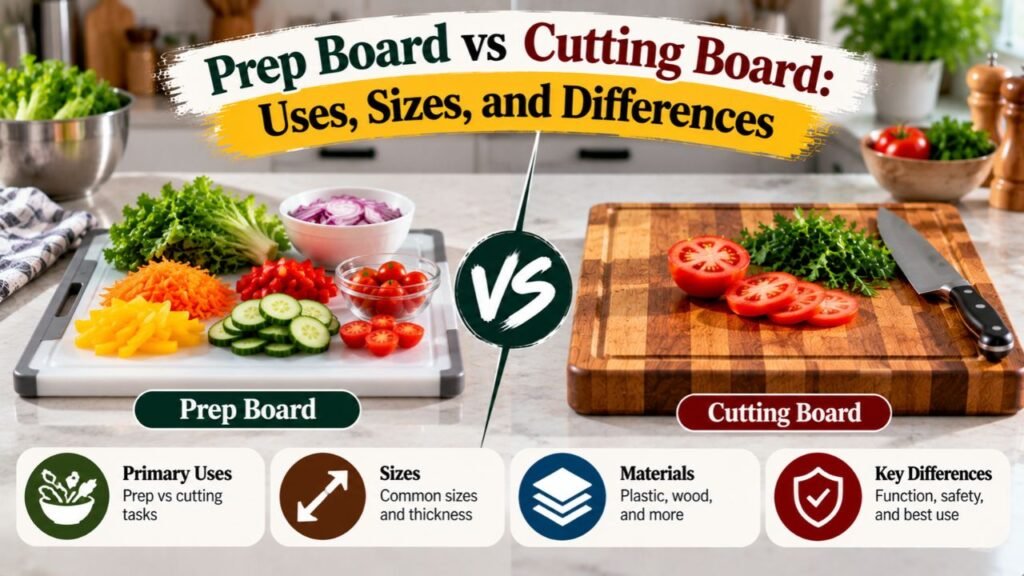
A prep board and a cutting board share the same basic purpose: providing a suitable surface for preparing food with a knife.
The main differences generally involve size, convenience, and the type of preparation tasks each product is marketed for.
| Feature | Prep Board | Cutting Board |
| Main purpose | Quick or organized ingredient preparation | General chopping, slicing, and cutting |
| Common size | Often small or compact | Small, medium, or large |
| Typical foods | Fruit, herbs, garlic, small vegetables, garnishes | Vegetables, fruit, meat, seafood, bread, and cheese |
| Cutting space | Often limited | Varies from compact to spacious |
| Thickness | Frequently thin or lightweight | Varies by design and material |
| Materials | Plastic, wood, bamboo, composite | Plastic, wood, bamboo, rubber, composite |
| Special features | Prep containers, pouring edges, compact design | Juice grooves, handles, non-slip feet |
| Knife use | Light to regular cutting, based on construction | Regular cutting, based on construction |
| Portability | Often easy to lift and move | Larger models may be heavy |
| Cleaning | Material-dependent | Material-dependent |
| Storage | Often fits small cabinets or drawers | Larger boards need more space |
| Best application | Small tasks or secondary preparation | Main food preparation surface |
These are common product differences, not strict rules.
A prep board can be large and designed for extensive meal preparation. A cutting board can also be small enough to handle only a lemon or a handful of herbs.
For home cooking, I would focus on the actual dimensions and features rather than treating the two names as separate equipment categories.
What Is a Prep Board and What Is a Cutting Board?
Both boards provide a surface for working with ingredients, but their names emphasize different aspects of food preparation.
What Is a Prep Board?
A prep board is a food preparation surface commonly used for quick slicing, trimming, chopping, and organizing ingredients before cooking.
Many prep boards are smaller versions of traditional cutting boards.
They are useful for preparing a few ingredients without bringing out a large butcher block or full-sized chopping board.
Common tasks include slicing strawberries, trimming green onions, cutting garlic, preparing sandwich ingredients, and chopping small amounts of herbs.
Some prep boards offer special features such as removable containers, integrated drip channels, or edges that direct chopped ingredients into bowls.
These designs support the preparation process beyond the cutting itself.
For example, a prep board with attached containers may let you transfer chopped onions and peppers directly into separate compartments.
Yet these additional features are optional. A plain rectangular board may also be marketed as a prep board.
What Is a Cutting Board?
A cutting board is a flat, durable food-contact surface intended for cutting, chopping, slicing, and preparing ingredients while protecting the countertop.
It is the general term for boards used with kitchen knives.
Cutting boards range from compact plastic models to thick wooden butcher blocks.
Some are intended for light slicing, while others provide a larger working area for chopping vegetables, carving cooked meat, or preparing several ingredients.
The surface should be stable, suitable for knife contact, and easy to clean according to its material.
A regular cutting board can perform nearly every task associated with a simple prep board.
Is a Prep Board Just a Small Cutting Board?
In many cases, yes.
Compact prep boards are commonly marketed for smaller kitchen tasks.
For example, some manufacturers offer prep boards measuring approximately 6 × 10 inches, while others sell larger versions measuring around 10 × 12 inches.
Those sizes are convenient for quick cutting tasks and limited counter space.
Still, the term prep board is not a standardized size classification.
Some products use the name for boards with built-in containers or workstation features, even when their cutting surfaces are fairly large.
A manufacturer’s product specifications provide a more reliable description than the name.
Key Takeaway: A prep board is usually a cutting board intended for quick or organized preparation. There is no universal construction or size standard separating the two.
Size and Thickness Differences Between Prep Boards and Cutting Boards
Board dimensions have a direct influence on cutting comfort, preparation space, and storage.
A surface that works well for slicing one apple may feel cramped when chopping ingredients for a family dinner.
Typical Prep Board Sizes
Compact prep boards commonly measure around 6–12 inches along their shorter or longer dimensions.
Smaller versions are suitable for tasks requiring little cutting space.
The following chart provides practical size examples rather than official industry standards.
| Board Dimensions | Typical Use |
| 6 × 10 inches | Garlic, lemons, cheese, small fruit |
| 8 × 10 inches | Herbs, garnishes, small vegetables |
| 10 × 12 inches | Onions, peppers, sandwich ingredients |
| 12 × 18 inches | General meal preparation |
| 15 × 20 inches | Larger batches and multiple ingredients |
A small prep board takes up less counter space and is generally easy to carry to the sink.
The disadvantage appears when ingredients begin piling up near the cutting area.
If chopped vegetables repeatedly fall onto the countertop, the board may be too small for the task.
Regular Cutting Board Sizes
Cutting boards are available in a broader selection of sizes.
A 12 × 18-inch cutting board provides a practical amount of space for many home cooking tasks.
A larger board around 15 × 20 inches offers more room for separating uncut ingredients from prepared pieces.
Larger dimensions also support longer cutting motions, especially when using a chef’s knife.
A spacious board is useful for chopping cabbage, cutting multiple vegetables, or slicing large pieces of cooked meat.
Yet bigger is not always better.
An oversized board may be difficult to wash in a small sink and inconvenient to store in an apartment kitchen.
Does Board Thickness Affect Cutting Performance?
Thickness can influence stability, weight, and resistance to movement.
Many compact plastic prep boards are relatively thin and lightweight.
Larger wooden cutting boards may be thicker and heavier, which can improve stability during repeated chopping.
But thickness alone does not determine quality.
A thin board with reliable non-slip feet may remain steadier than a heavy wooden board on a slippery countertop.
Likewise, a thick board with poor construction may warp or develop cracks.
For a compact prep board, I would prioritize a flat surface and non-slip support over unnecessary thickness.
For regular chopping, stability and enough usable cutting space deserve greater attention.
Key Takeaway: Small prep boards suit short cutting tasks, while larger cutting boards provide more room for repeated chopping. Choose dimensions that fit both the ingredients and your countertop.
Which Materials Are Best for Prep Boards and Cutting Boards?
Both product categories use many of the same materials.
Wood, plastic, bamboo, rubber, and composite boards are common choices.
Material selection affects cleaning, knife wear, weight, and maintenance more than the product’s name does.
Wooden Prep Boards and Cutting Boards
Wood is a popular material for both compact prep boards and larger cutting boards.
Common hardwood choices include maple, walnut, cherry, and acacia.
A wooden prep board offers a firm surface for slicing fruit, trimming vegetables, and preparing sandwiches.
Larger hardwood boards provide more room for general chopping.
Some cutting boards use edge-grain construction, where the long sides of wood strips form the working surface.
Others use end-grain construction, which exposes the ends of the wood fibers.
End-grain boards can provide a different cutting feel, but construction quality and wood species still matter.
Most wooden boards should be washed by hand unless their manufacturer permits dishwasher cleaning.
They also need prompt drying and, for many oil-finished models, occasional conditioning with food-grade mineral oil.
For frequent small tasks, a lightweight wooden prep board may be more convenient than lifting a heavy butcher block.
Plastic Prep Boards and Cutting Boards
Food-grade plastic is widely used for compact prep boards.
Its main advantages are low weight, relatively simple cleaning, and availability in dishwasher-safe designs.
A small plastic board works well for quick vegetable preparation or slicing fruit.
Plastic is also practical for boards dedicated to raw meat, poultry, or seafood because many models can be cleaned in the dishwasher.
Some plastic prep boards have non-slip feet, integrated pouring corners, and shallow channels for collecting liquid.
Repeated knife contact can produce scratches and grooves.
When these marks become deep enough to trap food residue and prevent thorough cleaning, the board should be replaced.
A manufacturer’s dishwasher instructions should always take priority over assumptions about the material.
Bamboo and Composite Prep Boards
Bamboo boards offer a firm cutting surface and are available in compact and full-sized designs.
They are commonly used for fruit, vegetables, bread, and everyday preparation.
Bamboo can be harder than many hardwoods, and some boards have a firm cutting feel.
Most bamboo boards require hand washing and careful drying, although manufacturer instructions vary.
Composite prep boards may use compressed wood fibers combined with resins or other manufactured materials.
Some composite boards are dishwasher-safe and require less conditioning than traditional wood.
Their weight, knife feel, and temperature resistance vary by product.
Check the material specifications before assuming every composite board performs the same way.
Rubber, Glass, and Metal Surfaces
Rubber cutting boards are used in some home and professional kitchens because certain formulations provide a resilient surface that is comfortable for repeated slicing.
They may be relatively heavy and often need hand washing.
Glass, stone, and metal boards can provide firm surfaces, but their hardness may cause faster knife-edge wear.
Glass can also be slippery and may break if dropped.
For a board used primarily with kitchen knives, I generally prefer suitable wood, plastic, rubber, or composite over glass or stone.
Key Takeaway: Prep boards and cutting boards use largely the same materials. Choose based on cleaning requirements, knife compatibility, weight, and construction rather than the product label.
Which Board Is Better for Different Food Preparation Tasks?
The most useful distinction appears during actual meal preparation.
Small tasks benefit from compact equipment, while larger cooking sessions generally need more room.
Quick Fruit, Vegetable, and Herb Preparation
A compact prep board is convenient when cutting a small amount of food.
For example, slicing a lemon for tea does not require a large wooden cutting board.
The same applies to chopping a few garlic cloves or preparing strawberries for breakfast.
A small board occupies less countertop space and usually takes less effort to carry, wash, and store.
It is also useful when preparing garnishes while another board holds the main ingredients.
My preference for these tasks is a compact board with enough room to keep the knife and food away from the edges.
Full Meal Preparation and Batch Cooking
A larger cutting board is generally more comfortable when preparing several ingredients.
Consider making vegetable soup with carrots, onions, celery, potatoes, and herbs.
On a small board, chopped vegetables quickly occupy the cutting area.
You may need to transfer each ingredient to a separate bowl before continuing.
A larger cutting board provides space to keep ingredients organized during preparation.
It also accommodates longer ingredients such as celery stalks, cucumbers, and large leafy vegetables.
For meal preparation involving several servings, I would choose a regular medium or large cutting board.
Raw Meat, Poultry, and Seafood Preparation
Both prep boards and cutting boards can be suitable for raw animal products when made from appropriate materials and maintained correctly.
The main concern is cross-contamination.
A small board may work for trimming one chicken breast, but it may be too cramped for cutting a whole chicken or handling a large piece of meat.
A larger board provides room for the food and knife while limiting the chance of ingredients hanging over the edges.
The USDA recommends using separate cutting boards for raw meat, poultry, and seafood and for fresh produce and bread.
A dishwasher-safe plastic board dedicated to raw animal products is a practical household option.
Sandwiches, Snacks, and Small Portions
A prep board works well for quick snacks and single-serving meals.
Slicing a tomato, cutting cheese, or preparing a small sandwich does not require much working space.
A compact board may also fit into a small drawer or narrow cabinet.
A regular cutting board performs these tasks equally well, but a smaller board can be more convenient to handle.
Key Takeaway: Use a compact prep board for small quantities and a larger cutting board for meals involving several ingredients, larger foods, or repeated chopping.
Special Features That Make Prep Boards Different
Some prep boards are marketed around their preparation features rather than their size.
These designs can reduce ingredient handling and make a crowded countertop more organized.
Prep Boards With Built-In Containers
Some preparation boards have removable containers attached along the sides.
The containers can collect chopped vegetables, food scraps, or ingredients that need to stay separate.
For example, while preparing a stir-fry, you could transfer chopped bell peppers into one container and sliced onions into another.
This keeps the cutting surface open for the next ingredient.
These systems may include removable racks, lids, and containers intended for short-term ingredient storage.
Check the product instructions for food-contact suitability, cleaning, and any refrigeration limitations.
The main drawback is that multiple components require cleaning and storage.
For someone who regularly prepares several vegetables, the organization may justify the extra parts.
Over-the-Sink Prep Boards
An over-the-sink prep board is designed to rest securely across or within a compatible sink or workstation ledge.
This arrangement can provide additional preparation space in a small kitchen.
Some designs sit over a sink accessory rail, while others extend across the sink edges.
They may be paired with colanders or containers for rinsing and collecting ingredients.
Stability is the main concern.
A board should fit its support system securely and should not slide, tip, or flex excessively during cutting.
I would avoid using an unstable over-the-sink board for forceful chopping.
Pouring Corners, Drip Channels, and Non-Slip Feet
Compact prep boards may include small features that improve everyday handling.
Pouring corners guide chopped ingredients or liquid toward a container.
Drip channels collect limited amounts of juice from fruit and vegetables.
Non-slip feet reduce movement on smooth countertops.
A juice groove may be useful for tomatoes or citrus fruit, although it also reduces the flat cutting area.
These features are not exclusive to prep boards.
Many regular cutting boards include similar designs, so they should be evaluated as product features rather than defining differences.
Key Takeaway: A prep board with containers, pouring edges, or sink compatibility may provide more organization than a plain cutting board. Those features matter most when they solve a real preparation problem.
Food Safety: Is a Prep Board Safer Than a Cutting Board?
A prep board is not inherently safer than a regular cutting board.
Both can become contaminated through raw food juices, dirty utensils, unwashed hands, or inadequate cleaning.
Food safety depends on material suitability, separation of ingredients, surface condition, and washing practices.
Separate Raw Foods From Ready-to-Eat Ingredients
The FDA recommends using one cutting board for fresh produce and another for raw meat, poultry, and seafood.
This applies equally to compact prep boards.
For example, a board used to trim raw chicken should not immediately be used to slice tomatoes for a salad.
The board must first be properly washed and sanitized as appropriate.
Having two separate boards provides a simple way to reduce accidental cross-contamination.
A small board for fruit and vegetables and a larger board for raw animal products can work, provided both are large enough for their assigned tasks.
Cleaning Prep Boards and Cutting Boards Properly
The USDA recommends washing cutting boards with hot, soapy water after each use.
A basic cleaning process includes:
- Remove food scraps from the surface.
- Wash the board thoroughly with hot, soapy water.
- Scrub corners, grooves, and other areas where food residue may collect.
- Rinse with clean water.
- Air-dry or pat dry with clean paper towels.
For additional sanitizing, USDA guidance describes a mixture of 1 tablespoon of unscented liquid chlorine bleach per gallon of water.
Apply the solution to a previously washed board, allow it to remain for several minutes, rinse with clean water, and dry.
Follow the bleach label and the board manufacturer’s instructions. Never mix bleach with ammonia, vinegar, or other cleaning products.
Can You Use Both Sides of a Prep Board?
Many compact prep boards are reversible, but using opposite sides does not automatically prevent contamination.
Food juices may reach the board’s edges or transfer to the reverse side.
A reversible design can provide additional working space when both sides remain clean.
Still, flipping an unwashed board after raw poultry preparation is not a reliable substitute for cleaning.
For household use, dedicated boards for raw animal foods and ready-to-eat ingredients provide a clearer separation.
When Should You Replace Either Board?
Both compact prep boards and full-sized cutting boards gradually wear down.
Knife marks are normal, but deep scratches can trap food residue and complicate cleaning.
The USDA recommends replacing boards that become excessively worn or develop hard-to-clean grooves.
Other warning signs include cracks, splintering, separated wooden joints, and significant warping.
A damaged prep board should not be kept indefinitely simply because it is used for small tasks.
Key Takeaway: Neither board has an automatic food safety advantage. Proper separation, washing, sanitizing, drying, and timely replacement are more important than board size or name.
Storage, Portability, and Everyday Convenience
Compact prep boards often have an advantage in kitchens with limited counter and cabinet space.
Their lighter weight makes them convenient to carry from the countertop to the sink.
Many small plastic or composite boards fit inside drawers or stand upright in narrow storage racks.
Full-sized wooden cutting boards may require more space and can be heavier to move.
Yet a large board may remain on the countertop throughout meal preparation, reducing the number of times ingredients must be transferred.
The trade-off is straightforward.
A compact board is convenient for short tasks and quick washing. A larger board offers more cutting space before the surface becomes crowded.
Storage should also allow boards to dry completely after washing.
Avoid stacking damp wooden boards tightly together or placing wet surfaces against cabinets.
For an apartment kitchen, I would generally prioritize a medium cutting board and one smaller prep board rather than several oversized boards.
Prep Board vs Cutting Board: Which Should You Buy?
The best purchase is the board that accommodates the amount of food you normally prepare.
There is little reason to buy specialized preparation equipment when a regular cutting board already handles your cooking routine.
Choose a Prep Board for Small, Frequent Tasks
A compact prep board makes sense when you frequently prepare small amounts of fruit, vegetables, herbs, or cheese.
It is also useful for small kitchens, quick breakfasts, and single-serving meals.
Look for a flat, stable surface that is easy to wash.
A model measuring around 8 × 10 or 10 × 12 inches may provide enough space for these tasks.
If you regularly transfer ingredients into containers, a prep board with pouring edges or removable bowls may be convenient.
Choose a Regular Cutting Board for Everyday Meals
A medium or large cutting board is the stronger choice when you prepare full meals, chop larger vegetables, or handle several ingredients.
A board around 12 × 18 inches provides a practical starting point for many home kitchens.
Choose a material suited to your cleaning routine.
A well-made hardwood board works well for general vegetable preparation, while a suitable plastic board is convenient for raw meat and poultry.
Prioritize stability, a clear cutting area, and enough space for the knife to move comfortably.
Choose Both for Greater Flexibility
Owning a compact prep board and a regular cutting board can be useful when both have distinct jobs.
For example, use a medium wooden board for vegetables and everyday cooking, then keep a smaller plastic board for quick snacks or other separately assigned preparation tasks.
If raw animal foods are prepared regularly, maintain a clearly dedicated board for those ingredients.
The purpose of owning multiple boards is not simply convenience. It also provides a clearer system for separating food groups.
Key Takeaway: Choose a prep board for compact tasks, a regular cutting board for larger meals, or both when quick preparation and food separation justify the extra equipment.
Common Mistakes When Choosing a Prep Board or Cutting Board
Some purchasing mistakes become apparent only after the board is used during a full cooking session.
Choosing a board that is too small: A tiny prep board may be convenient for fruit but uncomfortable for chopping a full onion, several carrots, and celery.
Assuming every prep board includes containers: Many prep boards are ordinary compact cutting boards without additional accessories.
Ignoring non-slip support: A lightweight board that slides across the countertop can interfere with controlled knife movement.
Buying a large board that does not fit the sink: A thick wooden cutting board may offer ample chopping space but become inconvenient to wash.
Using decorative surfaces for heavy cutting: Some serving-style boards have coatings or materials unsuitable for repeated knife contact.
Using one unwashed surface for different food groups: Switching from raw chicken to ready-to-eat vegetables requires proper cleaning, not just wiping away visible residue.
Overlooking maintenance: Wooden boards generally need careful drying and occasional conditioning, while scratched plastic boards may need replacement.
The most useful buying check is simple: measure the available workspace, consider the largest ingredients you regularly prepare, and choose a board that can be cleaned without difficulty.
Conclusion
The prep board vs cutting board comparison is primarily about intended use, size, and convenience rather than two fundamentally different kitchen tools. A prep board is often a compact cutting surface for quick ingredient preparation, while a regular cutting board may provide more space for everyday cooking.
Small prep boards work well for herbs, fruit, snacks, and simple preparation tasks. Larger cutting boards are more comfortable for chopping multiple ingredients, handling bigger foods, and preparing full meals. Material quality, non-slip support, and cleaning requirements matter for both.
My recommendation is to start with a stable, medium-sized cutting board if you need one main kitchen surface. Add a compact prep board when you want a convenient second surface for quick tasks or separate food preparation.
Choose by actual dimensions and features rather than product naming. A suitable board should provide comfortable knife movement, fit the countertop, and remain easy to clean after every use.
FAQs About Prep Boards and Cutting Boards
Is a Prep Board the Same as a Cutting Board?
Yes, a prep board is generally a type of cutting board used for preparing ingredients.
The name often refers to a compact surface intended for quick tasks such as slicing fruit, chopping garlic, or trimming vegetables.
Some manufacturers also use the term for cutting boards with integrated containers or workstation features. There is no universal technical distinction between the two names.
What Is a Prep Board Used For in the Kitchen?
A prep board is used for slicing, chopping, trimming, and organizing ingredients before cooking.
Common tasks include cutting fruit, preparing herbs, slicing cheese, chopping garlic, and assembling sandwich ingredients.
Some prep boards include containers that collect prepared ingredients. Others are simple compact cutting surfaces without additional features.
Can You Use a Prep Board for Cutting Meat?
Yes. A prep board can be used for raw meat if its material is suitable for food preparation and the surface is large enough to handle the task safely.
Use a dedicated board for raw meat, poultry, and seafood whenever possible.
Wash and sanitize the board as appropriate after preparation, and keep it separate from boards used for ready-to-eat foods.
What Size Prep Board Is Best for Everyday Use?
A prep board around 10 × 12 inches is a practical option for many small cutting tasks.
It offers space for slicing fruit, chopping herbs, or preparing one or two vegetables without occupying much countertop area.
For larger meals, a 12 × 18-inch cutting board may be more comfortable. The best dimensions should also fit your sink and storage area.
Do Professional Chefs Use Prep Boards?
Professional cooks use cutting boards for ingredient preparation, including compact boards and larger work surfaces.
The term prep board may describe a smaller board or a board positioned at a particular food preparation station.
Commercial kitchens may also use color-coded boards to separate food groups and reduce cross-contamination.
The equipment choice usually reflects the preparation task, workspace, and cleaning requirements rather than the product name.
Are Wooden Prep Boards Better Than Plastic Ones?
Wooden prep boards offer a firm cutting surface and an attractive appearance. Many suitable hardwoods are comfortable for regular knife work.
Plastic boards are often lighter, less expensive, and available in dishwasher-safe designs.
Wood generally requires more careful drying and may need occasional oiling. Plastic can develop deep knife grooves that eventually require replacement.
Both materials can be suitable when properly maintained.
Can a Prep Board Replace a Full-Sized Cutting Board?
Yes, if your food preparation tasks fit comfortably on its surface.
A compact prep board may be sufficient for slicing fruit, preparing sandwiches, and chopping small amounts of vegetables.
It becomes less convenient when cutting large ingredients or preparing several foods at once.
For frequent full-meal preparation, a medium or large cutting board usually provides more comfortable working space.
Should I Buy a Prep Board With Containers?
A prep board with containers may be useful when you regularly chop several ingredients and want to keep them separated during preparation.
The containers can collect chopped vegetables or food scraps without occupying additional cutting space.
Before purchasing, check the stability of the board, the capacity of the containers, how the components are attached, and their cleaning instructions.
A plain cutting board with separate bowls can perform the same basic tasks without specialized accessories.