Titanium vs Bamboo Cutting Board: Which Is Better?
For most home kitchens, a bamboo cutting board is a better everyday choice than a titanium board. Bamboo offers a more comfortable chopping surface, is generally gentler on knife edges, and costs less. Titanium resists moisture, stains, and odors and needs less maintenance, but its rigid metal surface can dull kitchen knives faster.
Choosing the wrong cutting surface can mean more frequent knife sharpening, uncomfortable food preparation, or a board that needs replacing earlier than expected. Titanium and bamboo have different strengths, so treating them as interchangeable can lead to disappointment.
A well-matched cutting board makes slicing vegetables, preparing meat, and cleaning up afterward more manageable. The goal is to balance knife protection, food hygiene, durability, and maintenance rather than choosing a material based only on its appearance.
The U.S. Department of Agriculture recommends cleaning cutting boards after use and gives a specific sanitizing solution of 1 tablespoon of unscented liquid chlorine bleach per gallon of water. Its food safety guidance also recommends separate cutting boards for raw animal products and ready-to-eat foods. These recommendations show why cleaning practices matter as much as board material.
During my research into the titanium vs bamboo cutting board comparison, one point stood out: titanium’s resistance to moisture does not automatically make it a better cutting surface. Independent knife-sharpness comparisons have found substantial blade wear on metal boards, while bamboo presents a less rigid surface.
Another detail deserves attention. Products advertised as titanium cutting boards do not always have identical construction. Some use solid titanium, while others combine a metal surface with different backing materials. The actual construction can change cleaning requirements, durability, and overall quality.
The differences in knife performance, food safety, cutting comfort, cleaning, lifespan, and cost explain which material makes more sense for everyday chopping and which is better suited to occasional food preparation.
Titanium vs Bamboo Cutting Board: Quick Comparison
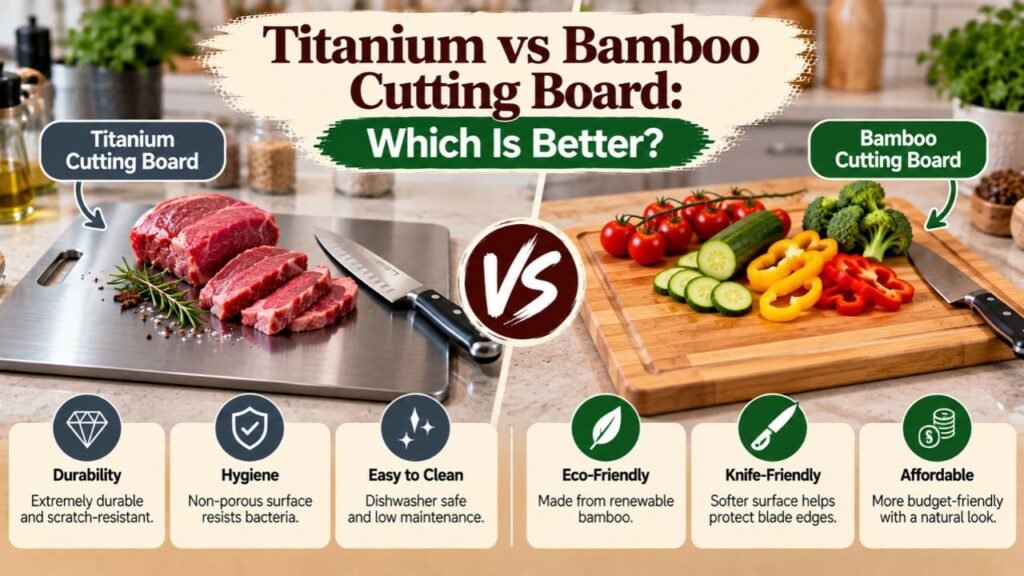
Titanium and bamboo boards serve the same basic purpose, but their construction creates different results during cutting and cleaning.
| Feature | Titanium Cutting Board | Bamboo Cutting Board |
| Material | Titanium metal or titanium-faced construction | Compressed or laminated bamboo |
| Knife friendliness | Hard on knife edges | Gentler than metal, but harder than some woods |
| Surface | Nonporous metal | Dense natural fibers |
| Water resistance | Excellent for genuine titanium | Good, but prolonged moisture can cause damage |
| Food hygiene | Easy to wash and sanitize | Safe with proper cleaning and drying |
| Durability | Resists splitting and moisture damage | Can crack, warp, or separate at joints |
| Maintenance | No oiling required | Occasional conditioning recommended |
| Dishwasher use | Model-dependent | Generally hand-wash only |
| Cutting noise | Louder metallic contact | Quieter chopping |
| Stability | Thin boards may slide without grips | Often stable when adequately sized |
| Price | Commonly more expensive | Usually more affordable |
| Best use | Occasional wet or messy preparation | Everyday vegetables, fruits, and general chopping |
The main difference is how each board handles repeated knife contact. Titanium prioritizes moisture resistance and low maintenance, while bamboo offers a more forgiving cutting experience.
For most households preparing several meals each day, bamboo offers a more practical balance. Titanium becomes more appealing when easy cleanup and resistance to moisture are the main priorities.
What Are Titanium and Bamboo Cutting Boards Made Of?
Understanding the construction of each cutting board explains many of its advantages and limitations.
What Is a Titanium Cutting Board?
A titanium cutting board is a food preparation surface made from titanium metal or a product containing a titanium cutting face.
Titanium is known for its strength, corrosion resistance, and relatively low density compared with many other metals. It forms a thin protective oxide layer that contributes to its resistance to corrosion during ordinary kitchen use.
A genuine titanium surface does not absorb water, meat juices, or food odors into its structure. This makes washing and drying more straightforward than with many plant-based materials.
Still, products sold as titanium boards can vary in composition.
Some are marketed as pure titanium, while others may use metal layers, composite construction, or backing materials. A board advertised with a titanium finish should not automatically be treated as solid titanium.
I recommend checking the manufacturer’s material specifications before buying, especially when the product description makes claims about purity, food-contact safety, or dishwasher compatibility.
What Is a Bamboo Cutting Board?
A bamboo cutting board is a food preparation board made from processed bamboo strips or fibers joined into a solid surface.
Bamboo is technically a grass rather than a tree. Its dense fiber structure makes it suitable for products that need strength and resistance to everyday wear.
Most bamboo cutting boards are manufactured using strips bonded together with adhesives. The strips are pressed, shaped, sanded, and finished to create a smooth cutting surface.
Bamboo has natural moisture resistance, but it is not waterproof. Repeated soaking or extended exposure to standing water can damage the board or weaken bonded joints.
The USDA describes bamboo boards as harder and less porous than many hardwood boards. That density helps them resist knife marks, although it also means they are less forgiving on blades than some softer cutting surfaces.
For food preparation, look for a board specifically manufactured for food contact, with clearly identified materials and finishes.
Key Takeaway: Titanium uses a nonporous metal surface, while bamboo relies on dense natural fibers and, commonly, bonded strips. Construction quality matters for both materials.
Which Cutting Board Is Better for Your Knives?
Bamboo is generally better for preserving knife sharpness than titanium, although neither material is as forgiving as a good end-grain hardwood or suitable rubber board.
The difference becomes more noticeable during repeated chopping, rocking cuts, and extended meal preparation.
How Titanium Affects Knife Sharpness
A titanium cutting board creates direct contact between a steel knife edge and a rigid metal surface.
When a knife reaches the board, some cutting force is transferred back toward the blade. A less forgiving surface can increase wear at the thin edge of the knife.
Over time, this contact may cause edge deformation, microscopic damage, and reduced sharpness.
Titanium is not necessarily harder than the steel used in every kitchen knife. Blade wear depends on several properties, including the material’s rigidity, surface finish, contact pressure, and knife geometry.
Independent cutting-board tests published in 2026 found substantially greater knife-edge deterioration on titanium than on bamboo during repeated cutting.
That does not mean every titanium board will dull every knife at the same rate. Knife steel, sharpening angle, surface texture, and cutting technique all influence the result.
Still, I would avoid using a titanium surface for repeated heavy chopping with expensive chef’s knives.
How Bamboo Affects Knife Sharpness
Bamboo provides more give under a knife than a solid metal cutting surface.
Its natural fibers absorb some cutting force, making everyday chopping less harsh on the knife edge.
That does not make bamboo the softest cutting-board material.
Bamboo is relatively hard and contains silica, a naturally occurring mineral compound. Its density and mineral content can contribute to knife wear, especially during frequent use.
Some laminated bamboo boards may also feel harder because of their manufacturing process and surface finish.
Compared with titanium, bamboo is usually a better surface for regular chopping. Compared with softer hardwoods or rubber, it may still require more attention to knife sharpness.
Which Material Is Better for Expensive Kitchen Knives?
For premium chef’s knives, especially thin Japanese-style blades, I would favor a cutting surface with more cushioning than either titanium or very hard bamboo.
Materials worth considering include:
- End-grain maple: Provides a forgiving surface for repeated chopping.
- End-grain walnut: Offers a softer cutting feel than many dense bamboo boards.
- Quality rubber: Provides grip and supports knife-edge preservation.
Bamboo remains a reasonable choice for ordinary household knives. Titanium is less suitable for frequent cutting with sharp, thin edges.
Key Takeaway: Bamboo is the better choice for knife protection in this comparison. Titanium’s rigid metal surface can increase blade wear during repeated chopping.
Titanium vs Bamboo Cutting Board: Food Safety and Hygiene
Both materials can be used safely for food preparation when properly manufactured, cleaned, and maintained.
Titanium has an advantage in surface cleanability, but bamboo is not automatically unsanitary because it contains natural fibers.
Is Titanium More Hygienic Than Bamboo?
Titanium has a nonporous cutting surface, meaning liquids do not penetrate the metal itself.
Food juices, oils, and other residues remain on the surface, where they can be removed through washing.
That can be convenient when preparing ingredients such as raw fish, meat, or strongly scented foods.
Bamboo is less porous than many hardwoods, but its surface and bonded joints may still be affected by moisture and repeated cutting.
A damaged bamboo board can develop cracks or separations where food residue becomes difficult to remove.
Even so, a properly cleaned bamboo board is suitable for normal food preparation.
The main hygiene advantage of titanium is its resistance to moisture absorption, not an ability to eliminate bacteria automatically.
Are Titanium Cutting Boards Naturally Antibacterial?
Titanium should not be considered self-sanitizing.
Some products advertise antibacterial properties, but nonporous does not mean bacteria-free.
Bacteria can remain on the surface of titanium after contact with raw food, just as they can remain on other kitchen materials.
Titanium dioxide is associated with antimicrobial activity under certain engineered and light-activated conditions. Those findings do not establish that an ordinary titanium cutting board kills bacteria during kitchen use.
Likewise, claims that bamboo naturally kills harmful bacteria should not replace proper cleaning.
For either board, product-specific antibacterial claims should be supported by relevant testing rather than marketing language alone.
Which Board Is Safer for Raw Meat and Chicken?
Both titanium and bamboo can be used for cutting raw meat, poultry, and seafood when handled correctly.
The USDA permits properly maintained wooden and nonporous cutting surfaces for raw animal products.
Its main recommendation is to separate raw meat preparation from ready-to-eat foods.
For example, raw chicken should be cut on a different board from the one used for washed lettuce, sliced tomatoes, or bread.
Titanium has a practical advantage because its metal surface does not absorb meat juices and can be washed without concerns about water entering wood fibers.
Bamboo can also be cleaned and sanitized, but it needs careful drying afterward.
For households that prepare raw poultry frequently, a dedicated dishwasher-safe plastic board is another practical option.
Key Takeaway: Titanium is easier to clean after wet food preparation, but both boards can be food-safe. Washing, sanitizing when needed, and preventing cross-contamination matter more than antimicrobial advertising.
Cutting Comfort, Stability, and Everyday Kitchen Performance
A cutting board needs to provide a steady working surface as well as resist damage.
The difference between metal and bamboo becomes noticeable during repetitive knife movements.
Cutting Feel and Noise
Titanium produces a firm, metallic contact when the blade reaches the board.
Repeated chopping may create a clanking or scraping sound. Some cooks also find the impact uncomfortable during long preparation sessions.
Bamboo absorbs more of that impact.
It provides a familiar chopping feel and generally produces less noise during slicing and rocking cuts.
For tasks such as chopping onions, mincing herbs, or cutting carrots, I prefer the less rigid surface of bamboo based on the cutting characteristics reported in independent comparisons.
Grip and Sliding Resistance
Stability deserves special attention with titanium cutting boards.
Many metal boards are made with thin profiles and smooth undersides. On polished countertops, a lightweight board without rubber feet may move during cutting.
Wet ingredients may also slide more readily across a smooth metal face.
Bamboo boards often have more thickness and weight, which can contribute to stability. Their grip still varies with size, finish, and underside design.
Safety Tip: Place a clean, damp towel or non-slip cutting-board mat underneath any board that moves during use. Stop cutting if the board shifts or rocks.
Choose a board large enough to hold the ingredients without crowding the cutting area.
Best Foods to Prepare on Each Material
The more suitable surface changes with the cutting task.
| Food Preparation Task | Better Choice | Main Reason |
| Chopping onions and carrots | Bamboo | More comfortable repeated cuts |
| Mincing herbs | Bamboo | Better feel during rocking movements |
| Slicing bread | Bamboo | Stable, familiar cutting surface |
| Preparing raw fish | Titanium for cleanup | Nonporous, moisture-resistant surface |
| Cutting raw chicken | Either, with separation | Cleaning practices matter most |
| Slicing juicy fruit | Titanium for cleanup | Resists absorbed stains and moisture |
| Preparing cheese | Bamboo | Comfortable slicing and serving |
| Heavy daily chopping | Bamboo | Less harsh on knife edges |
Titanium’s cleaning advantages are most relevant to wet or messy tasks. Bamboo remains more comfortable for repeated cutting.
Key Takeaway: Bamboo provides a quieter, more forgiving experience during daily meal preparation. Titanium can be convenient for wet ingredients, provided the board is stable and the knife-wear trade-off is acceptable.
Durability: Which Cutting Board Lasts Longer?
A well-made titanium board generally has greater resistance to moisture-related damage than bamboo.
That does not mean titanium is completely damage-proof or that bamboo has a short service life.
Titanium Durability and Surface Wear
Genuine titanium has strong resistance to corrosion during normal kitchen use.
It does not swell or split like plant-based materials when exposed to water.
This makes titanium attractive for kitchens where boards are washed frequently.
Still, knives can leave visible scratches on titanium. Thin metal sheets may also bend or develop permanent distortion if subjected to excessive force.
Surface coatings, attached handles, and non-slip backing materials can wear independently of the metal.
A solid metal board and a bonded, multi-material board should not be expected to age in exactly the same way.
Bamboo Durability and Cracking Risks
Bamboo boards resist everyday cutting marks reasonably well because of their dense structure.
Their main weakness is exposure to excessive moisture and uneven drying.
A bamboo board may develop problems such as:
- Small surface cracks
- Warping or rocking
- Separation along bonded joints
- Raised fibers or rough patches
- Persistent moisture damage
These problems become more likely when a board is soaked, placed in a dishwasher against manufacturer instructions, or stored while damp.
Proper washing, complete drying, and occasional conditioning can extend its usable life.
When Should Either Board Be Replaced?
Neither board has a fixed replacement schedule.
A bamboo board should be replaced when it has deep cracks, separating joints, persistent mold, or grooves that cannot be cleaned thoroughly.
A titanium board should be removed from food preparation if it develops sharp burrs, peeling food-contact layers, damaged coatings, or joints that trap debris.
Minor cosmetic scratches alone do not necessarily mean a titanium board must be discarded.
Key Takeaway: Titanium resists moisture damage better, but bamboo can last for years with suitable care. Replace either board when physical damage prevents safe cutting or thorough cleaning.
How to Clean and Maintain Titanium and Bamboo Cutting Boards
Both cutting boards need cleaning after food preparation, but bamboo requires more attention to moisture and conditioning.
Use ordinary dish soap, clean water, a nonabrasive sponge, and a clean drying towel for routine care.
How to Clean a Titanium Cutting Board
Titanium requires no wood oil or wax.
For normal daily cleaning:
- Remove food scraps and rinse loose residue from the cutting surface.
- Wash both sides using warm or hot, soapy water and a soft sponge.
- Clean around handles, edges, and attached non-slip parts.
- Rinse thoroughly to remove soap and food particles.
- Dry with a clean towel or allow the board to air-dry fully.
Avoid harsh scouring tools that could scratch decorative finishes or damage coatings.
Some titanium boards are dishwasher-safe, but this should be confirmed through the product’s care instructions.
A board with adhesive layers, coatings, or special backing may require hand-washing even when its metal surface tolerates high moisture.
How to Clean and Oil a Bamboo Cutting Board
Bamboo should generally be washed by hand.
Follow these steps:
- Remove leftover food and wash the board with warm, soapy water.
- Use a soft brush or sponge to clean knife marks and surface residue.
- Rinse briefly without leaving the board submerged.
- Dry both sides with a clean towel.
- Stand the board upright or place it on a drying rack until fully dry.
- Apply food-grade mineral oil when the board begins looking dry, following the manufacturer’s instructions.
Allow conditioning oil to absorb, then wipe away any excess before returning the board to service.
Avoid ordinary vegetable oils that may become sticky or develop unpleasant odors over time.
The board does not need oil after every use. Apply it according to its condition and the manufacturer’s recommendations.
How to Sanitize After Preparing Raw Foods
Cleaning removes food residue, while sanitizing reduces microorganisms remaining on the surface.
The USDA recommends a solution containing 1 tablespoon of unscented liquid chlorine bleach in 1 gallon of water for sanitizing suitable cutting boards.
After washing, apply the solution, allow it to remain for several minutes, then rinse with clean water and dry thoroughly.
For bamboo, avoid soaking and follow the manufacturer’s care instructions. For titanium, verify that the sanitizer is compatible with every food-contact material and finish.
A commercial food-contact sanitizer may also be used according to its label directions.
Never mix bleach with vinegar, ammonia, or other cleaning chemicals.
Key Takeaway: Titanium needs routine washing without oiling. Bamboo needs hand-washing, thorough drying, and occasional conditioning. Both require prompt cleaning after contact with raw animal foods.
Price, Environmental Impact, and Long-Term Value
Purchase price is not the only expense involved in choosing a cutting board.
Knife maintenance, replacement frequency, and product construction also influence long-term value.
Which Cutting Board Is More Affordable?
Bamboo cutting boards are generally less expensive than genuine titanium boards of similar usable size.
Bamboo is widely available, can be manufactured in many shapes, and is commonly sold in sets.
Titanium products may carry higher prices because of raw materials, fabrication requirements, and specialty positioning.
Prices vary substantially across brands and construction types.
A low-priced board advertised as titanium deserves closer inspection. Check the material description to confirm what portion of the product is actually titanium.
My recommendation is to compare the usable cutting area, construction, stability, and warranty rather than judging value by material name alone.
Is Bamboo More Environmentally Friendly Than Titanium?
Bamboo grows relatively quickly and can be harvested without replanting the entire root system in many production settings.
This gives bamboo a renewable-material advantage.
Still, the environmental impact of a finished board also includes adhesive production, finishing chemicals, factory energy, transportation, and product lifespan.
Titanium requires mineral extraction and energy-intensive processing. It is also recyclable, and a durable titanium product may remain usable for a long period.
Neither material is automatically the greener option in every situation.
A trustworthy comparison would require product-specific manufacturing and lifecycle information.
For bamboo, responsible sourcing and long service life are sensible priorities.
Does Titanium Save Money Over Time?
Titanium’s durability may reduce replacement needs, but it can increase knife maintenance.
If repeated use dulls blades faster, sharpening becomes another cost.
Bamboo needs occasional conditioning and may eventually require replacement because of cracks or surface wear.
For most home cooks, a reasonably priced bamboo board offers good everyday value without the high initial cost of titanium.
Key Takeaway: Bamboo usually wins on purchase price and everyday value. Titanium may last longer under frequent moisture exposure, but knife wear and manufacturing quality affect its true long-term cost.
Titanium vs Bamboo Cutting Board: Which Should You Choose?
The better choice becomes clearer when each material is matched to its most suitable role.
Choose Titanium If You Prioritize Easy Cleaning
A titanium cutting board may be suitable if you want:
- A nonporous food-contact surface
- Strong resistance to water and odors
- No routine conditioning
- A thin board for storage
- An occasional cutting surface for wet or messy foods
Before buying, verify the metal composition and cleaning instructions.
I would also check for rounded edges, a stable base, and a suitable thickness. A thin metal sheet that slides during cutting is less practical than a solid board with good grip.
Choose Bamboo for Regular Meal Preparation
Bamboo is usually the more sensible option if you:
- Chop vegetables frequently
- Want to reduce knife-edge wear compared with metal
- Prefer quieter cutting
- Have a limited budget
- Like a natural-looking board
- Are comfortable with hand-washing and occasional oiling
Choose a board with smooth edges, tightly bonded strips, a flat underside, and a food-safe finish.
Avoid products showing cracks, rough joints, or questionable construction quality.
Consider a Different Material for Frequent Heavy Chopping
Neither titanium nor bamboo is the gentlest material available for kitchen knives.
For daily use with high-quality chef’s knives, end-grain maple, walnut, or suitable rubber may be more appealing.
These materials provide a more forgiving contact surface than titanium and are often preferable to very hard bamboo.
A practical kitchen setup can also use separate boards for different jobs, such as a natural-material board for vegetables and a dishwasher-safe plastic board for raw poultry.
Key Takeaway: Choose bamboo for general chopping and affordability. Choose titanium mainly for its cleaning and moisture-resistance advantages, while accepting its limitations for knife performance.
Common Mistakes to Avoid With Both Materials
Some cutting-board problems are caused by incorrect use rather than poor materials.
Assuming titanium cannot scratch: Genuine titanium is durable, but knives can still mark its surface. Scratches do not automatically indicate that the product is defective.
Putting bamboo in the dishwasher: Heat, water exposure, and long washing cycles may damage bonded bamboo construction.
Trusting antibacterial marketing: Neither surface should be considered safe without cleaning after food preparation.
Ignoring knife sharpness: Repeated cutting on hard surfaces may increase sharpening needs. A knife that starts crushing tomatoes or slipping against food may need attention.
Using one unwashed board for every ingredient: Cutting raw poultry and then preparing salad ingredients on the same unwashed surface creates a cross-contamination risk.
Buying titanium without checking construction: A product labeled titanium may include other metals, coatings, or backing materials. Read the full specifications before purchase.
Avoiding these mistakes matters more than choosing the most expensive board available.
Conclusion
For everyday home cooking, the titanium vs bamboo cutting board comparison favors bamboo. It offers a more comfortable cutting experience, generally puts less stress on knife edges, and remains affordable for most households. Titanium stands out for moisture resistance, simple cleaning, and durability against water-related damage.
The main trade-off is between knife performance and maintenance. Titanium is easier to wash and needs no conditioning, while bamboo requires careful drying and occasional oiling. Both need proper cleaning and separate handling of raw and ready-to-eat foods.
I recommend bamboo for a primary cutting board if these are the only two options being considered. Titanium may serve a narrower purpose for occasional wet food preparation, but I would not choose it as the main surface for frequent chopping with expensive knives.
FAQs About Titanium and Bamboo Cutting Boards
Does Titanium Dull Knives Faster Than Bamboo?
Yes, titanium cutting boards generally cause faster knife-edge wear than bamboo boards during repeated cutting.
The rigid metal surface provides little cushioning when a knife makes contact. Bamboo has a more forgiving fiber structure, although it is still harder than many traditional wood cutting surfaces.
The amount of wear depends on the knife’s steel, edge angle, cutting pressure, and board finish. For regular chopping, bamboo is usually the better of the two for preserving sharpness.
Are Titanium Cutting Boards Safer Than Bamboo?
Both materials can be safe for preparing food when properly manufactured and cleaned.
Titanium has a nonporous surface that resists moisture absorption. Bamboo is dense and relatively moisture-resistant but can develop cracks if poorly maintained.
Titanium does not automatically kill bacteria, and bamboo is not automatically unsafe because it contains natural fibers. Proper washing, drying, sanitizing when needed, and separating raw foods remain the main safety considerations.
Can You Cut Raw Chicken on a Bamboo Cutting Board?
Yes, raw chicken can be prepared on a bamboo cutting board that is in good condition and cleaned properly afterward.
Use a separate board for ready-to-eat foods to reduce cross-contamination.
Wash the bamboo thoroughly with hot, soapy water, sanitize using a suitable method, rinse as directed, and dry completely.
Replace bamboo boards that develop deep cracks or separating joints where raw poultry juices may become trapped.
Are Titanium Cutting Boards Dishwasher-Safe?
Some titanium cutting boards are dishwasher-safe, but compatibility depends on the construction.
A solid titanium surface generally tolerates water well. Products containing bonded layers, coatings, adhesives, handles, or rubber components may have different cleaning limitations.
Check the manufacturer’s instructions before placing a board in the dishwasher.
Hand-washing with dish soap and water is a suitable routine cleaning method for most titanium boards.
Are Bamboo Cutting Boards Better Than Wood?
Bamboo is not necessarily better than hardwood.
Bamboo is dense, relatively affordable, and resistant to moisture absorption. It is also harder than many common wooden cutting surfaces.
Maple and walnut, especially in end-grain construction, often provide a more forgiving surface for kitchen knives.
Bamboo may be preferable for budget and appearance, while quality hardwood can be better for frequent cutting with sharp knives.
Both need suitable cleaning and maintenance.
Do Bamboo Cutting Boards Contain Glue?
Most commercially manufactured bamboo cutting boards contain adhesives used to join individual bamboo strips or sections.
The adhesive is part of the laminated construction that gives the board its shape and strength.
The presence of glue does not automatically make a bamboo board unsafe.
Choose products manufactured specifically for food contact, with trustworthy information about materials and finishes. Avoid boards with separating seams, exposed adhesive, or damaged surface coatings.
Can Titanium and Bamboo Cutting Boards Be Used Together?
Yes, both materials can serve different preparation tasks in the same kitchen.
Bamboo can be used for everyday chopping, including vegetables, fruit, bread, and herbs.
Titanium can be reserved for occasional messy preparation where its nonporous surface offers a cleaning advantage.
If either board is used for raw meat, poultry, or seafood, keep it separate from ready-to-eat food preparation and clean it thoroughly afterward.
Using both does not remove the need for proper sanitation.
Is a Titanium Cutting Board Worth Buying Instead of Bamboo?
For most home cooks, titanium is not worth replacing a well-maintained bamboo board solely for everyday cutting.
Titanium offers resistance to stains, odors, moisture, and water-related damage. Those advantages can be useful for occasional preparation tasks.
Its higher purchase price, rigid cutting feel, and potential for increased knife wear make it less appealing as a primary chopping surface.
Bamboo is generally the more practical purchase for routine food preparation, especially when knife protection, cutting comfort, and affordability are priorities.