What Cutting Board Is Best for Knives? Materials Compared
End-grain hardwood cutting boards and purpose-built soft rubber boards are among the best surfaces for protecting kitchen knife edges. Maple, walnut, and cherry are excellent wooden options, while softer synthetic cutting surfaces suit delicate Japanese knives. For everyday home cooking, a quality hardwood board offers a practical balance of knife protection, stability, and durability.
Using an unsuitable cutting surface can cause knife edges to wear faster, reducing cutting precision and increasing the need for sharpening. Glass, stone, ceramic, and metal boards are especially poor choices because their rigid surfaces provide little cushioning when a sharp blade strikes them.
A knife-friendly cutting board supports smooth slicing and chopping without excessive impact against the cutting edge. Choosing a suitable surface also improves knife control, reduces unnecessary maintenance, and makes daily food preparation more comfortable.
The U.S. Forest Products Laboratory reports a Janka hardness of approximately 1,450 pounds-force (lbf) for hard maple and 1,010 lbf for American black walnut. These figures measure resistance to denting rather than knife-edge wear, but they help explain why different hardwood cutting boards feel and behave differently.
During my research into what cutting board is best for knives, I found that surface resilience and construction deserve more attention than hardness alone. End-grain wood is often favored for knife care, but controlled comparisons do not consistently establish that it preserves sharpness longer than every edge-grain or soft synthetic board.
A surface that is too hard may accelerate edge wear, while one that is excessively soft can interfere with smooth knife movement. The goal is to find a board that provides some cushioning while remaining stable and easy to clean.
The following comparison covers the most knife-friendly cutting board materials, the best wood species, end-grain versus edge-grain construction, choices for Japanese and Western knives, materials to avoid, and practical ways to keep blades sharp during everyday cooking.
What Cutting Board Is Best for Knives? Quick Comparison
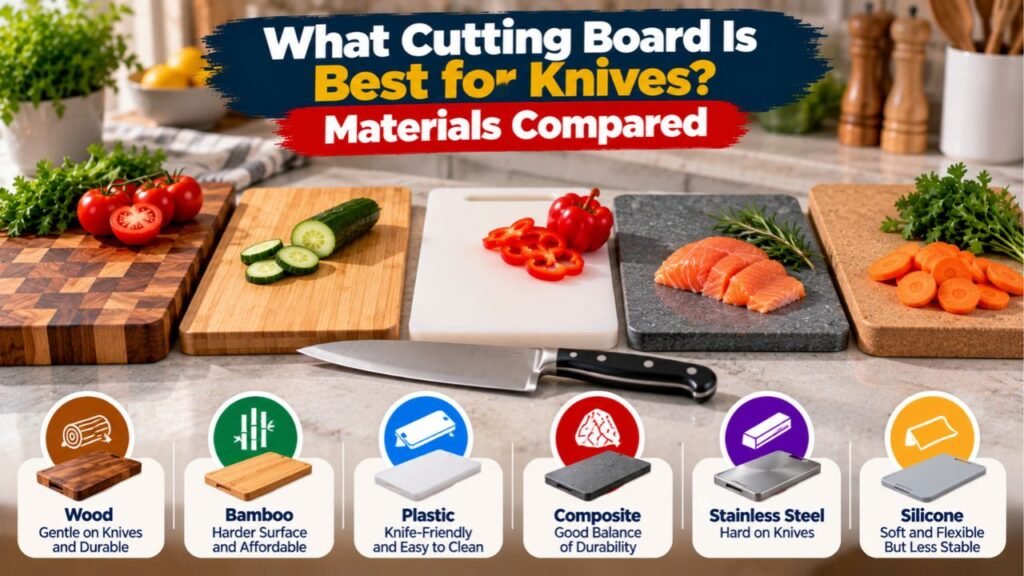
For most home kitchens, a quality end-grain or edge-grain hardwood board is a strong choice for protecting knives. Specialized rubber and soft synthetic boards are excellent alternatives, especially for delicate blades and frequent precision slicing.
The table below compares common cutting surfaces by their expected effect on knife edges.
| Cutting Board Material | Knife Friendliness | Best Use |
| End-grain hardwood | Excellent | Frequent chopping and premium knives |
| Edge-grain hardwood | Excellent | General everyday cooking |
| Soft rubber | Excellent | Frequent slicing and delicate knives |
| Specialized soft synthetic board | Excellent | Japanese knives and precision cutting |
| Hinoki wood | Very good to excellent | Fine Japanese knife work |
| Polyethylene plastic | Good to very good | Everyday preparation and raw meat |
| Polypropylene plastic | Good; varies by formulation | General cutting and easy cleanup |
| Bamboo | Variable; often firmer | Occasional food preparation |
| Hard wood-fiber composite | Less forgiving | General preparation where low maintenance matters |
| Glass or ceramic | Poor | Serving and presentation |
| Marble or granite | Poor | Non-cutting kitchen tasks |
| Stainless steel or titanium | Poor | Not recommended for routine knife cutting |
These ratings represent general material characteristics, not a universal laboratory ranking. Product construction, surface formulation, knife steel, and cutting technique can change the result.
Wood is often the simplest recommendation because it combines a stable platform with a surface that yields slightly under a blade.
Rubber and specialized synthetic boards deserve equal consideration when preserving delicate cutting edges is the main priority.
The materials to avoid most strongly are glass, ceramic, stone, and metal. Their low resilience creates unnecessary stress at the thin edge of a kitchen knife.
How Does a Cutting Board Affect Knife Sharpness?
Every time a knife finishes a cut, its edge contacts the board underneath the food.
The interaction may seem minor, but repeated contact contributes to gradual edge wear.
A cutting board influences this process through its hardness, resilience, texture, and stability.
Surface Hardness and Blade Contact
A kitchen knife’s cutting edge is extremely thin.
Under repeated pressure, the edge can gradually lose its original shape through abrasion, deformation, or small chips.
A very rigid cutting surface provides little cushioning.
Glass and stone are poor examples because the blade meets an unforgiving material at the end of each cut.
Wood, rubber, and suitable plastics provide more give.
Their surfaces can absorb some of the contact force instead of directing it entirely into the knife edge.
This is why a material that seems less scratch-resistant may actually be preferable for knives.
Why a Slightly Soft Surface Is Better
A knife-friendly cutting surface should yield slightly when the blade reaches it.
This helps reduce harsh contact without allowing the knife to sink excessively into the board.
Wood achieves this through its fibrous structure.
Rubber and soft synthetic boards achieve it through their flexible material properties.
Excessive softness creates another problem.
If a knife sinks deeply into the surface, cutting may feel sticky or resistant. The blade can also become difficult to move sideways without stressing the edge.
The ideal cutting feel is firm support with controlled surface resilience.
How Cutting Technique Changes Knife Wear
Board material is only one part of knife care.
Chopping with excessive force increases contact pressure.
Dragging the sharp edge sideways to collect chopped vegetables can also contribute to wear.
Twisting a thin blade while it is pressed against the board may damage the cutting edge.
A suitable board reduces unnecessary contact stress, but it cannot compensate for every cutting habit.
Key Takeaway: Knife-friendly cutting boards provide enough resilience to cushion blade contact while remaining firm and stable during cutting.
Best Cutting Board Materials for Keeping Knives Sharp
Several materials are suitable for knife care, but each has different strengths.
The best options balance cutting feel, resistance to surface damage, cleaning requirements, and long-term usability.
End-Grain Hardwood Cutting Boards
End-grain hardwood is a leading choice for serious home cooks.
These boards are constructed with the ends of the wood fibers facing upward.
The exposed fibers can yield around the knife edge as it contacts the surface.
This creates a comfortable cutting feel and can reduce the appearance of shallow knife marks.
Popular woods include maple, walnut, and cherry.
End-grain boards are often thick and heavy, which can improve stability.
Their main disadvantages are price, weight, and maintenance.
A well-made end-grain hardwood board is an excellent option for repeated chopping and everyday use with quality knives.
Edge-Grain Hardwood Cutting Boards
Edge-grain boards expose the long edges of wooden strips.
They provide a firm cutting surface with some natural resilience.
Maple, walnut, cherry, and beech are common choices.
Edge-grain boards often cost less than comparable end-grain models because their construction is simpler.
They may show knife marks more readily, but visible scratches do not automatically indicate excessive blade wear.
For most households, a quality edge-grain hardwood board provides very good knife protection without the added expense of a premium butcher block.
I consider edge-grain maple or walnut an excellent starting point for someone purchasing a first serious cutting board.
Rubber Cutting Boards
Rubber cutting boards are popular among some professional cooks because they provide a slightly springy cutting surface.
The material cushions knife contact while offering a stable platform when the board has adequate thickness.
Suitable rubber boards can be especially comfortable for slicing fish, vegetables, and other ingredients requiring controlled knife movements.
Some products can be resurfaced after shallow cutting damage, according to their manufacturers.
Rubber boards generally do not need mineral oil.
Their disadvantages include weight, cost, and varying heat resistance.
Not every rubber board is dishwasher-safe.
Soft Synthetic Cutting Boards
Specialized synthetic boards are another strong option for preserving sharp edges.
Some products use soft elastomer or polyethylene-based cutting surfaces, sometimes supported by a rigid internal core.
Hasegawa, for example, manufactures wood-core cutting boards with softer outer surfaces designed for knife contact.
This combination provides cushioning while limiting unwanted bending.
Certain Hasegawa models are dishwasher-safe, while some of the company’s thinner cutting mats are not.
These boards can suit Japanese knives with thin cutting edges.
Always distinguish a knife-rated cutting surface from a general-purpose kitchen mat.
Polyethylene and Polypropylene Cutting Boards
Plastic boards are not automatically bad for knives.
Common materials include polyethylene (PE) and polypropylene (PP).
Their behavior varies with formulation, thickness, surface texture, and manufacturing methods.
A reasonably forgiving plastic surface can support everyday knife use without the harsh impact associated with glass or stone.
Plastic boards are often lightweight, affordable, and easy to wash.
Many models are dishwasher-safe.
The main limitation is surface wear. Repeated knife cuts create scratches and grooves that may eventually require replacement.
Key Takeaway: End-grain and edge-grain hardwood, suitable rubber, and specialized soft synthetic boards are leading choices for knife protection. Ordinary plastic can also work well.
Which Wood Is Best for Cutting Board Knife Protection?
Not every type of wood provides the same cutting feel.
Wood species differ in hardness, grain structure, density, and natural extractives.
For kitchen knives, close-grained hardwoods with moderate hardness are generally reliable choices.
Maple Cutting Boards
Hard maple is one of the most established cutting board woods.
Its fine grain and durability make it suitable for repeated chopping.
The 2026 FDA Food Code identifies hard maple or equivalently hard, close-grained wood as an acceptable cutting board material in covered retail and food-service settings.
Maple is firm enough to resist deep indentation while offering some natural resilience.
It is widely available in both end-grain and edge-grain designs.
For everyday cooking, maple provides a dependable balance between knife care and board durability.
Walnut Cutting Boards
American black walnut is softer than hard maple.
Its Janka hardness is approximately 1,010 lbf, compared with maple’s 1,450 lbf.
Walnut offers a comfortable cutting surface and a distinctive dark appearance.
Its lower resistance to denting can make it feel slightly more forgiving.
Walnut boards may develop shallow knife marks sooner than harder woods.
That is not necessarily a disadvantage when the priority is protecting knife edges.
A well-made walnut board is an attractive option for regular vegetable preparation and precision slicing.
Cherry Cutting Boards
American black cherry is another suitable wood for kitchen knives.
It has a Janka hardness of approximately 950 lbf and a relatively fine grain.
Cherry generally feels less rigid than hard maple.
It is attractive for people who want a wooden board that provides a little more give under a knife.
The trade-off is lower resistance to dents and surface marks.
Cherry can still provide years of service when properly manufactured and maintained.
Hinoki Cutting Boards
Hinoki is Japanese cypress, a relatively soft wood traditionally used for certain Japanese cutting boards.
It provides a forgiving cutting surface, making it attractive for thin-edged knives.
Hinoki boards are generally lighter than thick hardwood butcher blocks.
They can develop knife marks more readily and require careful cleaning and drying.
A quality hinoki board is worth considering for Japanese-style slicing and delicate preparation work.
Comparing Wood Hardness
The following values are commonly reported for North American hardwoods.
| Wood Species | Approximate Janka Hardness |
| American black cherry | 950 lbf |
| American black walnut | 1,010 lbf |
| American beech | 1,300 lbf |
| Hard maple | 1,450 lbf |
Janka hardness measures resistance to indentation, not how quickly a knife becomes dull.
A softer board may be more forgiving, but a well-constructed harder wood board can also perform very well.
Grain orientation and surface quality should be considered alongside the wood species.
Key Takeaway: Maple, walnut, and cherry are strong hardwood choices for knives, while hinoki appeals to cooks who prefer a softer surface for delicate cutting.
End-Grain vs. Edge-Grain: Which Is Better for Knives?
End-grain and edge-grain describe how wood fibers are oriented within a cutting board.
Both constructions can be suitable for kitchen knives.
Their differences influence cutting feel, maintenance, surface wear, and cost.
How End-Grain Boards Work
An end-grain cutting board exposes the cut ends of the wood fibers.
The board often displays a checkerboard or block pattern.
As the knife contacts the surface, its edge meets the ends of the fibers, which can move slightly around the blade.
This construction creates a comfortable cutting feel.
End-grain boards are often described as self-healing because some shallow cutting marks become less visible as the fibers move back.
That does not mean the surface repairs deep cuts or prevents all damage.
How Edge-Grain Boards Work
An edge-grain cutting board exposes the long edges of wooden strips.
The knife contacts the sides of the fibers rather than their ends.
This can produce a somewhat firmer cutting sensation.
Edge-grain boards are usually simpler to manufacture and may be thinner or lighter than substantial end-grain blocks.
They remain excellent cutting surfaces for home kitchens.
A quality edge-grain walnut or maple board can support daily chopping without creating unnecessary knife wear.
Does End Grain Actually Keep Knives Sharper?
End-grain construction has a reasonable mechanical explanation for its knife-friendly reputation.
Some cutting board comparisons have found favorable edge-retention results with end-grain hardwood.
Other tests have found smaller differences between grain types and materials.
For example, consumer testing published by Which? in 2026 reported no detectable sharpness difference after more than 600 chops on the tested wood, bamboo, and plastic boards.
That result does not establish that all boards are identical over years of use. It shows that differences are not always measurable in shorter tests.
I would treat end grain as a premium cutting option rather than a guarantee that knives will remain sharp for a specific number of additional cuts.
Key Takeaway: End-grain wood often provides a softer cutting feel, but a quality edge-grain hardwood board remains an excellent option for knife care.
Cutting Board Materials That Can Dull Knives Faster
Some cutting surfaces prioritize scratch resistance, appearance, or ease of wiping over knife compatibility.
Those materials may be suitable for serving food but less desirable for regular chopping.
Glass, Marble, Granite, and Ceramic
Glass and stone boards are extremely rigid compared with wood and suitable rubber.
They provide almost no cushioning when a sharp blade reaches the surface.
Repeated contact can contribute to edge deformation, abrasion, or small chips.
The problem becomes more concerning with thin, delicate knife edges.
These boards may look attractive, but I would reserve them for food presentation and other tasks that do not involve repeated knife cutting.
Stainless Steel and Titanium Boards
Metal cutting boards are sometimes marketed for cleanliness and resistance to surface damage.
Those features do not make them good for preserving knife sharpness.
Stainless steel and titanium are much less forgiving cutting surfaces than hardwood or soft rubber.
Knife contact against metal can increase edge wear and create an unpleasant chopping feel.
A metallic cutting surface can also be noisy during use.
For ordinary food preparation, wood or a suitable synthetic board is a better choice.
Bamboo Cutting Boards
Bamboo is a grass rather than a hardwood.
Manufactured bamboo boards often have a firm surface, and the material contains naturally occurring silica.
These characteristics can contribute to abrasive contact with knife edges.
Bamboo cutting boards also vary in their density, grain orientation, and adhesive construction.
Some independent tests have found bamboo less knife-friendly than end-grain hardwood, while other comparisons have observed relatively modest differences.
Bamboo is not equivalent to cutting on glass.
Still, maple, walnut, or another suitable hardwood is generally my preferred recommendation when preserving knife edges is the main goal.
Hard Composite Cutting Boards
Some wood-fiber and paper-composite boards use resins to create a firm, durable surface.
They often offer convenient cleaning and a thin profile.
The trade-off is that certain formulations feel harder than traditional wood.
A rigid composite board may cause faster edge wear than a more forgiving cutting surface.
Product differences matter, so check the specific material and manufacturer information before drawing conclusions.
Ordinary Silicone Mats
Silicone is soft, but softness alone does not make a product suitable for cutting.
Many silicone baking and pastry mats are not designed for knife contact.
Some contain internal reinforcement that can be damaged if the surface is cut.
Use silicone only when the manufacturer specifically identifies the product as a knife-rated cutting board.
Key Takeaway: Avoid glass, stone, ceramic, and metal for routine knife work. Bamboo, hard composite, and silicone products require closer attention to their actual construction.
Best Cutting Board for Different Types of Kitchen Knives
The cutting board should suit the knife’s blade geometry, cutting style, and intended task.
A thin Japanese slicing knife and a heavy Western chef’s knife do not always benefit from identical cutting conditions.
Best Cutting Board for Japanese Knives
Japanese knives often feature relatively thin cutting edges and hard blade steel.
These characteristics support precise slicing but may make the edge more sensitive to harsh impact or sideways pressure.
Suitable choices include:
- Soft synthetic cutting boards designed for Japanese knives
- Quality end-grain hardwood boards
- Hinoki cutting boards
- Appropriate rubber cutting boards
A smooth, slightly forgiving surface is desirable.
Avoid twisting the blade while its edge is pressed into the board.
Glass, ceramic, and metal surfaces are poor matches for delicate Japanese knives.
Best Cutting Board for German Chef’s Knives
German-style chef’s knives commonly have somewhat tougher cutting edges and are frequently used with rocking motions.
A stable hardwood board works very well for this cutting style.
Maple and walnut are practical choices.
Edge-grain construction is usually sufficient for everyday vegetable chopping.
Rubber and suitable plastic boards can also work.
The board should be large enough to support the full knife movement without forcing ingredients toward the countertop edge.
Best Cutting Board for Serrated Knives
Serrated knives are commonly used for bread, tomatoes, and other foods that benefit from a sawing motion.
Their pointed teeth can leave scratches or grooves in a cutting surface.
A wooden bread board works well, although repeated contact may create visible marks.
A separate plastic board can also be practical for frequent bread slicing.
Avoid pressing the serrated edge aggressively against the board after cutting through food.
Best Cutting Board for Cleavers
The appropriate surface depends on the cleaver’s intended use.
A Chinese vegetable cleaver is generally used for slicing and chopping produce, not cutting through heavy bones.
A hardwood cutting board suits this type of knife.
A heavy bone-cleaving tool creates much greater impact.
For that task, use a substantial chopping block specifically intended for cleaver work.
A decorative wooden board or thin synthetic mat may not withstand repeated heavy strikes.
Key Takeaway: Soft synthetic, hinoki, rubber, and quality hardwood boards suit delicate Japanese knives. Stable hardwood is a strong general-purpose choice for Western chef’s knives and vegetable cleavers.
What to Look for in a Knife-Friendly Cutting Board
Material is the starting point, but physical design influences everyday knife use.
A well-chosen cutting board should be large enough for ingredients, remain steady during cutting, and have a smooth surface without structural damage.
Surface Firmness and Texture
A suitable cutting surface should feel firm with slight resilience.
Avoid products that feel as rigid as stone or unusually abrasive.
Also be cautious with surfaces that compress excessively under a sharp blade.
The board should support smooth knife movement without causing the edge to stick.
A clean, consistent surface is generally preferable to one with rough seams, deep grooves, or raised decorative elements.
Cutting Board Size
An undersized board limits knife movement.
It also leaves less space for chopped ingredients.
For many home kitchens, a board around 12 × 18 inches provides a useful working area.
Larger models may be more comfortable for extensive food preparation.
The board should still fit the sink and storage space.
If you use an 8-inch chef’s knife regularly, choose enough cutting area to complete long slicing motions comfortably.
Thickness and Stability
A thick board can provide a sturdy cutting platform.
Many substantial wooden cutting boards measure around 1 to 2 inches thick, although thinner designs can work well.
Rubber and synthetic boards may achieve stability with different constructions.
Thickness alone does not determine quality.
Check that the board lies flat and does not rock during cutting.
Non-slip feet or a suitable secure mat underneath can improve stability.
Food-Contact Finish and Construction
Wooden boards should have finishes and adhesives suitable for direct food contact.
The surface should be smooth, without splinters or open glue joints.
Synthetic boards should be manufactured for knife use rather than general kitchen protection.
Check the manufacturer’s care instructions.
A board that is difficult to clean or maintain may become less practical than its material description suggests.
Key Takeaway: Prioritize a resilient surface, stable construction, sufficient cutting space, and clear food-contact suitability over decorative features.
How to Keep Knives Sharp When Using a Cutting Board
Even a knife-friendly board cannot eliminate normal edge wear.
Cutting habits influence how quickly a blade loses sharpness.
A few practical adjustments can reduce unnecessary stress on the edge.
Avoid Excessive Downward Force
A sharp knife should pass through most vegetables without repeated heavy impacts.
Forceful chopping increases pressure where the edge meets the board.
Use controlled cutting movements rather than striking the surface unnecessarily hard.
For dense ingredients, select the proper knife and cutting technique.
Do Not Scrape Food With the Sharp Edge
Dragging the cutting edge sideways across a board is a common mistake.
That motion places lateral pressure on a thin edge.
Use the spine of the knife or a food-safe bench scraper to gather chopped ingredients.
This simple habit reduces unnecessary contact along the sharp edge.
Avoid Twisting the Blade Against the Board
When a blade is embedded in a firm ingredient, twisting it can apply sideways force to the edge.
This is especially concerning with thin Japanese knives.
Keep the blade aligned with the intended cut.
Lift it before changing direction rather than rotating the cutting edge against the surface.
Keep the Cutting Surface Clean and Flat
Deep grooves and damaged surfaces can interrupt smooth knife movement.
Inspect the board regularly.
Remove trapped food residue and check for uneven areas.
A warped board can shift unexpectedly during chopping.
Replace or appropriately restore the cutting surface when damage begins interfering with normal use.
Key Takeaway: Gentle cutting pressure, avoiding sideways scraping, and maintaining a stable board can reduce unnecessary knife-edge wear.
How to Clean and Maintain Knife-Friendly Cutting Boards
Board maintenance affects cleanliness, durability, and cutting feel.
Wood, rubber, and plastic require different care.
Caring for Wooden Boards
Most laminated wooden boards should be washed by hand.
Use warm water and mild dish soap, rinse thoroughly, and dry promptly.
Avoid soaking the wood or leaving it wet against the countertop.
Apply food-grade mineral oil or an approved board conditioner when recommended by the manufacturer.
Oiling reduces moisture-related stress but does not sharpen knives or repair deep cuts.
Keep the surface smooth and inspect glued joints for separation.
Caring for Rubber and Synthetic Boards
Rubber and synthetic cutting boards generally do not require wood conditioning oil.
Wash them according to the manufacturer’s instructions.
Some specialized synthetic models are dishwasher-safe, while certain rubber boards and soft cutting mats require hand washing.
Avoid assuming that every synthetic surface tolerates high temperatures.
Check for deep cuts, permanent deformation, or exposed internal materials.
Caring for Plastic Boards
Many polyethylene and polypropylene cutting boards are dishwasher-safe.
Clean them after every use, including the grooves and edges.
Inspect areas that receive repeated knife contact.
The USDA recommends replacing cutting boards that become excessively worn or develop hard-to-clean grooves.
A badly damaged plastic board is generally more practical to replace than repair.
Separating Raw Meat and Ready-to-Eat Foods
The USDA recommends using separate cutting boards for raw meat, poultry, and seafood and for ready-to-eat foods.
A hardwood board for general chopping paired with a dishwasher-safe plastic board for raw animal products is a practical kitchen arrangement.
Both boards still need cleaning after use.
Key Takeaway: Hand wash and condition wood as directed, follow rubber and synthetic product instructions, and replace any board that can no longer be cleaned or used safely.
Is an Expensive Cutting Board Worth It for Knife Care?
A premium cutting board may offer a more comfortable cutting experience, better construction, and longer service.
That does not mean spending more always keeps knives sharper.
A high-quality edge-grain maple board can be a sensible purchase for regular home cooking.
An expensive end-grain walnut board may feel more forgiving and provide additional thickness, but the difference in actual knife-edge retention will vary.
Specialized rubber or soft synthetic boards may appeal to cooks who regularly use thin-edged Japanese knives.
The most sensible upgrade is a board that provides a stable, resilient surface and fits your maintenance routine.
I would spend money on material quality, adequate size, and construction before choosing decorative grain patterns or extra features.
Conclusion
For anyone asking what cutting board is best for knives, quality hardwood, rubber, and specialized soft synthetic cutting surfaces are the strongest options to consider. End-grain maple, walnut, and cherry offer a comfortable cutting feel, while edge-grain hardwood boards provide excellent everyday performance at a more accessible price.
Avoid glass, marble, granite, ceramic, and metal boards for regular knife work. Their rigid surfaces provide little cushioning and can contribute to premature edge wear. Bamboo and hard composite products also deserve closer attention because their cutting characteristics vary.
My recommendation for most home kitchens is a well-made maple or walnut cutting board, paired with a separate dishwasher-safe board for raw meat preparation. For delicate Japanese knives, a quality soft synthetic, rubber, hinoki, or end-grain hardwood board is worth considering. Proper cutting technique and regular knife maintenance remain important regardless of the board material.
FAQs About the Best Cutting Boards for Knives
What Type of Cutting Board Keeps Knives Sharpest?
End-grain hardwood and specialized soft rubber or synthetic cutting boards are among the most knife-friendly options.
Their surfaces yield slightly under a blade rather than producing the harsh impact associated with glass or stone.
A quality edge-grain maple or walnut board is also an excellent choice.
Independent testing has not established one universal winner for every knife, so blade steel, cutting technique, and board construction remain relevant.
Is Wood or Plastic Better for Keeping Knives Sharp?
Wood is generally my preferred primary cutting surface because it combines resilience, stability, and durability.
Plastic can also be gentle on knives, especially when the material has some give.
Plastic formulation and surface condition influence how it behaves.
Many plastic boards are easier to clean in a dishwasher, making them practical for raw meat preparation.
A hardwood board paired with a washable plastic board suits many households.
Is End-Grain Wood Better for Knives Than Edge-Grain Wood?
End-grain construction often provides a more forgiving cutting feel because the knife contacts the ends of the wood fibers.
Edge-grain boards expose the sides of those fibers and may feel somewhat firmer.
Both can provide excellent knife protection.
Testing does not consistently show a large edge-retention advantage for end grain under every condition.
A well-made edge-grain board remains a sensible everyday choice.
Are Bamboo Cutting Boards Bad for Knives?
Bamboo boards are not automatically harmful to knives, but many have firm surfaces that may create greater edge wear than suitable hardwood.
Bamboo contains naturally occurring silica, and manufactured boards vary in density and construction.
Some cutting tests find modest differences, while others favor end-grain hardwood.
For frequent use with premium kitchen knives, I would generally choose maple, walnut, or a suitable rubber surface instead of bamboo.
Are Rubber Cutting Boards Good for Japanese Knives?
Yes. Suitable rubber and soft synthetic boards are popular options for thin-edged Japanese knives.
Their slightly yielding surfaces cushion blade contact and can feel comfortable during precision slicing.
Some products have a rigid internal core that prevents excessive bending.
Choose a board designed specifically for knife use and check its cleaning instructions.
Not every rubber or synthetic board is dishwasher-safe.
Will a Glass Cutting Board Ruin a Knife?
Repeated cutting on glass can dull or damage a kitchen knife edge faster than using a suitable wooden or rubber board.
Glass provides very little cushioning when the blade contacts the surface.
The risk is greater for thin or delicate cutting edges.
A single accidental contact does not guarantee permanent damage, but glass is a poor material for routine chopping.
Use glass boards for serving or other non-cutting tasks.
Is Walnut Better Than Maple for Knife Edges?
Walnut is softer than hard maple according to their Janka hardness ratings.
This can make walnut feel slightly more forgiving during chopping.
Maple is harder and generally resists dents better.
Both are established cutting board woods.
There is not enough consistent comparative evidence to guarantee that walnut preserves every knife edge longer than maple.
Construction quality, grain orientation, and cutting technique also influence the result.
What Cutting Board Should I Use With Expensive Kitchen Knives?
A well-made end-grain hardwood, quality edge-grain hardwood, or specialized soft rubber or synthetic board is a sensible choice for expensive kitchen knives.
For thin Japanese knives, a soft synthetic board or hinoki may be appealing.
For general Western chef’s knives, maple and walnut are excellent options.
Avoid glass, stone, ceramic, and metal surfaces, and do not scrape food sideways with the sharp edge.
The board should remain stable, clean, and free from deep damage.