Chopping Board vs Cutting Board: What’s the Difference?
A chopping board and a cutting board are generally the same kitchen tool: a flat surface for slicing, dicing, mincing, and chopping food. “Cutting board” is the more common American term, while “chopping board” is common in British English. Neither name guarantees a different material, thickness, or intended task.
The confusion starts when one store sells a slim “cutting board” beside a thick wooden “chopping board.” Those labels can make ordinary kitchen equipment sound like two separate products, leading to an unnecessary purchase or a board that does not suit your knives.
A better comparison focuses on the board’s actual construction, working area, grip, and cleaning needs. Those details determine how comfortably you can prep vegetables, handle meat, and maintain the surface after cooking.
The U.S. Food and Drug Administration recommends using separate boards for fresh produce and for raw meat, poultry, and seafood. That is a meaningful distinction between boards in a kitchen, but it has nothing to do with calling one a chopping board.
In my research, the clearest difference was the regional wording. I also found that retailers sometimes use “chopping” to suggest a heavier-duty design, even though that description is not a universal product standard.
The real chopping board vs cutting board decision comes down to the surface beneath your knife, not the word printed on the package. A thick wood board and a thin plastic board can both carry either label.
The sections below compare the names, common kitchen tasks, materials, board features, food safety, and maintenance so you can select a practical cutting surface without paying for a distinction that may not exist.
Chopping Board vs Cutting Board: Are They the Same?
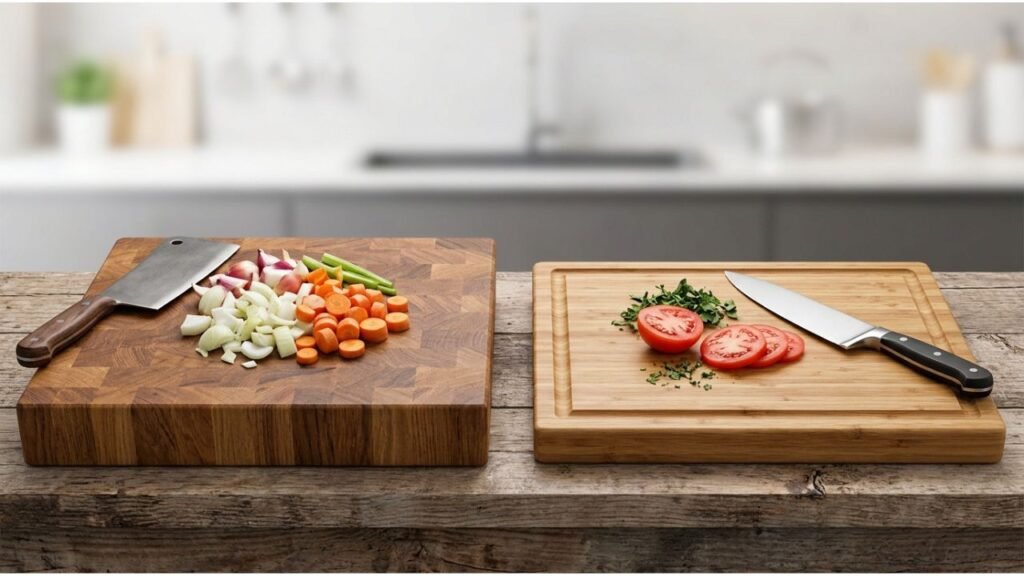
Yes. In ordinary kitchen use, both terms describe a flat, food-contact surface that protects a countertop while supporting knife work. There is no generally accepted rule that one must be wooden or thick while the other must be plastic or thin.
What is a cutting board?
A cutting board is a board used as a work surface for food preparation. You can slice bread, dice onions, trim boneless meat, mince garlic, or cut fruit on it. The name describes a broad purpose rather than one knife motion.
In the United States, this is the term most shoppers will see in kitchenware departments, food-safety advice, and product descriptions. Cutting boards come in many shapes, sizes, and materials.
What is a chopping board?
A chopping board serves the same purpose. It supports the repeated up-and-down knife movements used to chop herbs, vegetables, or other ingredients, but it is not restricted to chopping.
You can slice tomatoes or carve cooked meat on a suitable chopping board just as you would on a cutting board. The word “chopping” describes a common action, not a distinct category of equipment.
Why do the names vary by country?
The difference is mainly American English versus British English. Cambridge Dictionary identifies “cutting board” as the U.S. term and “chopping board” as the U.K. equivalent. Both names are understood in either country.
This distinction matters when reading recipes, shopping internationally, or comparing products listed by overseas sellers. A British recipe asking for a chopping board does not require a special purchase if you already own a clean, suitable cutting board.
Why do some stores treat them as different products?
A seller may use “chopping board” for a thick wooden board and “cutting board” for a smaller plastic one. That can be a useful way for the seller to describe its own collection, but it is not a standard definition across brands.
Check the material, dimensions, thickness, weight, and care instructions before drawing conclusions from the name. Two identical boards may be marketed under different labels in different countries.
Key Takeaway: Chopping board and cutting board usually mean the same thing. The actual product specifications tell you more than the label.
Chopping Board vs Cutting Board: Quick Comparison
| Feature | Chopping Board | Cutting Board |
| Basic meaning | Flat surface for food preparation | Flat surface for food preparation |
| Common regional usage | U.K. and other British-English markets | United States and Canada |
| Knife tasks | Chopping, slicing, dicing, mincing | Chopping, slicing, dicing, mincing |
| Materials | Wood, plastic, bamboo, rubber, composites | Wood, plastic, bamboo, rubber, composites |
| Thickness and weight | Vary by model | Vary by model |
| Food-safety rules | Clean and separate by food type | Clean and separate by food type |
| Cleaning method | Set by material and manufacturer | Set by material and manufacturer |
The names alone do not establish an advantage in durability, sanitation, or knife care. Compare the boards being sold, not the terminology used to sell them.
Do Different Cutting Tasks Need Different Boards?
Different foods and knife motions can favor different designs. That does not create a fixed divide between chopping boards and cutting boards.
Chopping vegetables and herbs
For onions, carrots, parsley, and similar ingredients, a broad, flat board gives your knife and food enough room to move. A board that slides under pressure can interfere with steady chopping, so non-slip feet or a secure base matter more than the name.
A medium or large wooden or plastic surface is suitable for everyday chopping. Avoid a very small board if chopped pieces routinely spill over the edges.
Slicing, dicing, and mincing
Precise cuts are easier on a surface that stays level and supports the full length of the knife. A flat working area is often more useful than a decorative shape with narrow corners.
For tasks such as thin cucumber slices or finely minced garlic, a deep perimeter groove can reduce usable space. A smooth, uninterrupted center gives you more room to gather and reposition ingredients.
Preparing raw meat and using a cleaver
Boneless meat can be trimmed on a properly cleaned wooden or plastic board. A separate, dishwasher-safe plastic board is a convenient option for raw poultry, fish, and meat because cleanup is straightforward when the product is rated for dishwasher use.
Heavy cleaver strikes place greater demands on stability and construction. A chopping block or butcher block is often thicker and heavier than an everyday portable board. Chopping hard bones calls for suitable equipment and a surface specifically intended for that task; the words “chopping board” alone are not proof of suitability.
Carving cooked meat and handling juices
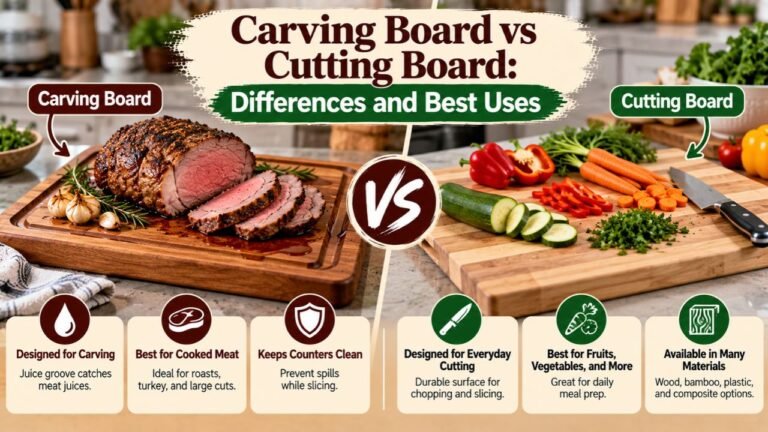
A carving board often has a perimeter juice groove that collects some liquid from roast chicken, turkey, or beef. A groove is a feature, not a sanitation system, and it can overflow if the board is moved or overloaded.
If you prepare both vegetables and roasted meat, a reversible board with a flat side and a grooved side may offer more flexibility. Clean the board between foods as needed, and never transfer cooked meat onto an unwashed surface used for raw meat.
Key Takeaway: Choose the working surface for the food, knife motion, and cleanup involved. Chopping and slicing do not require separate board categories.
What Matters More Than the Name When Buying a Board?
Material and knife contact
Wood: Hardwoods such as maple, walnut, and cherry make sturdy everyday boards. Wood has some give under a knife edge and can last a long time with proper washing, drying, and conditioning. Most wooden models need hand-washing.
Plastic: Food-contact plastic boards are lightweight and generally easier to wash and sanitize. Many are dishwasher-safe, making them convenient for raw meat preparation. Plastic can develop deep knife marks and eventually needs replacing.
Bamboo: Bamboo boards are often firm and resistant to surface moisture. Their hardness can be less forgiving on knife edges than some hardwood boards. They still need prompt washing and drying, and many should not go in a dishwasher.
Rubber and composites: Some rubber boards provide a resilient knife-contact surface and a secure feel on the counter. Composite materials vary widely. Follow each maker’s cleaning directions instead of assuming that every composite board is dishwasher-safe.
Glass, marble, and stone: These surfaces are easy to wipe clean but are generally poor everyday partners for sharp kitchen knives. Their hardness can dull or damage edges faster than wood, plastic, or suitable rubber. I would reserve them for serving or tasks that do not involve repeated knife strikes.
Size, thickness, and stability
Surface area determines how much food you can prepare without crowding. For a typical home kitchen, I would start by checking a board around 12 by 18 inches if counter and sink space permit. A smaller board can suit quick fruit prep, while a larger board gives you more room for several ingredients.
Thickness affects weight and how solid a board feels, but there is no official thickness cutoff separating a chopping board from a cutting board. A thin board with secure feet may stay put better than a thick board on a slippery counter.
Check that the board lies flat. Warping, rocking, or sliding makes knife work less predictable. A non-slip mat beneath a board without feet can improve stability.
Edge grain and end grain wood
Wooden boards can be built with different grain orientations. On an edge-grain board, the long wood fibers form the cutting surface. On an end-grain board, the ends of the fibers face upward, often creating a checkerboard appearance.
End-grain construction tends to be more forgiving of repeated knife contact, but these boards are often heavier, costlier, and more demanding to maintain. Edge-grain hardwood is a practical option for many home cooks who want a durable board without the bulk of a large block.
Neither grain style belongs exclusively to the chopping board or cutting board name. A product labeled either way can use either construction.
Juice grooves, handles, and reversible sides
A flat board is usually the simplest choice for vegetable prep because the entire surface remains available for knife work. A juice groove makes more sense for tomatoes, fruit, and carved meats that release liquid.
Handles or finger grips make heavier boards easier to lift. Reversible designs give you two work surfaces, but a second side is not a substitute for thorough washing or keeping raw animal foods separate from ready-to-eat ingredients.
Tip: Measure the inside of your sink and the storage space before buying an oversized board. A board that barely fits in either place may be awkward to wash or store.
Key Takeaway: Material, usable area, stability, and cleaning instructions should drive the purchase. None of these qualities is guaranteed by either name.
Is One Board Safer Than the Other?
No. A board called a chopping board is not automatically cleaner or riskier than one called a cutting board. Food safety depends on the material’s condition, cleaning, and how foods are separated during preparation.
Keep raw animal foods away from ready-to-eat foods
The FDA advises using one cutting board for produce and another for raw meat, poultry, and seafood. The goal is to prevent cross-contamination, which occurs when harmful microorganisms are transferred from one food or surface to another.
For example, slicing salad vegetables on a board that still holds raw chicken juices can transfer bacteria to food that will not be cooked. Changing the board’s name does nothing to prevent that problem. A dedicated board, clean knife, and clean hands are more useful safeguards.
Is wood or plastic more sanitary?
The U.S. Department of Agriculture allows both wood and nonporous materials for cutting raw meat and poultry. Nonporous surfaces, such as plastic, are generally easier to clean, while wood needs more attention to drying and surface condition.
Plastic is not permanently sanitary just because it is nonporous. Knife grooves can become difficult to wash, and wood can crack or split if it stays wet. Both types should be inspected and replaced when damaged beyond practical cleaning.
My preference for a two-board setup is a wooden board for bread and produce and a dishwasher-safe plastic board for raw animal foods. That is a convenience choice, not a rule that wood is unsafe for meat.
What if you have only one board?
A single suitable board can be used for different foods if it is thoroughly washed between tasks. Prepare ready-to-eat ingredients first, move them to a clean container, and then handle raw meat. Wash the board, knife, and surrounding surfaces after contact with raw animal foods.
If the board has deep cracks, trapped food, or grooves that cannot be cleaned, switching food order will not solve the underlying problem. Replace the board instead.
Key Takeaway: The key food-safety distinction is raw versus ready-to-eat food, not chopping versus cutting terminology.
How to Clean and Care for Either Type of Board
Wash the surface after each use
Scrape off food scraps, wash the board with hot, soapy water, and rinse it with clean water. Use a brush or sponge to reach the working surface and any juice grooves. Dry with clean paper towels or let it air-dry fully.
Do not assume that all boards with the same name share the same care requirements. Many plastic models tolerate dishwashers, while glued wood and bamboo can crack or warp under prolonged heat and moisture. Follow the product’s care label.
The USDA notes that some solid wood boards may be washed in a dishwasher, but many wood-board makers advise hand-washing. For an unknown wooden board, hand-washing and prompt drying are the more cautious approach.
Sanitize when extra cleaning is needed
After raw meat preparation or other potential contamination, sanitizing adds another step beyond routine washing. The USDA provides a method for wood and plastic boards using 1 tablespoon of unscented liquid chlorine bleach in 1 gallon of water.
First wash the board. Apply the prepared solution across the surface, let it stand for several minutes, rinse with clean water, and air-dry or dry with clean paper towels. Use the product’s safety instructions, and never mix bleach with vinegar, ammonia, or other cleaners.
For a dishwasher-safe board, use the dishwasher in line with the maker’s directions. Avoid treating a lemon-and-salt scrub as a reliable replacement for cleaning and sanitizing after raw animal foods.
Condition wood and watch for wear
After wooden boards are fully dry, apply food-grade mineral oil or a board conditioner if the manufacturer recommends it. This care reduces excessive drying and helps maintain the surface. Avoid common cooking oils that may turn rancid during storage.
Replace a board when deep cuts, cracks, splitting, or persistent hard-to-clean grooves prevent proper cleaning. The USDA recommends discarding excessively worn wooden and plastic boards. A faded color or small cosmetic knife mark alone does not always mean replacement is due.
Key Takeaway: Clean each board after use, follow material-specific care instructions, and replace surfaces that can no longer be washed thoroughly.
Which Board Should You Choose for Your Kitchen?
For everyday vegetables, fruit, and bread
Choose a flat wood, suitable rubber, or plastic board with enough space for your normal meal prep. A stable board is more useful than a decorative one that shifts as you chop. If you enjoy a wooden surface, plan on hand-washing and occasional conditioning.
For raw chicken, fish, and other meats
A separate nonporous board is a convenient choice, ideally one the manufacturer approves for dishwasher cleaning. Look for a surface without deep grooves, easy-to-clean corners, and enough space to keep raw juices contained while you work.
For repeated heavy chopping
Look beyond the label for a solid, stable construction and enough mass to resist movement. A dedicated butcher block may suit demanding tasks better than a thin prep board, but a heavy block still needs a proper food-safe surface and a suitable knife. Do not assume every thick board is intended for bone chopping.
For small kitchens and limited storage
A manageable, flat board may be preferable to a large wooden block. A board that fits the sink and drying rack is more likely to get cleaned promptly. If storage is tight, two compact, clearly identified boards can be more practical than one oversized model.
Key Takeaway: Match the board to your food, available space, knife use, and cleaning routine rather than buying by name.
Common Mix-Ups Worth Avoiding
A chopping block is not always interchangeable with the everyday term “chopping board.” The word “block” often suggests a thick, heavy cutting surface. A butcher block may refer to a thick board or a fixed butcher-block countertop. Those products can differ in construction and intended use.
A carving board is another related term. It commonly describes a board intended for slicing cooked meats, often with a juice groove or other features to manage liquids. It can still serve as a general food-prep board if its surface and care requirements suit the task.
Finally, avoid judging hygiene by color or price alone. A color-coded board only helps separate ingredients if you consistently assign it to the same food group and clean it after use. A high-priced board still needs washing, drying, and inspection.
Conclusion
The chopping board vs cutting board comparison has a simple answer: for everyday cooking, these are usually two names for the same kitchen tool. Regional language explains most of the difference, and retailers may apply their own labels to specific designs.
When choosing between actual products, examine material, stability, cutting area, weight, and care requirements. Separate surfaces for raw animal foods and ready-to-eat ingredients matter far more for hygiene than the wording on a label.
I would prioritize a board that stays steady under a knife and is straightforward to clean after the foods you prepare most often. That is a better buying test than searching for a special feature implied by the word “chopping.”
FAQs About Chopping Boards and Cutting Boards
Are chopping boards and cutting boards exactly the same?
In everyday kitchen language, yes. Both describe a flat board for cutting and preparing food. Individual products can differ in material, thickness, and shape, but those differences come from design rather than a standard dividing line between the two names.
Why do Americans say cutting board instead of chopping board?
“Cutting board” is the customary American English term, while “chopping board” is more common in British English. The wording reflects regional usage, not a different knife technique or mandatory construction. American shoppers may still see both names, especially on imported products.
Can a cutting board be used for chopping vegetables?
Yes. An ordinary cutting board is suitable for chopping onions, herbs, carrots, and other vegetables when it is sturdy, clean, and stable. Choose enough working area for the amount of food you are preparing, and secure a slippery board before starting.
Is a chopping block different from a chopping board?
Often, yes. “Chopping block” generally suggests a heavier, thicker surface intended to stay steady during demanding cutting tasks. A chopping board is a broader term for portable food-prep boards. Product names still vary, so examine dimensions and the maker’s intended-use instructions.
Which board material is gentler on kitchen knives?
Many hardwood and suitable rubber boards are more forgiving on knife edges than glass, marble, or stone. Plastic can also be a practical everyday cutting surface. For frequent chopping, I would avoid hard glass or stone boards because repeated knife contact can wear or damage the blade edge.
Do you need separate chopping boards for meat and vegetables?
The FDA recommends using one board for fresh produce and another for raw meat, poultry, and seafood. That separation reduces the chance of transferring harmful bacteria to food eaten without further cooking. If only one board is available, wash it thoroughly between food types and clean the knife and work area too.
Can you put a wooden chopping board in the dishwasher?
Check the board maker’s directions. Although the USDA states that some solid wood boards can be dishwashed, many wooden and laminated boards may warp, crack, or separate under dishwasher conditions. Hand-washing with hot, soapy water followed by thorough drying is a cautious default for most wooden kitchen boards.