Silicone vs Rubber Cutting Board: Which Is Better?
Rubber cutting boards are generally better for frequent chopping, knife control, and long-term durability, while silicone cutting boards offer flexibility, lighter weight, and convenient cleaning. A thick rubber board provides a stable surface that cushions knife edges. A silicone cutting mat works well for lighter preparation, but its softer surface can develop cuts and grooves under repeated knife pressure.
Choosing the wrong material can lead to a cutting surface that moves during chopping, collects difficult-to-clean grooves, or wears out sooner than expected. A flexible silicone mat that works well for slicing fruit may not provide enough support for forceful vegetable preparation.
A suitable cutting board keeps ingredients steady, supports controlled knife movement, and fits your cleaning routine. Comparing material firmness and construction can also prevent unnecessary spending on features that do not improve your daily cooking.
According to the U.S. Department of Agriculture (USDA), cutting boards should be washed with hot, soapy water after use. The agency also identifies 1 tablespoon of unscented liquid chlorine bleach per gallon of water as a cutting-board sanitizing solution. Material-specific cleaning instructions still matter because not every rubber board tolerates bleach or dishwasher heat.
The silicone vs rubber cutting board comparison has an important technical detail: silicone itself is a type of synthetic rubber. In kitchen product descriptions, however, silicone usually refers to softer, flexible cutting mats, while rubber commonly describes thicker cutting boards made from other natural or synthetic rubber compounds.
What stood out to me during my research was the variation in manufacturer instructions. Some premium rubber boards are dishwasher-safe, while others can warp from dishwasher heat. Silicone products also vary in thickness and resistance to knife damage.
Understanding the differences in knife friendliness, durability, stability, sanitation, heat tolerance, and price will help you choose a cutting surface that matches your cooking habits.
Silicone vs Rubber Cutting Board: Quick Comparison
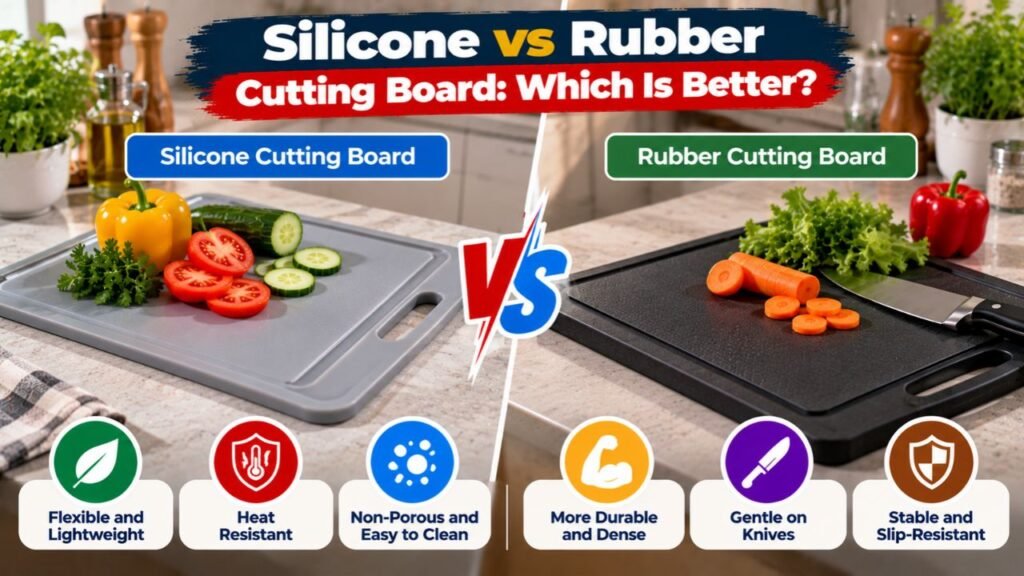
Both materials provide softer cutting surfaces than glass, stone, or stainless steel. Their construction and handling characteristics create noticeable differences during food preparation.
| Feature | Silicone Cutting Board | Rubber Cutting Board |
| Main material | Food-contact silicone elastomer | Natural rubber or other synthetic rubber compounds |
| Typical construction | Thin, flexible mat or thicker flexible board | Thick, solid board or reinforced composite |
| Cutting feel | Soft and sometimes slightly grippy | Cushioned but generally firmer |
| Knife friendliness | Gentle contact, but thin silicone can be cut | Generally excellent for sharp kitchen knives |
| Scratch resistance | Often shows knife marks with repeated chopping | Usually better suited to repeated cutting |
| Surface stability | Can grip counters but may flex | Usually stable due to thickness and weight |
| Flexibility | Often bends or rolls | Generally maintains its shape |
| Weight | Usually lightweight | Often heavier, except reinforced lightweight designs |
| Water absorption | Low in intact silicone | Low in most purpose-made cutting-board compounds |
| Dishwasher safety | Common, but product-specific | Varies considerably by manufacturer |
| Heat tolerance | Often relatively high | Depends on rubber formulation and construction |
| Maintenance | Usually no oiling required | Usually no oiling required |
| Resurfacing | Generally not practical | Some models can be sanded |
| Storage | Easy to hang, stack, or roll when permitted | Requires more flat storage space |
| Typical cost | Often lower for basic mats | Often higher for thick specialty boards |
| Best use | Light chopping, small kitchens, portable prep | Frequent chopping, meat preparation, precision knife work |
My recommendation: Choose a quality rubber board for a dedicated everyday chopping surface. Choose a silicone cutting board when portability, easy storage, and lighter food preparation matter more.
The exact product design can change this recommendation, especially when comparing a thick silicone board with a thin rubber mat.
What Is a Silicone Cutting Board?
A silicone cutting board is a food preparation surface made primarily from silicone elastomer, a flexible synthetic material commonly used in kitchen utensils, baking products, and food-contact equipment.
Silicone is valued for its flexibility, resistance to water absorption, and ability to tolerate temperature changes within its specified operating range.
How Silicone Cutting Boards Are Made
Silicone cutting boards are typically molded from food-contact silicone compounds.
Manufacturers can adjust the material’s firmness, thickness, color, and surface texture during production.
Some silicone cutting boards resemble flexible mats only a few millimeters thick. Others are thicker and have molded edges, handles, or juice grooves.
Many products can bend slightly to transfer chopped vegetables into a bowl or saucepan.
Silicone is generally nonporous, meaning its intact surface does not absorb liquid like unfinished wood.
The surface still requires cleaning because bacteria and food residue can remain on it.
Main Advantages of Silicone Cutting Boards
Silicone’s flexibility creates several practical advantages.
A lightweight mat is easy to lift, carry, and store. Some designs can be rolled or gently folded according to the manufacturer’s directions.
Silicone also provides friction against smooth countertops, reducing the tendency to slide during gentle slicing.
Many silicone cutting boards can be washed in dishwashers, making cleanup convenient after ordinary preparation.
Another advantage is resistance to cracking from normal bending.
These qualities make silicone attractive for occasional cooking, compact kitchens, and preparation tasks that do not require heavy knife pressure.
Main Disadvantages of Silicone Cutting Boards
The main limitation is surface damage from sharp knives.
Silicone is elastic, but it is not cut-proof.
Repeated chopping can create visible marks. A sharp knife pressed forcefully into a thin mat may cut deeply or penetrate the material.
Very soft silicone can also grip a blade, creating an unusual cutting feel compared with a conventional firm board.
Thin products may bunch, curl, or shift when used on uneven countertops.
Color transfer, stubborn stains, and retained odors can occur with certain foods or cleaning conditions.
Key Takeaway: Silicone boards offer portability, flexibility, and convenient cleaning. Their main limitations are reduced support during forceful chopping and susceptibility to deep knife cuts.
What Is a Rubber Cutting Board?
A rubber cutting board is a purpose-made chopping surface manufactured from natural rubber, synthetic rubber, or a combination of rubber-like materials.
Professional-style rubber boards are usually thicker and firmer than flexible silicone mats.
Natural Rubber vs Synthetic Rubber
Natural rubber comes primarily from latex obtained from rubber trees.
It has elastic properties that make it useful in many commercial products.
Synthetic rubber refers to manufactured elastomers with different chemical compositions and performance characteristics.
Not every synthetic rubber is suitable for food contact. Cutting-board manufacturers must select appropriate formulations and additives.
For example, NoTrax identifies the material used in its Sani-Tuff boards as synthetic styrene-butadiene rubber (SBR) with mineral fillers.
Asahi produces specialty cutting boards using synthetic rubber formulations.
Hasegawa manufactures certain soft cutting boards using elastomer surfaces supported by an internal core.
These examples demonstrate why the label “rubber cutting board” does not describe one identical material.
Why Rubber Boards Are Popular for Knife Work
A quality rubber board provides a surface that yields slightly when the knife makes contact.
That cushioning reduces harsh impact compared with rigid surfaces such as glass or stone.
At the same time, the board remains firm enough for controlled slicing.
Many professional rubber cutting boards are thick and heavy, which helps prevent unwanted movement.
Rubber surfaces are frequently used for fish preparation, vegetable chopping, and work involving sharp Japanese kitchen knives.
Disadvantages of Rubber Cutting Boards
Rubber boards also have limitations.
Solid models can be heavy and inconvenient to move between the countertop and sink.
Thicker boards need more storage space.
Some synthetic rubber boards have a noticeable odor when new, although that odor may diminish with washing and ventilation.
They can also stain, collect knife marks, and warp if exposed to temperatures outside their specified limits.
Premium models often cost more than basic silicone cutting mats.
Key Takeaway: Rubber boards generally provide greater stability and a firmer cutting surface, making them suitable for frequent preparation. Their main disadvantages are weight, price, and model-specific cleaning restrictions.
Which Material Is Better for Kitchen Knives?
Both silicone and rubber offer relatively soft contact compared with metal, glass, or stone.
That does not mean the materials behave identically under a sharp blade.
Silicone Cutting Surface and Knife Edges
Silicone can cushion the impact of a knife during light slicing.
Because the material is flexible, the blade encounters less rigid resistance than it would on glass.
This does not prove that silicone always preserves knife sharpness better than rubber.
Very soft silicone can grip the knife edge and create dragging resistance.
Forceful chopping may also cut into the surface instead of producing a clean, controlled stopping point.
A dedicated silicone cutting board is more appropriate for knife work than an ordinary silicone baking mat.
Many silicone baking mats contain fiberglass reinforcement and are not designed for cutting.
Rubber Cutting Surface and Knife Edges
A high-quality rubber cutting board generally combines surface cushioning with enough firmness for controlled knife movement.
The material compresses slightly under cutting pressure.
This is one reason rubber boards are popular among cooks using finely sharpened Japanese knives.
The surface supports slicing without creating the harsh contact associated with stone or metal.
In my view, this balance of firmness and cushioning gives rubber a stronger advantage for repeated chopping.
Which Material Causes Less Knife Dulling?
There is no reliable universal percentage showing that silicone or rubber reduces knife wear by a specific amount.
Knife sharpness depends on several factors, including blade steel, cutting technique, board material, surface firmness, and frequency of use.
A thick rubber board is a dependable choice for maintaining a comfortable cutting feel.
A silicone board may also be gentle during light slicing, but excessive softness does not automatically improve edge retention.
Avoid twisting or scraping a sharpened knife edge sideways against either surface.
Key Takeaway: Rubber is generally the better surface for repeated precision knife work. Silicone provides soft contact but may grip sharp blades or develop deeper cuts under heavy pressure.
Scratch Resistance and Long-Term Durability
Both materials resist cracking better than brittle cutting surfaces, but their ability to withstand repeated knife contact differs.
How Silicone Responds to Knife Cuts
Silicone is flexible and elastic.
Shallow impressions may become less noticeable after the knife is lifted, but elasticity is not the same as repairing damaged material.
Repeated cuts can leave permanent grooves.
Thin silicone boards are more vulnerable to penetration when a sharp knife is pressed firmly into the surface.
Serrated knives can also create damage because their teeth concentrate pressure along small contact points.
A heavily scored silicone board may become difficult to clean thoroughly.
How Rubber Responds to Knife Cuts
Thick rubber cutting boards are generally built to handle repeated knife contact.
Their surface yields under a blade while maintaining a supportive cutting platform.
They can still develop scratches, grooves, and deeper damage.
Certain rubber formulations show some recovery from shallow impressions, sometimes described as self-healing.
This does not mean the surface repairs deep cuts or missing material.
Can Rubber Cutting Boards Be Resurfaced?
Some rubber boards can be sanded to remove surface marks.
For example, NoTrax provides resurfacing instructions for certain Sani-Tuff cutting boards, and Asahi also describes an abrasive cleaning method for its products.
Resurfacing is a manufacturer-specific procedure.
A damaged board should not automatically be sanded without checking its construction and instructions.
Some boards have layered surfaces or internal reinforcement that must not be exposed.
Silicone cutting mats generally do not offer the same practical resurfacing option.
Once a silicone mat develops severe cuts, replacement is usually more appropriate.
Which Material Lasts Longer?
For repeated chopping, a thick, well-made rubber board usually has an advantage.
Its construction is intended for regular knife pressure, and some models can be restored after moderate wear.
Silicone can last well under lighter use, but thin mats may need replacement sooner when used for heavy chopping.
No fixed lifespan applies to every product.
Actual durability depends on thickness, formulation, manufacturing quality, cutting technique, and maintenance.
Key Takeaway: Rubber is usually the stronger long-term choice for frequent chopping. Silicone performs well for lighter tasks but can develop permanent knife damage that is difficult to repair.
Food Safety: Silicone vs Rubber Cutting Boards
Both materials can be suitable for direct food preparation when manufactured for food-contact use.
Neither material automatically prevents bacterial contamination.
Are Silicone Cutting Boards Food-Safe?
Food-contact silicone is commonly used in kitchen products.
The U.S. Food and Drug Administration (FDA) regulates substances used in food-contact materials.
Federal regulation 21 CFR 177.2600 addresses certain rubber articles intended for repeated food contact and includes silicone elastomers among the listed materials, subject to applicable conditions.
A product described as food-grade should have appropriate material documentation and be intended for its stated use.
A seller’s broad claim of “FDA approved” is not, by itself, proof that an entire cutting board received separate FDA product approval.
Silicone’s nonporous surface makes washing straightforward, but scratches and trapped food still require attention.
Are Rubber Cutting Boards Safe for Food?
Properly manufactured rubber cutting boards can also be suitable for food preparation.
The exact formulation matters because synthetic rubbers can contain different fillers, curing agents, and additives.
Look for clear food-contact information from the manufacturer.
Some professional boards also carry third-party food-equipment certification.
Avoid using general-purpose industrial rubber mats or workshop rubber sheets as cutting boards.
Products intended for floors, machinery, or construction may contain ingredients that are inappropriate for direct food contact.
Which Material Is Better for Raw Meat?
Both silicone and rubber can be used for raw-meat preparation when their manufacturers permit it and they can be cleaned and sanitized adequately.
The USDA recommends separating cutting boards used for raw meat, poultry, and seafood from boards used for produce and bread.
This reduces the risk of transferring harmful microorganisms to ready-to-eat foods.
A dedicated board is often easier to manage than repeatedly switching food categories during one cooking session.
For raw chicken or fish, I would prioritize a board with clear sanitizing instructions, a smooth surface, and enough space to contain food juices.
Do Silicone and Rubber Prevent Bacteria?
Neither material should be considered germ-free.
An intact, nonporous surface does not absorb liquid in the same way as untreated wood, but bacteria can remain on its surface.
Knife grooves and damaged areas may retain food particles.
Some cutting boards contain antimicrobial additives, but such claims do not replace washing and sanitizing.
The most reliable food-safety routine remains cleaning after use, preventing cross-contamination, and replacing damaged surfaces.
Key Takeaway: Both materials can be safe for food contact. Product composition, sanitation, surface condition, and separation of raw and ready-to-eat foods matter more than broad antibacterial claims.
Cleaning and Dishwasher Safety
Cleaning convenience is a major difference between silicone and rubber boards.
Can Silicone Cutting Boards Go in the Dishwasher?
Many silicone cutting boards are dishwasher-safe.
For example, some dedicated silicone cutting products are designed for dishwasher cleaning and high-temperature kitchen use.
Still, the instructions for the exact model should control the cleaning method.
Silicone products may contain reinforcing layers, handles, adhesives, or other components that respond differently to heat.
A manufacturer may also specify rack position or cleaning-cycle restrictions.
Do not assume that every silicone product is dishwasher-safe simply because silicone generally tolerates heat well.
Can Rubber Cutting Boards Go in the Dishwasher?
Rubber dishwasher safety varies substantially.
NoTrax states that its Sani-Tuff rubber cutting boards should be hand-washed because dishwasher heat can cause warping.
Asahi’s manufacturer guidance also warns against dishwasher and dish-dryer heat for its synthetic rubber chopping boards.
By comparison, Hasegawa states that many of its reinforced cutting boards are dishwasher-safe.
Its internal core provides structural support that helps resist deformation.
These differences explain why a universal dishwasher recommendation for rubber cutting boards would be misleading.
Which Material Is Easier to Clean?
Silicone usually has an advantage when its manufacturer permits dishwasher cleaning.
A flexible mat is also easy to lift, rinse, and inspect.
Rubber boards generally need no mineral oil or wax, which simplifies maintenance compared with wood.
Their weight and cleaning restrictions can make them less convenient after preparing large amounts of food.
Some rubber boards permit bleach-based sanitizing, while others advise against bleach because it may cause premature aging.
Always follow the manufacturer’s cleaning instructions.
Key Takeaway: Silicone often offers easier dishwasher cleaning. Rubber can be simple to maintain, but dishwasher and sanitizer compatibility differ among manufacturers.
Heat Resistance, Flexibility, and Countertop Stability
Heat tolerance and physical flexibility affect how each board behaves during daily cooking.
Which Material Handles Heat Better?
Food-contact silicone commonly tolerates higher temperatures than many conventional rubber cutting-board compounds.
Some dedicated silicone cutting boards carry heat-resistance ratings above 400°F.
Those ratings belong to specific products and do not mean every silicone cutting board can safely hold a hot skillet.
Manufacturers may also restrict direct contact with flames, heating elements, or certain cookware.
Rubber boards have more variable heat limits.
Some can soften or deform when exposed to high dishwasher temperatures.
Even heat-resistant rubber boards should not be used as trivets unless the manufacturer specifically allows it.
Which Board Is More Flexible?
Silicone cutting mats are generally more flexible.
Some can be bent into a shallow funnel to transfer chopped vegetables into a pot.
This is convenient when preparing small amounts of onions, herbs, peppers, or fruit.
Rubber cutting boards are generally designed to remain flat.
A thick solid rubber board may bend slightly when lifted but does not function like a foldable silicone mat.
Reinforced rubber boards are even more rigid.
Which Material Stays in Place Better?
Both silicone and rubber can grip a clean countertop.
Silicone often creates friction through its flexible surface.
Still, a thin silicone mat may bunch or lift if it is too small, uneven, or used with heavy cutting pressure.
A thick rubber board relies on surface friction, weight, and structural stability.
That combination is usually better suited to repeated chopping.
Safety Tip: Never chop on a cutting mat that slides, curls, or bunches under the knife. Place it on a clean, flat surface and stop using it if it cannot remain stable.
Key Takeaway: Silicone generally offers greater flexibility and potentially higher heat tolerance. Thick rubber boards usually provide greater stability for controlled knife work.
Which Material Is Better for Different Kitchen Tasks?
Different food preparation jobs place different demands on the cutting surface.
For Everyday Vegetable Chopping
Rubber is generally my preferred material for repeated vegetable preparation.
It provides a stable surface for dicing onions, chopping carrots, cutting potatoes, and mincing herbs.
Silicone works for lighter slicing tasks, especially when preparing small amounts of ingredients.
A thicker silicone model is preferable to an extremely thin mat if the board will receive regular knife contact.
For Sharp Japanese Kitchen Knives
Premium rubber boards are popular for delicate slicing with sharp Japanese knives.
Their cushioned yet supportive surfaces suit controlled cutting movements.
Silicone can feel too soft or grippy for some fine slicing tasks.
A quality rubber board is the more dependable choice for someone investing in a dedicated knife-friendly preparation surface.
For Raw Meat and Seafood
Both materials can be suitable, but the best option is a board that supports thorough cleaning and sanitizing.
Rubber provides a firm working surface for slicing fish or trimming meat.
Dishwasher-safe silicone may be convenient for light raw-meat preparation.
Avoid thin mats that shift while working with slippery ingredients or require forceful cuts.
For Small Kitchens and Occasional Cooking
Silicone is attractive for limited storage space.
A lightweight mat can be lifted and stored more easily than a heavy rubber block.
It may also simplify transferring chopped ingredients.
For occasional fruit slicing, sandwiches, or small vegetable portions, silicone can be a practical choice.
For Heavy Chopping and Repeated Preparation
Rubber is the better option when chopping is frequent or the board must remain stable through long preparation sessions.
A thick cutting surface is less likely to curl or bunch.
Still, neither silicone nor rubber should be used for cutting through hard bones unless the specific board and tool combination is suitable.
Key Takeaway: Rubber suits frequent knife work and precision slicing, while silicone is convenient for lighter preparation, smaller kitchens, and portable use.
Price and Overall Value
Basic silicone cutting mats are often less expensive than thick professional rubber cutting boards.
Silicone products are available in simple lightweight designs, making them accessible for occasional cooking.
Specialty rubber boards can cost more because of material thickness, manufacturing requirements, and professional-use construction.
A higher purchase price does not automatically guarantee better performance.
A thick rubber board may provide better long-term value when used for daily chopping.
A silicone mat may be more economical for occasional slicing, especially if easy storage and dishwasher compatibility are priorities.
I would compare actual thickness, working area, cleaning instructions, and durability rather than judging price alone.
How to Choose a Quality Silicone or Rubber Cutting Board
Material labels alone do not reveal the finished product’s performance.
Check Material Identification
For silicone, look for a product specifically described as a cutting board or chopping mat.
A silicone baking liner is not automatically suitable for knife work.
Some baking mats contain fiberglass mesh that can be damaged by knives.
For rubber, identify the compound if possible.
A product described as synthetic rubber may differ from one made from natural rubber or a reinforced elastomer composite.
Also check for documentation showing suitability for repeated food contact.
Compare Thickness and Size
Thickness affects stability and resistance to knife penetration.
A thin silicone mat may be convenient for light slicing but unsuitable for repeated forceful chopping.
A thicker silicone board can provide more support, although flexibility and material firmness still matter.
Rubber boards are often thicker and heavier.
For everyday kitchen preparation, an 18-by-12-inch cutting surface offers a practical working area if counter and sink dimensions allow it.
Smaller boards can work well for fruit and bread.
Look for Surface Quality and Cleaning Instructions
A new board should have an even surface without cracks, tears, loose layers, or exposed reinforcement.
Check how the manufacturer recommends cleaning it.
A product with unclear food-contact information or contradictory care instructions deserves additional scrutiny.
Natural rubber can contain latex proteins that are relevant to people with latex allergies.
If that concern applies, check the exact material composition and seek a verified latex-free product rather than assuming all rubber boards are interchangeable.
Key Takeaway: Prioritize food-contact suitability, appropriate thickness, a flat cutting surface, stable construction, and clear manufacturer instructions.
How to Clean Silicone and Rubber Cutting Boards Properly
Both materials should be cleaned after food preparation.
A straightforward cleaning routine prevents residue from accumulating in scratches and textured surfaces.
- Remove loose food particles. Clear chopped ingredients and scraps before washing.
- Wash with dish soap. Use warm or hot soapy water and a sponge or brush suitable for the board’s surface.
- Pay attention to grooves. Clean textured areas, juice channels, and visible knife marks where food may collect.
- Rinse thoroughly. Remove soap and food residue with clean water.
- Sanitize when appropriate. Use a food-contact sanitizer compatible with the exact board. The USDA publishes a diluted bleach method, but some rubber manufacturers prohibit bleach.
- Dry completely. Wipe with a clean towel or paper towels, or allow the board to air dry.
- Inspect before storage. Check for new deep cuts, tears, deformation, and damaged surfaces.
Dishwasher-safe silicone products may be washed according to their manufacturer instructions instead of relying entirely on hand-washing.
Rubber boards should be placed in a dishwasher only when the manufacturer permits it.
Neither material generally needs the mineral oil conditioning used for wooden cutting boards.
When Should Silicone or Rubber Cutting Boards Be Replaced?
Cutting boards gradually develop wear during normal use.
Small cosmetic marks do not always require immediate replacement.
The concern becomes more serious when damage interferes with cleaning or exposes internal material.
Replace a silicone cutting board if it develops deep cuts that trap residue, torn sections, loose fragments, or damage through the material.
A rubber board should be replaced if it develops severe warping, structural damage, or deep grooves that cannot be restored through an approved resurfacing procedure.
Unusual deterioration, sticky surfaces, exposed internal layers, or persistent contamination are also reasons to stop using a board.
Do not assume that elastic material permanently repairs itself after cutting.
Common Mistakes When Choosing Between Silicone and Rubber
One common mistake is treating every silicone product as a cutting board.
A heat-resistant silicone baking mat may be excellent for baking but unsuitable for direct knife contact.
Another mistake is assuming silicone is always gentler on knives because it is softer. Extremely soft surfaces can grip knife edges and develop deeper cuts.
Some buyers assume every rubber cutting board is dishwasher-safe.
Manufacturer instructions show that this is not true.
It is also misleading to assume rubber boards are always made from natural rubber. Many professional cutting boards use synthetic rubber compounds.
Finally, neither material should be considered permanently antibacterial or completely resistant to knife damage.
A board that cannot be cleaned thoroughly is unsuitable for continued food preparation, regardless of its original material.
Conclusion
The silicone vs rubber cutting board comparison favors rubber for frequent chopping, cutting stability, and long-term surface durability. Silicone offers advantages in portability, flexibility, and cleaning convenience, making it suitable for lighter kitchen tasks.
A thick, well-made rubber board provides a supportive surface for sharp knives and repeated ingredient preparation. Silicone cutting boards can serve occasional cooking routines well, but thin models are more vulnerable to deep cuts and movement under heavy pressure.
My preference is rubber for a primary everyday cutting board and silicone for a secondary lightweight preparation mat. I would also prioritize the exact manufacturer’s instructions over broad claims about heat resistance or dishwasher compatibility.
Choose a board specifically manufactured for cutting, verify its food-contact suitability, and replace it once surface damage prevents proper cleaning.
FAQs About Silicone and Rubber Cutting Boards
Is silicone better than rubber for cutting boards?
Silicone is generally better for lightweight, flexible cutting mats and convenient storage. Rubber is usually better for frequent chopping because thicker boards provide greater stability and resistance to knife damage. Both materials can be suitable for food preparation. The more practical choice depends on cutting frequency, board thickness, and cleaning requirements.
Are silicone cutting boards safe for sharp knives?
A silicone cutting board specifically intended for knife use can be suitable for ordinary slicing. Silicone cushions blade contact, but its softness also makes it vulnerable to deep cuts. Extremely thin mats may allow a sharp knife to penetrate the material. Avoid using ordinary silicone baking mats for cutting, especially products containing fiberglass reinforcement.
Do rubber cutting boards dull knives?
Quality rubber cutting boards are generally considered knife-friendly. Their elastic surfaces cushion knife contact instead of resisting it like glass or metal. This is one reason rubber boards are commonly used for preparation involving sharp Japanese knives. Actual edge wear still depends on blade steel, cutting technique, surface firmness, and use frequency.
Can silicone cutting boards go in the dishwasher?
Many silicone cutting boards are dishwasher-safe, but the manufacturer’s instructions should determine the cleaning method. Some products contain additional materials or construction features that affect heat tolerance. A silicone board’s general resistance to heat does not guarantee that every dishwasher cycle is suitable. Inspect the surface after cleaning for deformation or other damage.
Are rubber cutting boards dishwasher-safe?
Some are, but many are not. NoTrax Sani-Tuff boards and Asahi synthetic rubber boards have manufacturer warnings against dishwasher heat, while selected reinforced Hasegawa cutting boards are dishwasher-safe. Construction and material formulation explain these differences. Check the cleaning instructions for the exact product before exposing it to a high-temperature washing cycle.
Are silicone cutting boards self-healing?
Silicone is elastic, so certain shallow impressions may become less noticeable after pressure is removed. This does not mean knife cuts permanently repair themselves. Deep grooves, tears, and areas where material has been removed remain damaged. Replace a silicone board when cuts become difficult to clean or the surface begins shedding material.
Are rubber cutting boards safe for raw meat?
Yes, a food-contact-suitable rubber cutting board can be used for raw meat when it can be properly cleaned and sanitized. The USDA recommends keeping raw meat, poultry, and seafood preparation separate from fresh produce and bread. Choose a rubber board with clear sanitizing instructions, and replace or properly resurface it if knife grooves become too deep to clean.
Do silicone and rubber cutting boards need oiling?
No. Silicone and most purpose-made rubber cutting boards do not require mineral oil conditioning. They do not behave like wooden cutting boards, which can absorb conditioning oil into their fibers. Washing, thorough drying, surface inspection, and following the manufacturer’s specific care instructions are usually sufficient. Avoid applying wood-board oils or waxes unless the product maker specifically recommends them.