Silicone vs Plastic Cutting Boards: Which Is Better?
Silicone cutting boards are generally softer, more flexible, and more heat-resistant than traditional plastic boards. Plastic cutting boards offer a firmer chopping surface, greater structural stability, and often a lower price. Both can be safe for food preparation and easy to clean, but a sturdy plastic board is usually more practical for everyday chopping, while silicone suits lighter cutting tasks.
Choosing between these materials affects more than cleaning convenience. A surface that bends during chopping can reduce knife control, while a board with deep grooves can trap food residue and become difficult to sanitize.
A suitable board should remain steady during cutting, protect knife edges from unnecessary wear, and withstand repeated washing. Paying attention to material quality also reduces the chance of premature replacement.
In a 2023 study involving researchers at North Dakota State University, polypropylene cutting boards released approximately 14%–71% more microplastic particles than polyethylene boards under the tested chopping conditions. The findings raised questions about surface wear and particle release, although they did not establish that using plastic cutting boards causes health problems.
What stood out to me during the silicone vs plastic cutting boards research was that silicone’s softness is both an advantage and a limitation. It can feel forgiving under a knife, but thin silicone surfaces may stretch, develop cuts, or move during forceful chopping.
Another detail deserves attention: not every silicone mat is a cutting board. Some products marketed as silicone kitchen mats are designed for baking or pastry preparation and should never be cut with knives.
The following comparison explains material differences, knife friendliness, food safety, microplastics, durability, dishwasher cleaning, and real-world cutting performance. It also shows which material works better for raw meat, vegetables, small kitchens, and regular meal preparation.
Silicone vs Plastic Cutting Boards: Quick Comparison
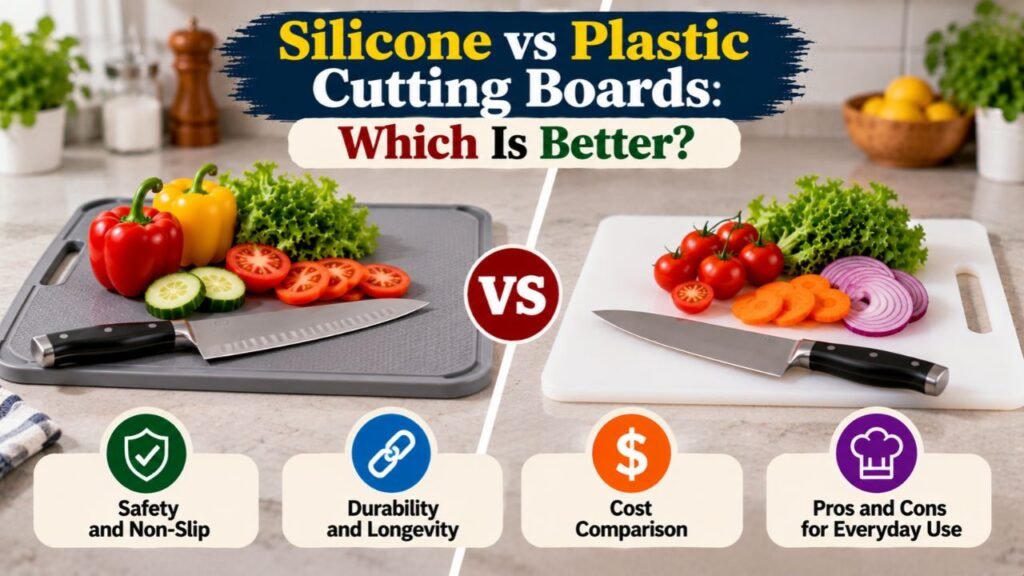
Silicone and plastic cutting boards are both synthetic kitchen products, but their physical characteristics differ.
Silicone is an elastic, rubber-like material, while most plastic cutting boards are made from relatively firm polyethylene or polypropylene.
| Feature | Silicone Cutting Board | Plastic Cutting Board |
| Main material | Silicone elastomer | Polyethylene or polypropylene |
| Surface feel | Soft and flexible | Firmer and more rigid |
| Knife friendliness | Often forgiving, but can grip blades | Generally knife-friendly |
| Chopping stability | Varies with thickness and support | Usually better with thick boards |
| Scratch resistance | May develop cuts or tears | Develops knife grooves |
| Moisture absorption | Very low | Very low |
| Cleaning | Usually easy to hand wash | Usually easy to hand wash |
| Dishwasher safety | Model-dependent | Many models are dishwasher-safe |
| Heat resistance | Generally higher | Generally lower |
| Flexibility | Often highly flexible | Rigid or moderately flexible |
| Microplastic concerns | Different particle-shedding behavior; limited research | Documented particle release during chopping |
| Typical price | Varies, often higher for thick models | Usually more affordable |
| Best use | Light slicing and flexible food transfer | Regular chopping and mixed preparation |
The most meaningful difference is the cutting experience.
A thick plastic board provides a consistent surface for chopping onions, slicing meat, and dicing vegetables. A silicone board can feel softer, but its flexibility may become inconvenient during repetitive knife work.
Both materials have advantages, and neither is automatically superior for every kitchen task.
What Are Silicone and Plastic Cutting Boards Made From?
Although both materials are manufactured from synthetic polymers, their chemical structures and physical characteristics differ.
Those differences influence flexibility, heat resistance, surface wear, and cleaning requirements.
What Is a Silicone Cutting Board?
A silicone cutting board is a food-preparation surface made from silicone elastomer, a flexible synthetic material with rubber-like properties.
Silicone contains a polymer backbone built from alternating silicon and oxygen atoms.
This structure contributes to its flexibility and resistance to temperature changes.
Silicone boards are often soft, lightweight, and easy to bend. Some are manufactured as relatively thick mats, while others include reinforced or rigid sections.
A soft silicone surface can provide cushioning beneath a knife blade.
Still, flexibility does not automatically mean resistance to sharp cuts.
A thin silicone board may be damaged if a knife penetrates deeply or repeatedly strikes the same area.
Important: A silicone baking mat is not the same as a silicone cutting board. Many baking mats contain fiberglass reinforcement and specifically prohibit cutting with knives.
Use only a product that the manufacturer identifies as suitable for direct cutting.
What Is a Plastic Cutting Board?
A plastic cutting board is a food-preparation surface commonly manufactured from polyethylene or polypropylene.
The two most familiar materials are:
- High-density polyethylene (HDPE): A durable, relatively firm plastic frequently used in commercial and household cutting boards.
- Polypropylene (PP): A lightweight plastic used in rigid cutting boards, flexible mats, and other kitchen products.
Both materials resist water absorption and can be manufactured with smooth food-contact surfaces.
Plastic boards are available in thick, rigid designs and thin, flexible formats.
Their physical properties vary with the plastic formulation and manufacturing method.
A thick HDPE cutting board generally provides more support during chopping than a very thin plastic sheet.
Some boards also include non-slip feet, juice grooves, handles, or textured undersides.
Is Silicone Actually a Type of Plastic?
Silicone and conventional plastic are both synthetic polymer materials, but they belong to different material families.
Plastic cutting boards generally contain carbon-based polymers such as polyethylene or polypropylene.
Silicone elastomers have a silicon-oxygen polymer backbone.
This chemical difference contributes to silicone’s elastic behavior and temperature tolerance.
It also matters when discussing microplastic pollution because conventional plastic fragments and silicone particles are not identical materials.
Still, silicone is not a natural or biodegradable substitute for plastic.
Key Takeaway: Silicone is a soft synthetic elastomer, while standard plastic boards use firmer polyethylene or polypropylene. Their material structures explain many differences in flexibility and cutting stability.
Which Is Better for Knife Sharpness and Cutting Performance?
Both silicone and plastic can provide knife-friendly cutting surfaces.
The practical difference involves surface firmness, blade resistance, and how the board responds to repeated cuts.
How Silicone Affects Knife Edges
Silicone generally provides a softer surface than conventional rigid plastic.
This softness may reduce the impact experienced when a knife edge contacts the board.
Some silicone boards also have a slightly elastic surface that compresses beneath light cutting pressure.
That can feel comfortable during controlled slicing.
The limitation is that soft silicone may grip a sharp blade, producing a dragging or sticking sensation.
A thin mat may also stretch beneath cutting pressure.
These characteristics are less noticeable during light fruit slicing than during repetitive chopping.
There is limited direct testing that establishes exactly how much longer knives remain sharp on silicone compared with different polyethylene or polypropylene boards.
I would not assume that every silicone board preserves knife sharpness better than every plastic board.
How Plastic Affects Knife Edges
A conventional plastic cutting board provides a firmer surface than silicone.
Food-grade HDPE and PP boards are commonly used for chopping because they resist moisture and provide consistent support.
Their surfaces can develop knife marks as the blade contacts the plastic.
That slight yielding is preferable to cutting against glass, stone, or metal.
Dense plastic may feel harder than silicone, but a suitable plastic board is still generally considered knife-friendly for household use.
The actual effect on sharpness varies with knife steel, cutting pressure, and plastic formulation.
A heavily scarred board can also affect cutting feel because the blade may catch in existing grooves.
Which Material Provides Better Knife Control?
A thick, rigid plastic board generally provides better support for repeated chopping.
The board remains relatively flat when pressure is applied, creating a predictable cutting surface.
Silicone can provide good traction against countertops, but the cutting surface itself may bend or stretch.
This is most noticeable with thin silicone mats.
For dicing onions, mincing vegetables, and making repeated downward cuts, I prefer a stable plastic board.
A thick silicone board specifically designed for knife work may perform better than a thin flexible mat.
Key Takeaway: Silicone offers a softer cutting feel, while rigid plastic provides more consistent support. For frequent chopping, a stable plastic board is generally the more practical option.
Which Material Is Safer and Easier to Clean?
Both silicone and plastic cutting boards can be hygienic when manufactured for food contact and cleaned correctly.
Their smooth, low-absorption surfaces make routine washing relatively straightforward.
Bacteria and Surface Porosity
Silicone and conventional cutting-board plastics are generally considered nonporous materials.
This means they do not absorb water in the same way as unfinished wood.
A smooth, intact surface can be washed and sanitized without requiring the moisture-control practices associated with many wooden boards.
Still, nonporous does not mean bacteria cannot remain on the surface.
Food particles, grease, and moisture can collect in scratches or surface damage.
A heavily scarred plastic board may become difficult to clean thoroughly.
Similarly, a silicone board with tears or deep cuts may retain residue.
The USDA recommends replacing cutting boards when they become excessively worn or develop grooves that cannot be cleaned adequately.
Cleaning After Raw Meat and Poultry
Both materials may be used for raw meat and poultry when they are intended for food preparation.
The USDA recommends using separate cutting boards for raw animal foods and ready-to-eat ingredients.
This reduces cross-contamination between raw meat juices and foods that will not receive further cooking.
After preparing raw chicken, beef, or seafood, wash the cutting board with hot, soapy water.
Rinse thoroughly and sanitize when appropriate.
USDA guidance describes a sanitizing solution made with 1 tablespoon of unscented liquid chlorine bleach per gallon of water.
The solution is applied after cleaning, allowed to remain for several minutes, then rinsed away before the board is dried.
Check that the board material is compatible with the sanitizer and follow the product label.
Dishwasher Safety
Many conventional plastic cutting boards can be cleaned in a dishwasher.
HDPE and PP products are often marketed as dishwasher-safe, but heat tolerance varies by formulation and thickness.
Thin plastic boards may warp if exposed to excessive dishwasher heat.
Many food-grade silicone cutting boards are also dishwasher-safe.
Their flexibility can make them convenient to position in a dishwasher, but thin mats should be secured so they do not contact heating elements.
A manufacturer may recommend hand washing for certain reinforced or specialty silicone products.
For both materials, dishwasher compatibility should be confirmed from the product instructions rather than assumed.
Key Takeaway: Silicone and plastic can both be easy to clean. Thorough washing, proper sanitizing, and replacing deeply damaged surfaces matter more than choosing one material solely for hygiene.
Silicone vs Plastic Cutting Boards: Microplastics and Food Safety
Microplastic release is an important concern in this comparison.
Research has demonstrated that chopping on conventional plastic surfaces can release small particles.
The available evidence does not establish that silicone cutting boards eliminate every form of particle exposure.
What Research Shows About Plastic Cutting Boards
A 2023 study published in Environmental Science & Technology examined particle release from polyethylene and polypropylene cutting boards during chopping.
Researchers, including scientists affiliated with North Dakota State University, found that knife contact released microplastic particles from both materials.
The amount released varied according to board material and chopping conditions.
The researchers also developed estimates of possible annual exposure based on assumed cutting-board use.
Those estimates were modeled projections, not measurements of what every person actually consumes.
The study demonstrates a possible route for plastic particles to enter food.
It does not establish that using a plastic cutting board causes a specific illness.
The U.S. Food and Drug Administration states that current scientific evidence does not demonstrate that the levels of microplastics and nanoplastics detected in foods pose a risk to human health.
Research into exposure, detection methods, and potential health effects is continuing.
Do Silicone Cutting Boards Release Microplastics?
Silicone is chemically different from polyethylene and polypropylene.
It is therefore inaccurate to assume that silicone behaves exactly like the conventional plastic boards examined in the 2023 study.
Still, silicone cutting surfaces can experience wear.
Sharp knives may produce cuts, detached fragments, or other forms of surface damage.
Silicone particles are different from conventional polyethylene microplastics, but that distinction does not establish that all silicone particles are harmless.
There is also less direct research comparing particle shedding from silicone cutting boards against common plastic cutting boards under identical conditions.
For that reason, claims that silicone boards are completely free from particle-shedding concerns go beyond the available evidence.
Does Food-Grade Silicone Mean It Is Safer?
Food-grade silicone is manufactured for applications involving food contact.
U.S. federal regulations, including 21 CFR 177.2600, contain requirements for certain rubber articles intended for repeated food contact and include specified silicone elastomers.
Conventional food-contact plastics are also regulated.
A product’s suitability depends on its formulation, additives, manufacturing quality, and intended use.
The phrase “FDA-approved” should not be treated as proof that the FDA independently tested and endorsed a particular cutting board.
Look for clear food-contact compliance information and manufacturer instructions.
Also, BPA-free labeling alone is not a meaningful reason to favor silicone over HDPE or PP. Bisphenol A is not a standard building block of either polyethylene or polypropylene.
Key Takeaway: Plastic cutting boards can release microplastic particles during chopping. Silicone has different chemistry but can still wear, and research does not currently justify declaring either material completely risk-free.
Durability, Heat Resistance, and Surface Wear
The long-term durability of a cutting board depends on how its surface handles repeated knife contact, washing, and storage.
Silicone and plastic fail in different ways.
Scratches, Deep Cuts, and Surface Damage
Plastic cutting boards usually develop visible knife scratches during ordinary use.
Over time, repeated chopping can create deeper grooves.
A heavily grooved board may become difficult to clean, especially after contact with raw meat.
Silicone has a more elastic surface, so some light pressure marks may be less noticeable.
That does not make silicone cut-proof.
A sharp knife can damage a soft silicone mat, and repeated cuts may produce tears or openings.
Thin silicone mats are especially vulnerable to cutting through the material.
Neither material should be used after surface damage begins creating loose fragments or hard-to-clean areas.
Heat Resistance and Warping
Silicone generally tolerates higher temperatures than polyethylene or polypropylene.
This is one reason silicone is commonly used in baking tools and heat-resistant kitchen accessories.
Some silicone products are rated for contact with hot cookware.
Still, a silicone cutting board should not automatically be used as a trivet unless its manufacturer specifically permits that application.
Plastic cutting boards have lower heat tolerance.
A hot pan or direct contact with a heating element may cause melting, softening, or permanent distortion.
Avoid placing hot cookware on an ordinary plastic cutting board.
Helpful Insight: A material’s general heat resistance is not a substitute for checking the finished product’s temperature rating.
Stains, Odors, and Long-Term Appearance
Both surfaces can develop discoloration from foods such as turmeric, tomatoes, and beets.
Some silicone products may retain strong food odors or develop a persistent oily film after repeated contact with fatty ingredients.
Plastic can also retain odors, especially when its surface becomes heavily scratched.
Wash boards promptly after handling strongly colored or aromatic foods.
Use cleaning products recommended by the manufacturer, and avoid abrasive tools that could cause additional surface damage.
Replace a board when damage or persistent contamination makes thorough cleaning impractical.
Key Takeaway: Plastic is generally firmer but accumulates knife grooves. Silicone bends without cracking easily, yet can tear or become damaged by sharp blades. Both need inspection and replacement when worn.
Silicone vs Plastic Cutting Boards for Different Foods
Cooking habits often reveal which material is more practical.
The best cutting surface for slicing soft fruit may not be the best one for repeated chopping or raw meat preparation.
Best for Raw Meat, Poultry, and Seafood
A thick plastic cutting board is my preferred choice for routine raw meat preparation.
It offers a stable surface for trimming chicken, slicing beef, and preparing fish.
Many models can be cleaned in a dishwasher, making routine sanitation convenient.
A silicone board specifically designed for knife work may also be suitable.
Still, a thin silicone mat can bend when handling heavy or slippery ingredients, reducing cutting stability.
For raw poultry or large pieces of meat, a firm plastic board with a non-slip base is generally easier to control.
Best for Vegetables, Fruits, and Herbs
Both materials work for light vegetable and fruit preparation.
Silicone boards are convenient for slicing strawberries, cutting soft fruit, or preparing smaller quantities of vegetables.
A flexible board can also be lifted and curved to transfer ingredients into a bowl or pan.
Plastic boards are preferable for repeated dicing, chopping firm vegetables, or preparing larger quantities of ingredients.
A rigid surface provides consistent support when cutting carrots, potatoes, onions, and similar foods.
For regular meal preparation, I favor a sturdy plastic board over a very thin silicone mat.
Best for Bread, Cheese, and Light Slicing
Silicone may be useful for soft cheese, fruit, and gentle slicing tasks.
Its flexible surface is easy to handle, although certain foods may drag against the material.
Plastic also works well for bread, cheese, and sandwiches.
A serrated bread knife can create noticeable wear on softer surfaces if pressed forcefully into the board.
Use controlled cutting pressure and avoid dragging the knife tip unnecessarily.
A lightweight plastic board may be more convenient for occasional sandwich preparation than a large, heavy chopping block.
Best for Small Kitchens and Limited Storage
Flexible silicone boards can fit into narrow cabinets or drawers.
Some can be loosely rolled or folded according to manufacturer instructions.
Thin plastic cutting mats offer similar storage advantages and are often less expensive.
For small kitchens, a compact rigid plastic board with a hanging hole may provide a better balance of storage and chopping stability.
A flexible mat is useful as a secondary preparation surface, but it may not replace a sturdy main cutting board.
Key Takeaway: Plastic is generally more practical for raw meat and repeated vegetable chopping. Silicone is appealing for gentle slicing, flexible ingredient transfer, and lightweight storage.
Price, Storage, and Environmental Differences
Initial purchase price is only one part of the comparison.
Replacement frequency, manufacturing materials, and local disposal options also deserve attention.
Which Material Costs Less?
Standard polyethylene and polypropylene cutting boards are usually available at lower prices.
Simple plastic boards are widely manufactured and sold in many sizes.
Thicker commercial-style HDPE boards generally cost more than thin plastic mats.
Silicone cutting boards vary in price according to thickness, reinforcement, and design.
A thin silicone mat may be inexpensive, while a substantial silicone cutting surface can cost considerably more.
I recommend comparing boards of similar working size and thickness rather than judging value by material name alone.
Which Material Is Easier to Store?
Both materials are available in lightweight designs.
Thin silicone boards are often more flexible and may be rolled for storage when the manufacturer permits it.
Thin plastic mats can also be curved to transfer food, although repeated tight folding may leave permanent creases.
Thicker plastic boards retain their shape and are often easier to store vertically.
Avoid placing heavy objects on folded silicone or thin plastic boards because this may distort their surfaces.
Which Material Is More Environmentally Responsible?
Neither material is automatically environmentally harmless.
Polyethylene and polypropylene are petroleum-derived plastics that can contribute to persistent plastic waste.
Some plastic products can be recycled, but household recycling programs do not necessarily accept cutting boards.
Silicone is also a manufactured polymer and is not readily biodegradable.
Specialized recycling routes exist for some silicone products, but they are not commonly available through ordinary curbside programs.
A durable, well-maintained board that stays usable for years may reduce repeated purchases.
Consider product lifespan, manufacturing quality, repair limitations, and local recycling options before assuming one material has a smaller environmental impact.
Key Takeaway: Plastic usually costs less and is easy to find. Silicone provides flexible storage options, but neither material has a guaranteed environmental advantage without considering production and disposal.
How to Choose a Good Silicone or Plastic Cutting Board
The material alone does not tell the full story about product quality.
A suitable board should be stable, smooth, clearly intended for knife use, and easy to clean.
What to Look for in a Silicone Board
For silicone, I would prioritize products explicitly marketed as cutting boards rather than multipurpose baking mats.
Check these features:
- A clearly stated food-contact material
- Manufacturer confirmation that knives may be used
- Adequate thickness for the intended cutting tasks
- A stable, flat cutting surface
- Clear cleaning and dishwasher instructions
- No exposed reinforcement or questionable coatings
Avoid products that feel excessively thin for chopping or move easily beneath a knife.
If the silicone surface is reinforced with another material, confirm that cutting will not expose the reinforcement.
A silicone baking mat that contains fiberglass should not be repurposed as a cutting board.
What to Look for in a Plastic Board
For most households, I recommend a rigid HDPE or PP board with enough cutting area for vegetables and meat.
Choose a board that rests flat on the countertop.
Non-slip feet are useful, and a juice groove can contain liquid released while carving meat.
Look for a smooth surface without raised edges, rough manufacturing marks, or visible defects.
Confirm dishwasher compatibility if machine washing is part of your normal cleaning routine.
A sturdy board that does not flex under chopping pressure will usually feel more predictable than a thin plastic cutting sheet.
When Should Either Board Be Replaced?
Regular inspection is more useful than relying on a fixed replacement schedule.
Replace a cutting board if you notice:
- Deep grooves that cannot be thoroughly cleaned
- Loose plastic or silicone fragments
- Tears or holes in the cutting surface
- Permanent distortion that causes rocking
- Persistent contamination after proper cleaning
- Damaged layers or exposed internal reinforcement
Minor cosmetic scratches do not automatically mean replacement is necessary.
The deciding issue is the condition of the food-contact surface and its ability to remain clean and stable during cutting.
Key Takeaway: Choose silicone only when the product is intended for knives. For plastic, prioritize rigidity, food-contact suitability, and dishwasher compatibility. Replace either type when surface damage prevents safe use.
Conclusion
The silicone vs plastic cutting boards comparison shows that silicone offers flexibility, a softer cutting feel, and generally higher heat resistance, while conventional plastic provides better support for everyday chopping. Both materials can be suitable for food preparation when properly manufactured and maintained.
Silicone may appeal to people who prefer lightweight, flexible preparation surfaces. Plastic is usually more practical for repeated vegetable chopping, raw meat preparation, and tasks requiring a firm surface. Both can develop damage, and neither material should be considered automatically free from particle-shedding concerns.
For most home kitchens, I recommend a thick, food-contact-safe plastic cutting board with a stable base. A purpose-made silicone cutting board can work as a secondary option for lighter tasks. Check cleaning instructions, avoid using silicone baking mats as cutting surfaces, and replace boards when deep damage develops.
FAQs About Silicone and Plastic Cutting Boards
Are silicone cutting boards better than plastic?
Silicone cutting boards are better for some light preparation tasks because they are flexible and often provide a softer surface under a knife.
Plastic boards are generally better for daily chopping because their rigidity creates a stable work surface.
Both can be easy to clean and suitable for food contact. A thick plastic board is usually the more versatile option, while a purpose-made silicone board may be convenient for gentle slicing.
Do silicone cutting boards dull knives?
Silicone’s relatively soft surface may be forgiving under knife edges, but there is limited direct testing that proves silicone preserves sharpness better than all conventional plastics.
Some silicone boards may also grip a blade during cutting.
Knife wear varies with the board’s formulation, knife steel, edge geometry, and cutting technique.
A suitable silicone board can be knife-friendly, but it should not be treated as a guarantee against dulling.
Are silicone cutting boards safer than plastic cutting boards?
Both materials can be safe when manufactured for food contact and used according to their instructions.
Conventional plastic cutting boards have been shown to release microplastic particles during chopping. Silicone has different chemistry but may still release fragments when damaged.
Current evidence does not establish that every silicone board is safer than every plastic board.
Material quality, cleanliness, cutting stability, and surface condition remain important.
Can silicone cutting boards release microplastics?
Silicone is not the same polymer material as polyethylene or polypropylene, so its wear particles differ from conventional plastic fragments.
Still, silicone can be cut, abraded, or torn by knives.
Research directly comparing particle release from silicone cutting boards with standard plastic boards remains limited.
Choosing food-contact-safe products and replacing visibly damaged cutting surfaces is sensible for either material.
Are silicone cutting boards dishwasher-safe?
Many purpose-made silicone cutting boards are dishwasher-safe, but the manufacturer’s instructions determine the appropriate cleaning method.
Some reinforced mats or specialty products may require hand washing.
If the board is dishwasher-safe, position it securely so it cannot fall onto a heating element.
Plastic boards also vary in dishwasher compatibility, and thin models may distort under excessive heat.
Can you cut meat on a silicone cutting board?
Yes, if the silicone product is specifically manufactured for cutting food with knives.
A suitable silicone board can be used for meat preparation when it is stable and properly cleaned afterward.
Thin, unsupported silicone mats may be inconvenient for trimming large or slippery cuts of meat.
A rigid plastic board with a secure base is generally the more practical choice for routine raw meat preparation.
Is a silicone baking mat the same as a silicone cutting board?
No. A silicone baking mat is intended for baking or pastry work and may not tolerate direct contact with sharp knives.
Many baking mats contain fiberglass reinforcement that can become exposed if the silicone surface is cut.
A silicone cutting board should be explicitly identified as suitable for knife use.
Never substitute a baking mat for a cutting board unless its manufacturer specifically approves cutting on that product.
Which lasts longer, silicone or plastic cutting boards?
There is no guaranteed lifespan advantage for either material.
A thick plastic board may withstand years of regular chopping before deep grooves require replacement.
A quality silicone board may remain usable for a long period during light cutting, but sharp blades can cause tears or surface damage.
The actual lifespan depends on product construction, cutting pressure, cleaning practices, and storage. Replace either board when it develops structural damage or hard-to-clean surfaces.