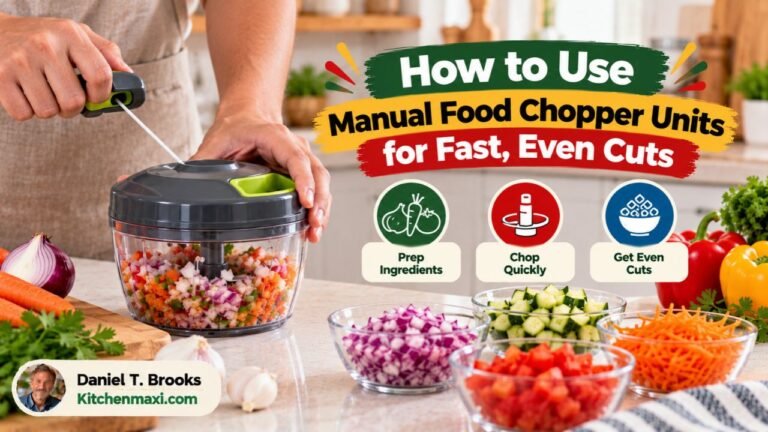
Fullstar All-in-1 Vegetable Chopper: Review, Blades, and Uses
This manual vegetable-prep tool combines push-down dicing with mandoline-style slicing, julienne cutting, grating, and zesting. The commonly sold All-in-1 version has eight interchangeable blades, a 5-cup catch container, two working lids, a non-slip base, and cleaning tools, making it best suited to people who prepare several vegetables at a time.
The Fullstar All-in-1 sits between a basic onion chopper and a separate mandoline slicer. Instead of buying one tool for dicing and another for slicing or grating, you can change the insert while using the same catch tray and main body.
Its biggest strength is the range of cuts. The eight-blade setup commonly includes small and large dicing grids, a slicer, julienne cutter, fine and coarse graters, a zester, and a wavy-cut blade. That covers many everyday jobs without electricity.
For this Fullstar All-in-1 Vegetable Chopper, the tradeoff is that more functions also mean more pieces to handle, clean, and store. Hard vegetables such as potatoes and carrots may also need to be cut into thinner sections before they will pass comfortably through the dicing grid.
The product is manual, so the blade does not spin like an electric food processor. For dicing, the hinged lid pushes food through a fixed grid. For slicing and grating, the food moves across the appropriate mandoline-style insert.
Another detail worth recognizing is the product naming. The same general model family may appear as an All-in-1, 8-in-1, or Pro Original chopper and mandoline depending on packaging and retailer. Blade count, chassis, and model identification are more useful than relying only on the marketing name.
Fullstar All-in-1 Vegetable Chopper Review: Quick Verdict
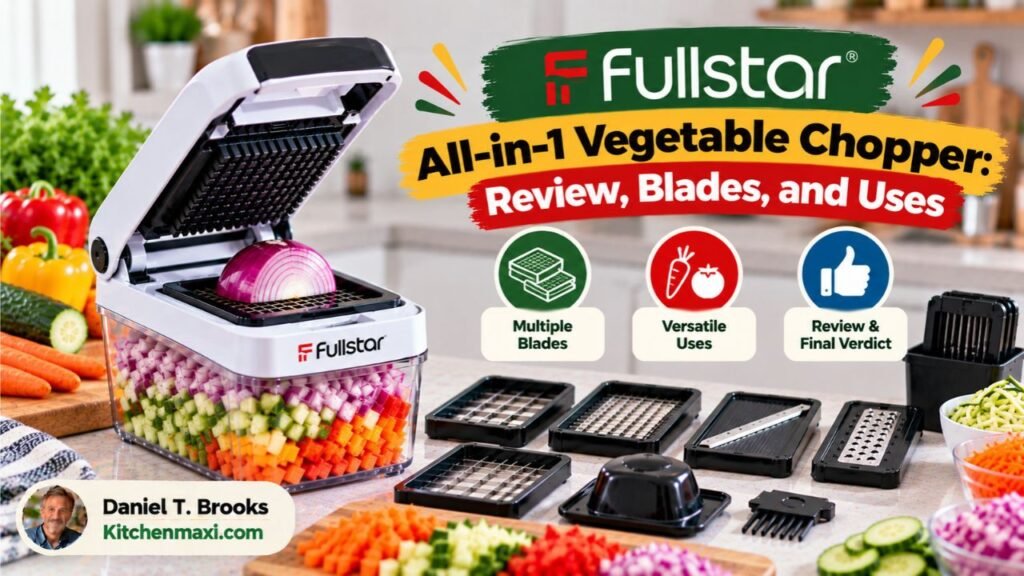
The All-in-1 makes the most sense for someone who regularly prepares several types of vegetables and wants more than square dicing.
It works well for foods such as:
- Onions
- Bell peppers
- Cucumbers
- Zucchini
- Potatoes
- Carrots
- Cabbage
- Apples
- Firm tomatoes
- Garlic
- Firm cheese with suitable inserts
The dicing system is the strongest part of the design. Once food is cut to fit the grid, pressing the lid can create a batch of similarly sized pieces far faster than individually cutting each cube with a knife.
The mandoline lid broadens its use. Swapping inserts lets the same base handle slices, julienne strips, grated vegetables, zest, and decorative wavy cuts.
What I Like About the Fullstar All-in-1
The main advantages are:
- Eight cutting inserts
- Two dicing sizes
- Dedicated mandoline setup
- 5-cup catch tray
- Food holder for safer slicing
- Non-slip base
- Side handle
- Cleaning grid, brush, and pick
- Manual operation
- Dishwasher-safe construction on the commonly listed All-in-1 model
The container is especially useful during batch prep. Instead of covering a cutting board with diced onion or cucumber, the food drops directly beneath the blade.
What I Would Consider Before Buying
The main downsides are:
- Hard vegetables require force
- Large ingredients need pre-cutting
- Fine dicing grids trap food
- Eight inserts require storage
- Mandoline blades need careful handling
- Fixed inserts offer less thickness control than some dedicated mandolines
- A knife may still be quicker for one small ingredient
I would choose this model for repeated meal prep rather than occasional chopping.
Key Takeaway: The Fullstar All-in-1 is strongest for people who want dicing, slicing, julienne, grating, and similar prep jobs in one manual system rather than a simple onion-only chopper.
Read More: Fullstar Vegetable Chopper vs Mueller
What Comes With the Fullstar All-in-1 Vegetable Chopper?
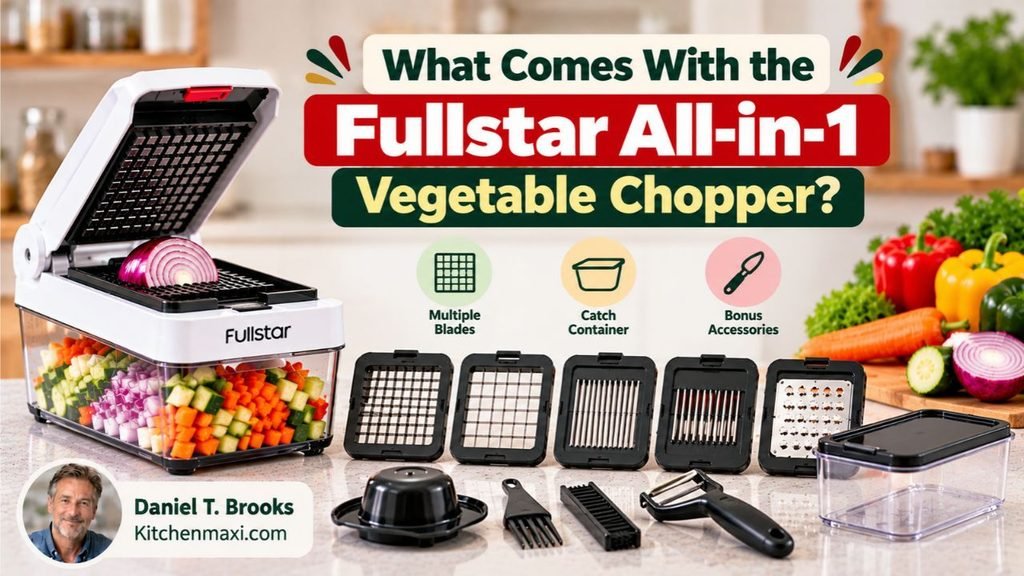
The commonly sold All-in-1 package centers on one catch container with two ways to process ingredients.
Typical contents include:
- Main chopper body
- Push-down chopping lid
- Slim mandoline lid
- Small dicer blade
- Large dicer blade
- Slicer blade
- Julienne blade
- Coarse grater
- Fine grater
- Zester
- Wavy blade
- 5-cup catch tray
- Tray lid
- Food holder or finger guard
- Cleaning pusher grid
- Cleaning brush
- Cleaning pick
Exact packaging can change, so the product box should be checked against the blade set before purchase.
Fullstar Chopping Lid
The chopping lid is used with the dicing grids.
Food sits over the blade and is pressed through when the lid closes.
This setup works best for ingredients that can be given a reasonably flat surface.
Fullstar Mandoline Lid
The second lid supports slicing, julienne, grating, and similar inserts.
Food moves across the blade rather than being pushed straight through it.
The food holder is important because the cutting edge remains exposed during this type of use.
Fullstar Catch Tray
The tray holds roughly five cups on the commonly listed All-in-1 model.
That is enough room for a useful quantity of:
- Diced onion
- Peppers
- Potatoes
- Cucumber
- Salad vegetables
The tray can fill faster with large-dice foods, so check underneath the blade before continuing a large batch.
Key Takeaway: The All-in-1 combines a press-down chopping lid, mandoline lid, eight cutting inserts, a catch tray, and dedicated cleaning accessories in one package.
Fullstar All-in-1 Vegetable Chopper Blade Guide
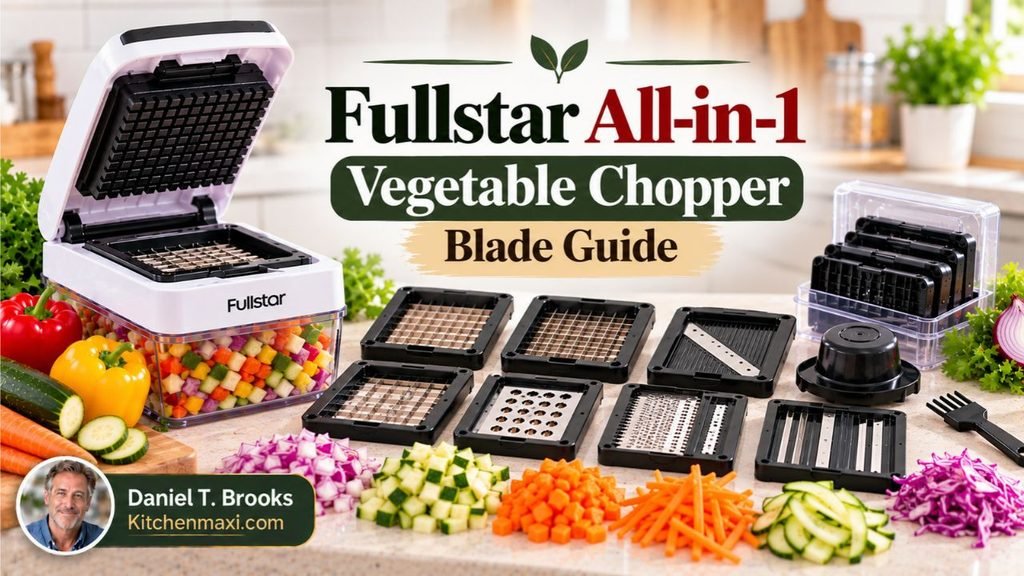
The eight inserts determine most of what this chopper can do.
Small Dicer Blade
The small dicing grid creates smaller cubes.
It works well for:
- Onion
- Pepper
- Cucumber
- Celery
- Firm tomato
- Garlic in suitably sized pieces
The smaller openings create more resistance than the large grid.
Dense ingredients should therefore be cut thinner before pressing.
Large Dicer Blade
The larger grid produces chunkier pieces and usually needs less force.
It is a good match for:
- Potato
- Apple
- Zucchini
- Onion
- Cucumber
- Vegetables for soup or roasting
For hard potatoes, cutting them into manageable slabs before dicing reduces stress on the lid and blade frame.
Slicer Blade
The slicer produces flat pieces for:
- Cucumber
- Potato
- Zucchini
- Onion
- Radish
- Firm fruit
Unlike an adjustable mandoline, the insert determines the slice thickness.
That makes operation simple but gives you less control over exact thickness.
Julienne Blade
The julienne insert creates narrow strips.
It suits:
- Carrots
- Zucchini
- Cucumber
- Potatoes
- Salad vegetables
It is useful for slaws, stir-fries, garnishes, and vegetable bowls.
Coarse Grater Blade
The coarse grater produces larger shreds.
Possible uses include:
- Carrot
- Zucchini
- Firm cheese
- Cabbage
- Potato
Fine Grater Blade
The finer grater creates smaller shreds.
It can work for:
- Cheese
- Carrot
- Garlic
- Chocolate
- Other suitable firm ingredients
Zester Blade
The zester handles small, fine material.
Typical uses include:
- Lemon zest
- Lime zest
- Orange zest
- Garlic
- Ginger
Only the colored outer citrus peel should normally be removed for zest; the white pith underneath is more bitter.
Wavy Blade
The wavy insert creates crinkle-style cuts.
It can be used for:
- Potatoes
- Cucumbers
- Carrots
- Zucchini
This blade is more about shape than changing ingredient size dramatically.
Key Takeaway: The eight inserts cover two dice sizes plus slicing, julienne, coarse and fine grating, zesting, and wavy cuts, giving the All-in-1 much broader use than a basic chopper.
How to Use the Fullstar All-in-1 Vegetable Chopper for Dicing
Correct food preparation makes the chopper easier to close and reduces stress on its frame.
Step 1: Place the Fullstar Chopper on a Flat Counter
Use a dry, stable work surface.
Make sure the non-slip base sits flat.
Do not operate the chopper on a wet or oily counter.
Step 2: Choose the Dicing Blade
Select either:
- Small dicer
- Large dicer
Hold the insert by its plastic frame.
Keep fingers away from the metal edges.
Step 3: Lock the Blade Into the Chopping Lid
Seat the insert completely.
Do not use it if:
- One side sits higher
- The insert rocks
- The frame does not lock
- The blade appears damaged
Step 4: Cut the Vegetable to Fit the Grid
Large vegetables should be divided before they go onto the blade.
For example:
- Halve or quarter onions
- Cut potatoes into slabs
- Cut thick carrots into shorter or thinner pieces
- Remove pepper stems and cores
A flat side keeps food from rolling during the press.
Step 5: Position the Ingredient on the Blade
Center the food over the grid.
Avoid placing a large piece partly outside the cutting area.
Step 6: Press the Lid With Firm, Even Force
Close the lid in one controlled movement.
If it will not close without extreme force, stop.
The ingredient may be:
- Too thick
- Too hard
- Too large
- Poorly positioned
Cut it smaller rather than repeatedly slamming the lid.
Step 7: Check the Catch Tray
Let the diced food fall away from the blade.
Empty the tray before chopped pieces begin pressing against the underside of the grid.
Key Takeaway: Fullstar dicing works best when vegetables are cut flat and thin enough for the selected grid, then pressed through with controlled force rather than repeated impact.
How to Use the Fullstar All-in-1 as a Mandoline Slicer
Mandoline operation is different from dicing because the blade stays exposed while food moves across it.
Install the Mandoline Lid
Remove the chopping setup and fit the slimmer slicing lid according to the product design.
Lock the required insert in place.
Use the Food Holder
Do not hold a shrinking vegetable directly with your fingertips near the blade.
The food holder keeps your hand farther from the cutting edge.
Move the Food Evenly Across the Blade
Use consistent pressure and movement.
Tilting the food can create uneven slices.
Stop Before the Food Becomes Too Small
Do not try to get one last slice by moving exposed fingers toward the blade.
Discard or knife-cut the remaining small piece if the holder can no longer grip it securely.
How Well the Fullstar All-in-1 Chops Onions
Onions are one of the best foods for the push-down dicer.
Peel the onion and cut it into halves or quarters depending on size.
Place a flat cut face against the grid.
The small blade works well for salsa and finer onion pieces.
The larger grid suits:
- Soup
- Chili
- Roasted vegetables
- Stews
A very soft onion may crush more than a fresh firm one.
The chopper works best when the onion still has a crisp structure.
How Well the Fullstar All-in-1 Cuts Potatoes
Potatoes can be diced successfully, but they are denser than onions.
The large dicer is usually the easier choice.
Cut a large potato into thinner pieces before pressing.
Trying to force a thick potato section through a fine grid places unnecessary load on:
- Blade
- Plastic frame
- Lid hinge
- Handle
For fries or decorative potato pieces, the slicing and wavy inserts may be more suitable than the dicing grids.
How Well the Fullstar All-in-1 Cuts Carrots
Raw carrots are among the harder ingredients for a manual chopper.
Thin sections work better than thick chunks.
For dicing, cut large carrots lengthwise or into smaller pieces before placing them on the grid.
For salad or stir-fry preparation, the julienne insert may make more sense.
If the chopper lid stops moving, do not use body weight to force it shut.
Remove the carrot and make it thinner.
How Well the Fullstar All-in-1 Cuts Tomatoes
Firm tomatoes work better than very ripe tomatoes.
A firm tomato can produce neat pieces for:
- Salsa
- Salad
- Tacos
A very soft tomato may compress under the lid and release juice before the skin passes cleanly through the grid.
The large dicer often treats softer tomatoes more gently than a very fine dicing grid.
How Well the Fullstar All-in-1 Slices Cucumbers and Zucchini
Cucumber and zucchini are well suited to the mandoline section.
Their relatively soft texture means they move through the slicer with little force.
Use them for:
- Salad slices
- Pickling
- Sandwiches
- Vegetable bowls
- Julienne strips
Long zucchini may need to be cut into shorter sections so the food holder can control it safely.
Key Takeaway: Onions, cucumbers, peppers, zucchini, and firm tomatoes are easy matches for the Fullstar, while potatoes and carrots need smaller or thinner starting pieces.
Is the Fullstar All-in-1 Vegetable Chopper Easy to Clean?
It is relatively simple to clean if food is removed immediately.
Waiting for potato starch, onion skin, or grated cheese to dry in the grid makes the job much harder.
Remove the Blade Carefully
Hold the insert by its frame.
Do not press fingers into the cutting openings.
Use the Cleaning Pusher Grid
The pusher section can collect small food fragments after dicing.
The removable cleaning grid is intended to lift or expose this trapped residue.
Use the Brush and Pick
The included tools are useful around:
- Fine dicing openings
- Pusher blocks
- Corners
- Grater holes
Use the pick only as intended and keep fingers away from the cutting side.
Rinse Immediately
Running water through the back of a dicing blade can push food away from the cutting edges.
This is much easier than removing dried residue later.
Is the Fullstar All-in-1 Vegetable Chopper Dishwasher Safe?
The commonly listed All-in-1 model is specified as dishwasher safe.
Fullstar also recommends top-rack dishwasher cleaning for many of its choppers.
Disassemble the unit before loading it.
Do not wash the entire chopper closed and assembled because food and water can remain trapped between:
- Blade
- Pusher
- Lid
- Container
For the safest routine:
- Remove food.
- Take out the cutting insert.
- Rinse trapped debris.
- Place dishwasher-approved parts securely on the rack.
- Dry the blade inserts before storage.
Fullstar has sold several closely related configurations, so care directions on the exact box or manual should override a general rule if they differ.
Key Takeaway: Cleaning is easiest immediately after use, and the commonly sold All-in-1 is dishwasher safe, though blade grids should still be rinsed and cleared before loading.
Fullstar All-in-1 Vegetable Chopper Safety
The product is manual, but its blades are extremely sharp.
Hold Inserts by the Plastic Frame
Do not grip the metal cutting area while changing blades.
Use the Food Guard With the Mandoline
The dicing lid keeps your hands above the food, but the mandoline exposes the blade.
Use the holder rather than moving your bare fingertips close to it.
Never Clear the Blade With Your Fingers
Food trapped in a dicing grid can hide sharp edges.
Use:
- Cleaning grid
- Brush
- Pick
- Running water
instead.
Do Not Force Jammed Vegetables
A stuck potato or carrot is a signal to stop and reduce the food size.
Extreme pressure can cause:
- Blade movement
- Food slipping
- Frame stress
Store Blades Securely
Do not leave loose inserts mixed with ordinary utensils.
Anyone reaching blindly into a drawer could contact a blade edge.
Fullstar All-in-1 Vegetable Chopper Build and Materials
The chopper combines stainless steel cutting inserts with a molded body and collection container.
Current Fullstar Pro Original products use 420J stainless steel cutting inserts and BPA-free, PFAS-free body materials.
The All-in-1 style also uses a non-slip base and side handle to keep the chopper more stable during pressing.
Blade Frame Condition Matters
Stop using an insert if its frame becomes:
- Cracked
- Warped
- Loose
- Unable to lock correctly
Inspect the Chopper Hinge
The push-down lid takes repeated force.
Pre-cutting hard vegetables reduces unnecessary stress on the hinge.
Check Cutting Edges
A blade that bends, chips, or becomes noticeably dull should be replaced rather than forced through food.
Fullstar All-in-1 Replacement Blades and Parts
Fullstar sells replacement blade kits for selected chopper models.
Compatibility needs to be checked before ordering because the company has more than one chassis and blade-frame size.
Look for:
- Model name
- Model number
- Blade dimensions
- Chassis family
- Replacement-kit compatibility list
Do not assume an insert fits simply because both products carry the Fullstar name.
Replacement dicing blades are useful because a worn cutting grid does not automatically mean the entire chopper has to be discarded.
Availability of:
- Lids
- Containers
- Cleaning pieces
- Mandoline inserts
can differ by model and over time.
Fullstar All-in-1 vs Basic Fullstar Vegetable Chopper
A basic chopper is simpler.
The All-in-1 offers more cut styles.
| Feature | Fullstar All-in-1 | Basic Fullstar Chopper |
| Dicing | Yes | Yes |
| Multiple dice sizes | Yes | Model-dependent |
| Slicing | Yes | Model-dependent |
| Julienne | Yes | Often limited |
| Grating | Yes | Usually limited |
| Zesting | Yes | Usually no |
| Wavy cuts | Yes | Usually no |
| Attachments to store | More | Fewer |
| Cleaning time | More | Less |
| Best for | Mixed meal prep | Basic chopping |
If you mainly want onions and potatoes diced, a simpler model is easier to store.
If you regularly switch between slicing, grating, julienne, and dicing, the All-in-1 makes more sense.
Fullstar All-in-1 vs Food Processor
These tools create different results.
Fullstar Produces Defined Shapes
It is better for:
- Uniform dice
- Slices
- Julienne strips
- Grated vegetables
- Decorative cuts
Food Processor Produces Faster Bulk Prep
A food processor is better for:
- Large-volume shredding
- Chopping without exact cubes
- Purees
- Sauces
- Dough on compatible machines
- Large batches
The Fullstar also needs no electricity and takes less counter space.
A food processor requires less hand force with hard vegetables.
Fullstar All-in-1 Vegetable Chopper Pros and Cons
Fullstar All-in-1 Pros
- Eight cutting blades
- Two dicing sizes
- Dicing and mandoline lids
- Slicing and julienne functions
- Fine and coarse grating
- Zesting and wavy cuts
- 5-cup catch container
- No electricity
- Non-slip base
- Cleaning tools included
- Dishwasher-safe common configuration
- Replaceable blade options
Fullstar All-in-1 Cons
- More attachments to store
- Dense vegetables need preparation
- Fine grids can trap food
- Manual force is required
- Fixed slicer thickness
- Sharp inserts require careful handling
- More cleanup than a knife for tiny jobs
Key Takeaway: The Fullstar All-in-1 offers many prep functions for its size, but its extra blades create more cleanup and storage than a basic two-blade chopper.
Who Should Buy the Fullstar All-in-1 Vegetable Chopper?
It makes the strongest case for people who prepare vegetables several times a week.
It is a good match for:
- Family meal prep
- Weekly batch cooking
- Salads
- Salsa
- Soups
- Stews
- Slaws
- Stir-fries
- Roasted vegetables
- Potato dishes
It is also useful when uniform size matters.
Similar pieces tend to cook more evenly than a mixture of very large and very small hand-cut pieces.
Who May Not Need the Fullstar All-in-1?
A simpler option may make more sense if you:
- Chop only small amounts
- Prefer knife work
- Need adjustable paper-thin slices
- Have limited storage
- Dislike cleaning multiple inserts
- Have hand or wrist limitations
- Mostly want puree or irregular chopped food
An electric chopper or food processor may require less physical force for certain jobs.
Is the Fullstar All-in-1 Vegetable Chopper Worth It?
For frequent mixed vegetable prep, I think the All-in-1 format makes sense.
Its biggest advantage is not simply speed. It is the ability to switch between several defined cut styles while using the same catch container and base.
The product is less attractive if most of the eight blades would remain in storage.
Someone who only dices onions may get the same day-to-day use from a simpler Fullstar model with fewer pieces.
Someone who dices onions, slices cucumbers, juliennes carrots, grates cheese, and prepares potatoes is more likely to use what the All-in-1 package offers.
Conclusion
The Fullstar All-in-1 Vegetable Chopper combines a press-down vegetable dicer and mandoline-style preparation system with eight interchangeable cutting inserts. It handles small and large dice, slicing, julienne, grating, zesting, and wavy cuts while collecting prepared food in the tray below.
Its strongest foods are onions, peppers, cucumbers, zucchini, potatoes, carrots, cabbage, and other produce that can be trimmed to fit the blade. Dense vegetables need smaller starting pieces, and softer foods such as ripe tomatoes require a lighter approach.
The eight-blade setup gives it more flexibility than a basic vegetable chopper, but those additional functions mean more pieces to clean and store. Immediate rinsing makes the dicing grids much easier to maintain.
I would choose it for regular meal prep where several cut styles are actually useful. For basic occasional dicing, a smaller Fullstar model may be simpler.
FAQs About Fullstar All-in-1 Vegetable Chopper
How many blades does the Fullstar All-in-1 Vegetable Chopper have?
The commonly sold All-in-1 model includes eight interchangeable cutting inserts. They cover small and large dicing, slicing, julienne, coarse grating, fine grating, zesting, and wavy cuts.
Is the Fullstar All-in-1 the same as the 8-in-1?
The naming has varied across listings and packaging. The commonly sold All-in-1 model with eight cutting inserts may also appear as an 8-in-1 or as part of Fullstar’s Pro Original family. Check the blade list and model identification rather than relying only on the name.
Can the Fullstar All-in-1 chop onions?
Yes. Onions are one of its best uses. Peel and halve or quarter the onion, place a flat side against the dicing grid, and close the lid with firm, even pressure.
Can the Fullstar All-in-1 chop potatoes and carrots?
Yes, but both are dense foods. Cut large potatoes into thinner sections and reduce thick carrots before dicing. The larger grid generally requires less force than the small dicing grid.
Is the Fullstar All-in-1 dishwasher safe?
The commonly listed All-in-1 version is dishwasher safe. Disassemble the blades first, rinse food from the grid, and follow the dishwasher placement instructions supplied with the exact model.
Is the Fullstar All-in-1 good for slicing vegetables?
Yes. Its separate mandoline-style lid and slicing insert work well for cucumbers, zucchini, potatoes, onions, and similar foods. Use the supplied food holder as the ingredient approaches the blade.
Can you buy replacement blades for the Fullstar All-in-1?
Fullstar sells replacement blade sets for selected chopper models. Check the model, frame dimensions, and compatibility information before buying because not every Fullstar insert fits every chassis.
Is the Fullstar All-in-1 worth buying?
It is a good fit if you regularly use several preparation styles such as dicing, slicing, julienne, and grating. If you only need basic onion or potato dicing, a smaller chopper with fewer blades may be easier to store and clean.